




 Brush motor / Universal motor
| 111 - Starting Performance Analysis of a Universal Motor |
Module:DP |
2009-04-14 |
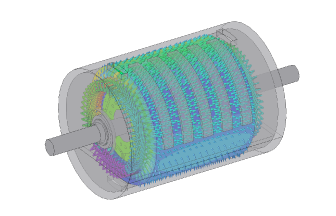
A universal motor is a motor that rotates on both direct and alternating currents. A universal motor is used in home appliances and industrial machines because these motors are robust and compact with a simple construction. However, problems such as vibration and a reduction in starting torque caused by the cogging torque occur as the size of the motor becomes smaller. Evaluating the starting performance of a universal motor at the design stage is necessary to resolve these problems.
This example presents the use of a magnetic field analysis to obtain the speed versus time graph, the current waveform, and the torque versus time graph for a universal motor.
|

| 106 - Iron Loss Analysis of a Brush Motor |
Module:DP,LS |
2011-01-17 |
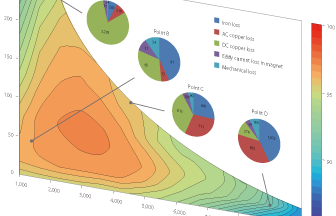
| Recently, the growing demand for energy conservation and highly efficient
motors is raising the importance of reducing losses. Iron loss, which is
one of the major losses for motors, is produced when energy is released
as heat, causing the efficiency to decrease and the temperature of the
motor to rise. It is advantageous to measure the iron losses via simulation
during the design stage of a motor. This example presents the use of a
magnetic field analysis to obtain the iron losses of the stator core and
rotor core of a brush motor. |

| 95 - Analysis of Characteristics of a Universal Motor |
Module:DP |
2011-01-17 |
| Universal motors rotate by either AD or DC. Since universal motors have
a simple structure which is robust, compact, and capable of high speeds,
they are used in home appliances and industrial electric tools. Also, in
universal motors, the rotation speed is determined by the load when field
coil and armature coil are connected in series. This note presents the
use of magnetic field analysis to obtain the characteristics of the universal
motor, including torque versus current (T-I), torque versus speed (T-N),
and magnetic flux density distribution. |

| 71 - Analysis of a Slot Motor: 2 Brushes, 6 Poles, and 19 Slots |
Module:DP |
2011-01-17 |
| A brush motor rotates when the brush and commutator alternate the direction
of the current passing through the armature coils.The torque needs to be
evaluated based on the rotation speed of a motor because the torque varies
with the rotation speed if the supply voltage is constant.Evaluating the
relationship between the torque and current during the design stage is
also advantageous because the torque is proportional to the current.This
example presents the use of a magnetic field analysis to obtain the speed
versus torque curve and torque versus current curve for a slot motor that
has 2 brushes, 6 poles, and 19 slots. |

| 3 - Analysis of a Permanent Magnet Brush Motor UP! | Module:DP | 2012-04-10 | A brush motor generates torque through the electromagnetic attraction and repulsion between its rotor and stator. They do not have many parts and do not require drive circuits, so they are widely used as a power source for compact equipment. A brush motor is composed of a magnetic circuit part, which actually generates torque via electromagnetic phenomena, and the brush/commutator part, which corresponds to the drive circuit. In order to aim at improving the performance of a brush motor, it is necessary to raise the usage efficiency of the magnetic circuit in each part and expertly utilize the nonlinear material characteristics. Proper placement of the brush/commutator that correspond to the drive circuit is also vital. In order to evaluate the usage efficiency of the magnetic circuit, torque variations, current waveforms, etc. at the design stage, it is best to first do a detailed calculation of the magnetic flux density in each part, and then perform an electromagnetic field simulation using the finite element method (FEM), which can evaluate torque with high accuracy. This note presents how the characteristics of the brush-type PM motor can be obtained, including torque versus current (T-I), torque versus speed (T-N), and magnetic flux density distribution.
|

|