



Application Catalog


Stepper motor
129 - Characteristic Analysis of a PM Stepping Motor Accounting for Magnetization Module:ST,TR 2011-01-17
Stepper motors are commonly used for positioning in printers and digital cameras.The magnetization of the magnets used for the PM stepping motor largely affect the motor's characteristics.Therefore, it is advantageous to accurately measure the characteristics of the PM stepping motor by clearly defining the magnetization with an analysis.This example presents the use of magnet field analyses to obtain the induced voltage of a PM stepping motor that combines magnetization distribution, surface flux density, and magnetization of magnets magnetized with a magnetization device.
94 - Analysis of Detent Torque of a PM Stepper Motor Module:TR 2011-02-28
Stepper motors are commonly used for positioning in printers and digital cameras. In evaluating a stepper motor, detent torque is an important characteristic since it is the cause of vibration and noise. Detent torque needs to be investigated before designing a stepper motor. This note presents the use of magnetic field analysis to evaluate the detent torque of a stepper motor.
89 - Stiffness Torque Analysis of a PM Stepper Motor Module:TR 2011-02-28
Stepper motors are commonly used for positioning in printers and digital cameras. Stiffness torque is an important characteristic in evaluating a stepper motor since the stiffness torque is important for positioning. This note presents the use of magnetic field analysis to evaluate the stiffness torque of a stepper motor at 0.5 A.
16 - Analysis of a Hybrid Stepper Motor UP!Module:TR2012-04-10
Hybrid stepper motors are used as actuators for equipment where position detection accuracy is required, such as the joints of robots or rotary tables for machine tools. The rotor has a construction that sandwiches a magnet that is magnetized in the axial direction between two rotor cores that have serrated teeth to create salient poles, and the tips of the stator core's teeth are shaped like gears as well. The rotation resolution is determined by the number of gears in the rotor and the number of phases in the drive coil, so the number of gears is set to rather large numbers like 50 and 100 to raise the angle resolution. The most important characteristics for a stepper motor are the controllability, the detent torque, which is a non-excitation holding torque, and the stiffness torque, which is an excitation holding torque, and not the motor's output.
The two-plated rotor core of a stepper motor has an N pole on one side and an S pole on the other, so a multipole magnet is achieved by deviating the saliency of the gear condition by 1/2 pitch. Consequently, the magnetic circuit is 3D. There are also times when the division pitch geometry of the teeth is complicated, so it is necessary to carry out a 3D electromagnetic field analysis using the finite element method (FEM) to proceed with an accurate preliminary study.
This Application Note describes how the detent torque and stiffness torque can be calculated for a hybrid stepper motor.
11 - Pull-in/pull-out Analysis of a PM Stepper Motor Using a Control Simulator and the JMAG-RT System UP!Module:RT,TR2012-04-10
Stepper motors are commonly used for positioning in printers and digital cameras. With a PM stepper motor, there are excitation types such as one phase excitation, two phase excitation, and one-two phase excitation for the excitation system, and the accuracy for stepper motor positioning changes depending on which system is used. Pull-in and pull-out torques are important indicators that show the transient characteristics of a stepper motor, so it is vital to understand and study them in advance.
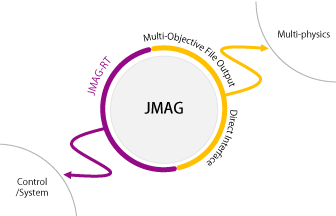
To measure them, begin to gradually reduce the load on the stepper motor from a stationary state, measure the pull-in torque when it begins to rotate, begin to gradually increase the load in sync with the pulses from a rotating state, and measure the pull-out torque when it loses synchronism. It is necessary to carry out transient analysis while changing the load in order to solve this phenomenon in magnetic field analysis. While it is possible to calculate it using an equation of motion with JMAG's 3D transient response analysis, such calculations take too much time. With JMAG, it is possible to create a motor model that is detailed and conforms to a real machine, and that accounts for spatial harmonics and magnetic saturation characteristics that are included in a stepper motor. By importing this motor model, a "JMAG-RT model," to the control/circuit simulator, it is possible to derive the stepper motor's pull-in and pull-out torques quickly and accurately because it accounts for the motor's magnetic saturation characteristics and spatial harmonics.
This note presents how JMAG-RT system can be used to calculate holding torque and coil inductance that varies with current. The result is the JMAG-RT motor model used as a reference for a circuit / control simulator that runs a transient analysis to obtain pull-in and pull-out torques of the stepper motor. By also using a single JMAG-RT motor model and changing the circuit on the circuit/control simulator, it is possible to obtain the characteristics of two types of drives: a bifilar winding with a unipolar drive, and a monofilament winding with a bipolar drive. Other parameters are the same for both analyses. The system that creates a JMAG-RT model using magnetic field analysis is referred to as JMAG-RT system.


Contact US