





Rotation Motion
 | 181 - Analysis of SR Motor Drive Characteristics
| Module:DP,LS | 2013-01-23 | With the skyrocketing prices of rare earth magnets, expectations have been rising for SR (switched reluctance) motors because they have a motor format that does not use permanent magnets. SR motors have a simple structure that can achieve solid performance at a low price. However, torque generation depends only upon the saliency between the stator and rotor, so torque variations are extremely large and cause vibration and noise, meaning that the use applications are limited. On the other hand, because of the skyrocketing prices of rare earth metals, the improvement in current control technology, the possibility of optimized designs thanks to magnetic field analysis, and the rising ability to reduce challenges, SR motors are being re-examined. SR motors sometimes drive while changing switch timing in accordance with rotation speed so it is useful to understand properties such as torque, current and iron loss in accordance with revolution speed. This example presents how to confirm drive characteristics such as torque, loss, and efficiency in a motor when its switch timing changes for each rotation speed.
|

 | 180 - Analysis of SR Motor Dynamic Characteristics
| Module:DP | 2013-01-23 | With the skyrocketing prices of rare earth magnets, expectations have been rising for SR (switched reluctance) motors because they have a motor format that does not use permanent magnets. SR motors have a simple structure that can achieve solid performance at a low price. However, torque generation depends only upon the saliency between the stator and rotor, so torque variations are extremely large and cause vibration and noise, meaning that the use applications are limited. On the other hand, because of the skyrocketing prices of rare earth metals, the improvement in current control technology, the possibility of optimized designs thanks to magnetic field analysis, and the rising ability to reduce challenges, SR motors are being re-examined. SR motors create their excitation state by alternating between opening and closing switches in accordance with the position of the rotor's rotation, however the timing of the alternating causes major changes in the torque properties. Also, it is important not only to increase the torque average and torque constant, but also to consider the optimum switch timing to control vibration and noise. This example presents how to carry out an analysis with different switch timings to evaluate torque and current in SR motors.
|

 | 179 - Analysis of SR Motor Static Characteristics
| Module:DP | 2013-01-23 | With the skyrocketing prices of rare earth magnets, expectations have been rising for SR (switched reluctance) motors because they have a motor format that does not use permanent magnets. SR motors have a simple structure that can achieve solid performance at a low price. However, torque generation depends only upon the saliency between the stator and rotor, so torque variations are extremely large and cause vibration and noise, meaning that the use applications are limited. On the other hand, because of the skyrocketing prices of rare earth metals, the improvement in current control technology, the possibility of optimized designs thanks to magnetic field analysis, and the rising ability to reduce challenges, SR motors are being re-examined. SR motors operate using the nonlinear region of a magnetic steel sheet, so because the inductance displays nonlinear behavior, it is impossible to carry out advanced projections that are accurate with calculation methods that follow linear formulas. Consequently, it becomes necessary to use the finite element method (FEM), which can handle nonlinear magnetic properties in material and minute geometry. This example presents an evaluation for each rotor position of the effect on flux linkage (shown as I-Psi characteristics below) when excitation current is changed.
|

 | 178 - Analysis of SR Motor I-Psi Characteristics
| Module:DP | 2013-01-23 | With the skyrocketing prices of rare earth magnets, expectations have been rising for SR (switched reluctance) motors because they have a motor format that does not use permanent magnets. SR motors have a simple structure that can achieve solid performance at a low price. However, torque generation depends only upon the saliency between the stator and rotor, so torque variations are extremely large and cause vibration and noise, meaning that the use applications are limited. On the other hand, because of the skyrocketing prices of rare earth metals, the improvement in current control technology, the possibility of optimized designs thanks to magnetic field analysis, and the rising ability to reduce challenges, SR motors are being re-examined. SR motors operate using the nonlinear region of a magnetic steel sheet, so because the inductance displays nonlinear behavior, it is impossible to carry out advanced projections that are accurate with calculation methods that follow linear formulas. Consequently, it becomes necessary to use the finite element method (FEM), which can handle nonlinear magnetic properties in material and minute geometry. This example presents an evaluation of flux linkage, inductance and torque for each rotor position when the flowing current value is changed.
|

 | 177 - Torque Characteristic Analysis of a Three Phase Induction Motor | Module:DP,LS | 2012-08-31 | An induction motor is a motor in which the rotating magnetic field of the stator coils causes induced current to flow in an auxiliary conductor, which exerts force on the rotor in the rotational direction and causes it to spin. Induction motors are widely used in everything from industrial machines to home appliances because they have a simple construction and are small, light, affordable, and maintenance-free. It is possible to drive an induction motor so that its slip is constant by adjusting the voltage or current against load variations. When this happens, each characteristic changes with influence from magnetic saturation and leakage flux because of the excitation variations in a specific slip. This Application Note explains how to obtain the torque characteristics in an induction motor when the current amplitude has been changed in a specific slip.
|

 | 176 - Drive Characteristic Analysis of a Three-Phase Induction Motor | Module:DP,LS | 2012-08-31 | An induction motor is a motor in which the rotating magnetic field of the stator coils causes induced current to flow in an auxiliary conductor, which exerts force on the rotor in the rotational direction and causes it to spin. Induction motors are widely used in everything from industrial machines to home appliances because they have a simple construction and are small, light, affordable, and maintenance-free. In an induction motor, the current induced by the auxiliary conductor exerts a large influence on its characteristics. It also causes strong magnetic saturation in the vicinity of the gap, in particular. This is why a magnetic field analysis based on the finite element method (FEM) is useful when investigating the motor's characteristics for a design study. This Application Note explains how to confirm drive characteristics such as torque, loss, and efficiency in an induction motor when its rotation speed changes.
|

 | 175 - PWM Magnet Loss Analysis of an IPM Motor Using a Gap Flux Boundary
| Module:DP,FQ | 2012-06-08 | It is becoming increasingly common for permanent magnet motors to use rare earth magnets in order to achieve higher output density because they have a high energy product. Neodymium rare earth magnets have a high electric conductivity because they contain a great deal of iron, so when a varying magnetic field is applied to them they produce joule loss from eddy currents. IPM structure adoption and field weakening controls have become prevalent in recent years in order to allow faster rotation. This has led to an increase in the frequencies and fluctuation ranges of the varying fields applied to magnets, resulting in a corresponding increase in joule losses. By dividing the magnet like one would a laminated core to control eddy currents, one can obtain a method of lowering the apparent electric conductivity while lowering the eddy currents. Armature reactions in the stator occur before the eddy currents produced in the magnet, so the eddy currents are determined by: The slot geometry of the stator core, the geometry of the rotor, the nonlinear magnetic properties of the core material, and the current waveform that flows through the coil. In order to examine these kinds of magnet eddy currents ahead of time, one has to be precise when accounting for things like these various geometries and material properties. This is why a magnetic field simulation using the finite element method (FEM), which can account for them, would be the most effective. This Application Note explains how to use the gap flux boundary condition to evaluate the eddy current loss in the magnet by changing the number of magnet divisions. This will make it possible to obtain effective results in a shorter period of time than with a normal transient response analysis.
|

 | 173 - Basic Characteristic Analysis of an IPM Motor
| Module:DP,LS | 2012-06-08 | Demand for higher efficiency and smaller size in motors has grown from the need to accommodate devices that incorporate miniaturization and energy efficiency in their designs. In order to meet this demand, motors have to improve their output density and reduce their losses. One type of loss commonly found in motors is iron loss, which increases drastically at high rotation speeds and high magnetic flux densities. This increase can lead to a rise in temperature and a reduction in efficiency. Consequently, it is growing more important to predict iron loss at the motor design stage. Unfortunately, it is not possible to obtain iron losses accurately in studies that use the magnetic circuit method or rules of thumb. In order to obtain them accurately, one needs to find the distribution and time variations of the magnetic flux density in each part of the motor after accounting for a fine geometry and the material's nonlinear magnetic properties. Using the finite element method (FEM) is essential in order to carry out this kind of a detailed analysis. This Application Note demonstrates an analysis in which an IPM motor's cogging torque, torque, magnetic flux density distribution, and iron loss in the stator core are obtained.
|

 | 172 - High-Frequency Induction Heating Analysis of a Test Piece (Rotational Induction Hardening)
| Module:FQ,HT | 2012-07-31 | Machine parts like shafts and gears are made to be resistant to wear and tear. This is accomplished by giving them a certain degree of flexibility by maintaining their interior toughness while increasing the hardness of their surfaces. By using high-frequency induction heating, which is a type of surface hardening method, the part is heated rapidly on only its surface by a high frequency power source. This process also has many other benefits, such as providing a clean working environment because it uses electrical equipment, being very efficient, and providing uniform results for each product. This is why it is being aggressively implemented in the field. With induction hardening like the kind used on the work piece in this analysis, the main requirement is to heat a given surface uniformly and increase rigidity. The high-frequency's varying magnetic field produces eddy currents with an offset in the surface of the work piece, so handling the phenomena inside the work piece with a numerical analysis based on the finite element method (FEM) is the most effective means analyzing the process in detail. This Application Note explains how to create a numerical analysis model when obtaining the optimum coil geometry, current conditions (power supply frequency, current value), and rotation speed. It also shows how to evaluate whether the target temperature distribution is being achieved by analyzing the elevated temperature process.
|

 | 167 - Iron Loss Analysis of a Three Phase Induction Motor UP!
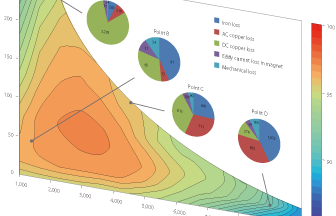
| Module:DP,LS | 2013-06-17 | An induction motor is a motor in which the rotating magnetic field of the stator coils causes induced current to flow in an auxiliary conductor, which produces force in the rotational direction. Induction motors are widely used in everything from industrial machines to home appliances because they have a simple construction without parts that experience wear from abrasion, and can be used simply by connecting them to a power source. Improved efficiency in induction motors is an important theme. Iron loss, a cause of lower efficiency along with primary and secondary copper loss, must be reduced in order to improve efficiency. The relative importance of iron loss tends to grow especially with higher rotations due to the inverter drive, so it is helpful to estimate the complex iron loss distribution inside the core. This Application Note presents an example of how to find the iron loss in the stator core and rotor core at a rotation speed of 3,300 r/min.
|

 | 166 - Line Start Simulation of an Induction Machine Using a Control Simulator and the JMAG-RT
| Module:FQ,RT | 2013-02-28 | Collaborative design is difficult because the controls and motor are designed independently. However, it has become necessary to resolve challenges through high-accuracy simulations at the beginning of the development process in order meet demands for more advanced motors. An effective way of achieving this is for the simulations to be performed while collaborating on the motor design circuit/control designs. An induction motor's characteristics are influenced by leakage reactance and resistance, including resistance on the secondary side. The resistance on the secondary side is affected by the skin effect, so the finite element method (FEM) needs to be used to obtain the distribution of the secondary induced current. With JMAG, it is possible to use a magnetic field analysis to obtain the resistance and leakage reactance, and to create a model of an induction motor, as well. Incorporating this motor model, called a "JMAG-RT model," to a circuit/control simulator makes it possible to use JMAG-RT to run a linked simulation with it. This Application Note explains how to use the JMAG-RT to create a JMAG-RT model of an induction motor, import it to a circuit/control simulator, and run an induction motor line start simulation.
|

 | 165 - Creating an Efficiency Map for an IPM Motor
| Module:DP,LS,RT | 2012-07-31 | IPM motors use rare earth sintered permanent magnets because they have strong magnetic energy. They can use the magnetic torque from the magnet's field and the rotating magnetic field in addition to the reluctance torque that originates from the difference in inductance between the d-axis and q-axis, so they have a wide drive range and are highly efficient. Their efficiency changes with their rotation speed and their load, so it is beneficial to create an efficiency map when designing the motor and its controls. However, the calculations required to create an efficiency map are typically huge, so it takes time to organize the results as well. Though is possible to estimate the efficiency by using the motor's voltage equation and torque formula to calculate the torque, voltage, and current, one cannot use this method to estimate the iron loss or account for the effects of the nonlinear magnetic properties of the motor's iron core. The main problem is the difficulty of correctly calculating the efficiency. To help with this problem, an efficiency map that accounts for influence from iron loss and nonlinear magnetic properties can be easily obtained by creating a JMAG-RT model of the target and using JMAG-RT Viewer's efficiency map calculation function. This Application Note presents the use of the JMAG-RT Viewer to create an efficiency map for an IPM motor.
|

 | 163 - Torque-Current Curve Analysis of an SPM Motor UP!
| Module:DP | 2013-06-17 | One of the fundamental properties of a permanent magnet synchronous motor is the relationship between its current and torque (torque-current curve). The torque generated at each current value is uniform with increases in current up to a certain point, so the torque increases in a linear fashion. However, magnetic saturation effects occur with further current increases, and the torque generated with each increase in current begins to drop off. Because a permanent magnet synchronous motor's torque-current curve is highly susceptible to saturation effects in the motor's magnetic circuit, it is helpful to obtain the torque-current curve with a magnetic field analysis taking saturation into account in order to evaluate the motor's design and drive characteristics. This Application Note presents how to obtain the torque-current curve as a basic property of one type of permanent magnet synchronous motor, the surface permanent magnet synchronous (SPM) motor.
|

 | 162 - Drive Simulation of an SR Motor Using a Control Simulator and the JMAG-RT System
| Module:DP,RT | 2011-07-12 | Collaborative design is difficult because the control and motor are designed independently. Linking a magnetic field analysis and a circuit/control analysis is necessary to evaluate the precise motor behavior accurately using simulation to reinforce motor development. A simulation that accounts for both the nonlinear characteristics of the motor and the drive control characteristics can be run by linking to a circuit/control simulator using JMAG. This example presents the use of a control simulator and the JMAG-RT system to simulate the drive of an SR motor.
|

 | 161 - Line Start Analysis of a Three-phase Induction Machine | Module:DP | 2012-08-31 | The simplest method for starting an induction motor is a line start that connects the motor to a direct power supply. For a line start, the static impedance is small compared to impedance during rated operation, so a large current flows during the initial start-up. The large current flowing through both the primary and secondary sides during start-up causes intense magnetic saturation near the induction motor's gap. This magnetic saturation results in reduced impedance, so the starting current grows even larger. The size of the starting current affects the voltage source capacity connected to the induction motor, as well as both the electromagnetic force and heat capacity that operate on the motor's coils. This is why it is beneficial to investigate the starting performance of an induction motor with the finite element method (FEM), which can account for local magnetic saturation. This Application Note presents an analysis that simulates the line start of an induction motor and obtains the starting performance of its rotation speed variations.
|

 | 159 - Sensitivity Analysis of Dimensional Tolerance in an SPM Motor UP!
| Module:DP | 2013-06-17 | The corners of magnets used in surface permanent magnet (SPM) motors can be filleted, chamfered, etc. However, it is difficult to maintain exactly the same production in the manufacturing process, and some variation among finished products will occur. Dimensional tolerance is set so as to eliminate the effects of these variations on motor performance. There are tradeoffs between dimensional tolerance, performance, and cost, so it is important to investigate these at the design stage. With numerical analysis using the finite element method (FEM), it is possible to evaluate the sensitivity of motor performance, such as torque, by simply changing the dimensions. This Application Note presents how to assume a dimensional tolerance of ±0.4 mm for a chamfer, and find out whether changing dimensions within the tolerance range has an effect on motor performance by comparing cogging torque and induced voltage.
|

 | 157 - Analysis of Eddy Currents in an IPM Motor Using the Gap Flux Boundary UP!
| Module:DP,FQ | 2013-06-17 | It is becoming increasingly common for permanent magnet motors to use rare earth magnets in order to achieve higher output density because they have a high energy product. Neodymium rare earth magnets have a high electric conductivity because they contain a great deal of iron, so when a varying magnetic field is applied to them they produce joule loss from eddy currents. IPM structure adoption and field weakening controls have become prevalent in recent years in order to allow faster rotation. This has led to an increase in the frequencies and fluctuation ranges of the varying fields applied to magnets, resulting in a corresponding increase in joule losses. By dividing the magnet like one would a laminated core to control eddy currents, one can obtain a method of raising the apparent electric conductivity while lowering the eddy currents. Armature reactions in the stator occur before the eddy currents produced in the magnet, so the eddy currents are determined by: The slot geometry of the stator core, the geometry of the rotor, the nonlinear magnetic properties of the core material, and the current waveform that flows through the coil. In order to examine these kinds of magnet eddy currents ahead of time, one has to be precise when accounting for things like these various geometries and material properties. This is why a magnetic field simulation using the finite element method (FEM), which can account for them, would be the most effective. This Application Note explains how to use the gap flux boundary condition to evaluate the eddy current loss in the magnet by changing the number of magnet divisions. This will make it possible to obtain effective results in a shorter period of time than with a normal transient response analysis.
|

 | 156 - Segregation Analysis of Torque Components for an IPM Motor
| Module:DP | 2012-07-31 | IPM motors are often used as high performance motors because they are highly efficient and their structure makes it possible to achieve a wide range of operation. They are able to achieve high efficiency because they obtain maximum total torque by using their controls to adjust their magnet and reluctance torques. For this reason, it is important to find out the distribution of both of these torques during operation when the IPM motor is being designed. The motor's detailed geometry and the material's nonlinear magnetic properties need to be taken into account to obtain the torque characteristics, and it is even more difficult to segregate the torque into two components by using manual calculations. In order to proceed with the design while looking into how much each one contributes, it needs to be studied with an electromagnetic field analysis that uses the finite element method (FEM). In this Application Note, the torque components are separated and the magnetic flux density distributions created by each magnetomotive force are confirmed.
|

 | 154 - Calculation of Equivalent Circuit Parameters in a Three-Phase Induction Motor | Module:DP | 2012-08-31 | An induction motor is a motor in which the rotating magnetic field of the stator coils causes induced current to flow in an auxiliary conductor, exerting force on the rotor in the rotational direction and causing it to spin. Induction motors are widely used in everything from industrial machines to home appliances because they have a simple construction and are small, light, affordable, and maintenance-free. An induction motor's characteristics are influenced by leakage reactance and resistance, including resistance on the secondary side. These are referred to as equivalent circuit parameters, and they are important because they characterize a device's properties. Equivalent circuit parameters are greatly affected by both the current distribution induced in the auxiliary conductor and the magnetic saturation near the gap, so a finite element analysis (FEA) needs to be run in order to investigate these characteristics with precision. This Application Note explains how to obtain the secondary resistance, leakage inductance, and excitation inductance of an induction motor when its power supply frequency has been changed with regard to its voltage and current controls.
|

 | 142 - Press Fit Analysis of a Divided Core
| Module:DP,DS,LS | 2013-02-28 | Smaller size and higher output are being demanded of the motors used for applications such as air conditioning compressors. One production technique for achieving this is a higher lamination factor in divided cores. The stress caused by press-fitting a divided stator core into a frame is known to increase iron loss in a motor if magnetic steel sheet is used for the core. Iron loss is affected by magnetic flux density and stress. Specifically, it increases in areas of high magnetic flux density with high frequency, and in areas of high stress. Further, the stress caused by press fitting has its own distribution, and is particularly large in the core and back yoke. So, in order to evaluate the iron loss with good accuracy, it is necessary to correctly obtain the magnetic flux density distribution, time variations, and stress distribution. This Application Note presents how to use the Press Fit condition to model an analysis of the stress from fitting a core to a frame, and then obtain the iron loss density of an IPM motor under no load, with and without accounting for the stress.
|

 | 138 - Vibration Analysis of an SR Motor UP!
| Module:DP,DS | 2013-06-17 | There are high hopes for SR motors to provide robustness and low cost, thanks to their relatively simple construction without permanent magnets. However, the large electromagnetic force produced by the saliency of their stator and rotor causes vibration and noise. The electromagnetic force working in an SR motor causes vibration and noise as an electromagnetic excitation force. Vibration and noise are caused when this electromagnetic excitation force resonates with the motor's eigenmode. In order to evaluate this phenomenon with acceptable precision, it is necessary to accurately ascertain the distribution of the electromagnetic force acting on the stator core, which is the source of radiated sound, and to obtain the eigenmode of the entire motor including its connected case. This Application Note presents an example of how to obtain the electromagnetic force generated in the stator core of an SR motor and evaluate the sound pressure by linking it to the motor's eigenmode.
|

 | 129 - Characteristic Analysis of a PM Stepping Motor Accounting for Magnetization
| Module:ST,TR | 2011-01-17 | Stepper motors are commonly used for positioning in printers and digital cameras. The magnetization of the magnets used for the PM stepping motor largely affect the motor's characteristics. Therefore, it is advantageous to accurately measure the characteristics of the PM stepping motor by clearly defining the magnetization with an analysis. This example presents the use of magnet field analyses to obtain the induced voltage of a PM stepping motor that combines magnetization distribution, surface flux density, and magnetization of magnets magnetized with a magnetization device.
|

 | 124 - Cogging Torque Analysis of an SPM Motor Accounting for an Varied Stator Diameter UP!
| Module:DP,DS | 2013-06-17 | When a motor is constructed, the diameter of the stator becomes uneven because of fabrication errors and shrink fitting. It is advantageous to investigate the uneven diameter of the stator because it largely effects the cogging torque. This example presents the use of a structural and magnetic field analysis to obtain the cogging torque with stator teeth that have an uniform and varying diameter based on the displacement obtained with a stress analysis.
|

 | 122 - Inductance Analysis of an IPM Motor - d/q-axis Inductance Obtained by Actual Measurement -
| Module:DP | 2013-01-28 | Evaluating the inductance characteristics along the d/q-axis is important when analyzing the saliency of a rotor in an IPM motor. With actual measurements, it is possible to calculate the inductance in the d-axis and q-axis by measuring the no-load magnetic flux or the voltage and current with a three-phase current flowing when the motor is in actual operation. If it cannot be measured while the motor is operating, an LCR meter can be entered in two phases when the rotor is in a stationary state. However, current conditions are different between three phases and two phases, so the motor will express different characteristics during actual drive, especially when it is strongly affected by magnetic saturation. For this reason, the analysis contents need to be determined according to the situation of the actual measurements when comparing the measurements with an analysis. This Application Note presents an analysis that obtains d/q-axis inductance in an IPM motor while assuming actual measurements in a stationary rotor.
|

 | 121 - Output Analysis of a Salient-Pole Synchronous Generator
| Module:DP | 2013-04-26 | Salient-pole synchronous generators are used in hydroelectric generators and the like. Power is generated in the stator coils (armature) by a field current flowing in the rotor coils and the rotor rotating. Reactions occur between the field current and the armature current that either strengthen or weaken the magnetic flux depending on the power factor of the connected load of a salient-pole synchronous generator. This causes the operating point of the magnetic circuit inside the generator to change, which affects the output. The core normally has nonlinear magnetic properties, so an evaluation of the magnetic circuit with magnetic field analysis, which can handle nonlinear magnetic properties, is useful. This Application Note presents the use of a magnetic field analysis to obtain the magnetic flux density distribution, no-load saturation curve, and output of a salient-pole synchronous generator.
|

 | 120 - Thermal Demagnetization Analysis of an SPM Motor
| Module:DP | 2013-04-26 | Exactly how to resolve the problem of rising temperatures is a vital issue when trying to achieve an improvement in a motor's efficiency and output. Among the materials used in a motor, the magnet experiences the greatest variations in properties in relation to temperature. In the case of rare-earth magnets, demagnetization can occur within tens of degrees above 100 deg C. Whether they demagnetize or not depends on the reverse magnetic field applied and the temperature. They still have some resistance if either the temperature is raised only or if a reverse magnetic field is applied only, but the combination of the two causes a great reduction in resistance. A large current flows in the coils when the motor is overloaded and is producing a lot of torque, which leads to a large reverse magnetic field and heat, increasing the possibility of demagnetization. Solutions to this problem include heat-resistant magnets and increased motor size, but these lead to trade-off issues during the design stage because of the larger size and higher cost. In order to carry out a precise evaluation of demagnetization, it is necessary to get a definite grasp of areas where a reverse magnetic field occurs and the materials' demagnetization properties. With magnetic field analysis simulation using the finite analysis method (FEM), it is possible to calculate the reverse magnetic field and determine whether magnets and other parts demagnetize due to reverse magnetic field, taking material demagnetization properties into account. This Application Note presents how to change the temperature of permanent magnets in an analysis, and then evaluate the effects on the torque waveform, magnetic flux density distribution, etc.
|

 | 119 - Torque Characteristic Analysis of a Three Phase Wound Rotor Induction Motor
| Module:DP | 2011-02-28 | A wound rotor induction motor is a motor that produces torque in the secondary coil through the interaction of the rotating magnetic field and the current induced in the secondary coil by the rotating magnetic field of the stator coil. Because an induced current flows through the coil, the electromagnetic force can be utilized and regenerated through a slip ring. The current induced in the secondary coil effects the performance of the wound rotor induction motor.For this reason, it is important to evaluate the current that is induced. This example presents the use of a magnetic field analysis to obtain the current density distribution and the slip versus torque curve of a three-phase wound rotor induction motor.
|

 | 115 - Eccentricity Analysis of an SPM Motor
| Module:DP | 2013-04-26 | Motors have many parts, which must be assembled correctly for a usable product. Even if each part is made within acceptable limits for manufacturing errors, when various parts with small errors are put together, the errors can have a cumulative effect. In particular, if eccentricity (deviation, deflection) occurs in the cylindrical axis of the rotor and stator, the magnetic flux density distribution and electromagnetic force can become unbalanced, causing vibration and noise. Ideally, parts would be manufactured without any errors, but in reality, error reduction requires precise mechanical manufacturing, which means a huge increase in costs. This is why it is necessary to figure out the tolerance zone of trade-off between settings and performance for each part at the design stage. In order to grasp these at the design stage, highly precise evaluation sensitive to parts' manufacturing errors is needed, so electromagnetic field analysis using the finite element method (FEM) is effective. This Application Note presents how to evaluate the cogging torque waveform and effects on the electromagnetic force acting on the stator in an SPM motor with and without eccentricity.
|

 | 114 - Vibration Analysis of an Outer Rotor Motor
| Module:DP,DS | 2012-07-31 | An outer rotor motor has a magnetic rotor that rotates around a stator. The rotor radius of an outer rotor motor is large, so it can produce a larger amount of drive torque than an inner rotor motor with the same diameter, giving it a superior constant velocity. On the other hand, countermeasures for vibration and noise that occur during rotation are vital as well. The electromotive force is a cause of the vibration that occurs when a motor rotates. Additionally, when this electromotive force resonates with the motor's eigenmodes, it causes even larger vibrations and noise. Countermeasures such as changing the motor's eigenfrequency through processes like setting a hole in the rotor core have been taken with the objective of preventing resonance. In order to carry out these kinds of studies, it is necessary to get a precise, definite grasp of the electromotive force's spatial distribution, frequency analysis, and natural frequency. This note presents the use of a magnetic field analysis and structural analysis to obtain the sound pressure caused by electromagnetic vibrations in an outer rotor motor with holes fabricated in the rotor core.
|

 | 111 - Starting Performance Analysis of a Universal Motor
| Module:DP | 2009-04-14 | A universal motor is a motor that rotates on both direct and alternating currents. A universal motor is used in home appliances and industrial machines because these motors are robust and compact with a simple construction. However, problems such as vibration and a reduction in starting torque caused by the cogging torque occur as the size of the motor becomes smaller. Evaluating the starting performance of a universal motor at the design stage is necessary to resolve these problems. This example presents the use of a magnetic field analysis to obtain the speed versus time graph, the current waveform, and the torque versus time graph for a universal motor.
|

 | 109 - Operating Time Analysis of an Electromagnetic Relay Accounting for Eddy Currents
| Module:TR | 2013-04-26 | Electromagnetic relays are devices that use an electromagnet to physically connect and disconnect contact points. Magnetic flux is generated from the magnetomotive force, which is expressed as the product of the number of turns in the coil and the current that is applied to the coil. This flux produces an attraction force in the movable core, making the relay close. To put it simply, the attractive force is determined from the area of the gap between the movable core and the stator core and the size of the magnetic flux density produced in said gap. With a relay whose movable core does not move linearly, however, it is a difficult problem to predict the magnetic flux density in the gap because it does not become parallel. The nonlinear magnetic properties of the iron core and yoke also affect the magnetic flux density in the gap. With a JMAG magnetic field analysis, it is possible to obtain the attraction force of the movable core while accounting for these factors. One of the reasons that the response is delayed in electromagnetic relays is eddy currents, which are produced when the magnetic flux generated by current flow undergoes time variations. The eddy currents are generated in a direction that inhibits changes in the magnetic flux, causing a delay in the initial rise of the attraction force when the current begins to flow. This reduces the injector's responsiveness. JMAG makes it possible to account for the effects from eddy currents and obtain an electromagnetic relay's responsiveness by running a transient response analysis. This Application Note presents the use of the motion equation function to evaluate the operating time of an electromagnetic relay with DC voltage drive. Eddy currents generated in the core are considered for this purpose.
|

 | 106 - Iron Loss Analysis of a Brush Motor
| Module:DP,LS | 2011-01-17 | Recently, the growing demand for energy conservation and highly efficient motors is raising the importance of reducing losses. Iron loss, which is one of the major losses for motors, is produced when energy is released as heat, causing the efficiency to decrease and the temperature of the motor to rise. It is advantageous to measure the iron losses via simulation during the design stage of a motor. This example presents the use of a magnetic field analysis to obtain the iron losses of the stator core and rotor core of a brush motor.
|

 | 103 - Efficiency Analysis of a Permanent Magnet Synchronous Motor
| Module:DP,LS | 2013-04-26 | A permanent magnet synchronous motor rotates by converting electric energy to mechanical energy. The important thing when converting energy is efficiency indicated by the power factor for the amount of current effectively used, as well as the percentage of output versus input. Evaluating the power factor and input/output characteristics that account for efficiency is necessary to design a highly efficient motor. This example presents the use of a magnetic field analysis to evaluate the efficiency of a permanent magnet synchronous motor.
|

 | 95 - Analysis of Characteristics of a Universal Motor
| Module:DP | 2012-03-01 | Universal motors rotate by either AD or DC. Since universal motors have a simple structure which is robust, compact, and capable of high speeds, they are used in home appliances and industrial electric tools. Also, in universal motors, the rotation speed is determined by the load when field coil and armature coil are connected in series. This note presents the use of magnetic field analysis to obtain the characteristics of the universal motor, including torque versus current (T-I), torque versus speed (T-N), and magnetic flux density distribution.
|

 | 94 - Analysis of Detent Torque of a PM Stepper Motor
| Module:TR | 2013-02-28 | PM stepper motors are commonly used for positioning of moving parts in small devices such as printers and video equipment. In order for its drive to function with an open loop, the most important characteristics for a stepper motor are controllability and holding torque, and not the motor's output. Therefore, the desired characteristics are detent torque, which is a non-excitation holding torque, and stiffness torque, which is an excitation holding torque. A PM stepper motor is made up of a multi-pole magnetized rotor and offset inductors for each phase. In order to reduce their size and number of parts, claw pole inductors are made from folded steel sheet. Because of this, the flow of magnetic flux is three dimensional, so it is necessary to carry out a 3D electromagnetic field analysis using the finite element method (FEM) to proceed with an accurate preliminary study. This Application Note describes how the detent torque can be calculated for a PM stepper motor.
|

 | 93 - Cogging Torque Analysis of a Motor with 8 Poles and 9 Slots Accounting for Eccentricity
| Module:DP | 2010-08-31 | Eccentricity can occur on the center axis or the rotation axis of a motor. It is advantageous to evaluate the effects of eccentricity because it can cause vibrations and noise and break the symmetry of the magnetic flux density distribution and the electromagnetic force. This example presents the use of a magnetic field analysis to obtain the cogging torque and electromagnetic force with and without eccentricity.
|

 | 91 - Iron Loss Analysis of an IPM Motor Including the Effects of the Press Fitting Stress
| Module:DP,DS,LS | 2013-02-28 | One of the demands for IPM motors is higher efficiency over a wide range of rotation speeds in combination with motor drives, as reluctance torque can be used in addition to magnet torque. Iron loss makes up a particularly large proportion of total loss in the high rotation region, and how to make this smaller is a major design issue. Generally, IPM motor cores have laminated structures, and methods such as press fitting or shrink fitting are used to maintain them. For motors using magnetic steel sheet for their cores, the stress generated by press fitting can increase iron loss, so it is important to take this stress into account when evaluating iron loss. Iron loss is generated when there are magnetic-field variations in steel sheet. Also, the amount of iron loss depends on the steel sheet's iron loss properties. These iron loss properties of steel sheet become worse when it is subjected to stresses such as press fitting. The stress caused by press fitting has its own distribution, and is particularly large in the back yoke. So, in order to evaluate the iron loss with good accuracy, it is necessary to correctly obtain the stress distribution for the magnetic flux, time variation, and steel sheet. This Application Note presents modeling the press fitting of a core and frame with the Press Fit condition and then obtaining the iron loss density of an IPM motor with and without accounting for the stress generated at that time.
|

 | 90 - Analysis of the Effect of PWM on the Iron Loss of an IPM Motor
| Module:DP,LS | 2012-07-31 | Current vector controls are generally used in interior permanent magnet synchronous motors (hereinafter referred to as IPMs), and among them PWM inverters are widely utilized to create a command current. It is vital to get a good understanding of iron losses in order to raise the efficiency of an IPM motor. However, iron losses increase when power is converted by the PWM inverter because the carrier harmonic created by the PWM becomes superimposed on the current and the magnetic flux density waveform in the IPM motor's core. There are two methods for obtaining iron loss that considers the PWM's carrier harmonics: Couple a control/circuit simulator that contains the PWM inverter with a magnetic field analysis by inputting the current waveform obtained from the simulation into the analysis, or input the actual measurements of a current into a magnetic field analysis. This Application Note demonstrates an analysis in which a coupled analysis between a separate JMAG-RT model and a control/circuit simulator is carried out, and the effects of a carrier harmonic against an IPM motor's iron loss are displayed by inputting the current waveform calculated from the analysis.
|

 | 89 - Stiffness Torque Analysis of a PM Stepper Motor
| Module:TR | 2013-02-28 | PM stepper motors are commonly used for positioning of moving parts in small devices such as printers and video equipment. In order for its drive to function with an open loop, the most important characteristics for a stepper motor are controllability and holding torque, and not the motor's output. Therefore, the desired characteristics are detent torque, which is a non-excitation holding torque, and stiffness torque, which is an excitation holding torque. A PM stepper motor is made up of a multi-pole magnetized rotor and offset inductors for each phase. In order to reduce their size and number of parts, claw pole inductors are made from folded steel sheet. Because of this, the flow of magnetic flux is three dimensional, so it is necessary to carry out a 3D electromagnetic field analysis using the finite element method (FEM) to proceed with an accurate preliminary study. This Application Note describes how the stiffness torque at 0.5 A of current can be calculated for a PM stepper motor.
|

 | 87 - Iron Loss Analysis of an IPM Motor Including the Effect of Shrink Fitting
| Module:DP,DS,LS | 2013-02-28 | Magnetic steel sheet is used for the cores of drive motors for HEVs and EVs. This is to make them more compact, lighter, and more efficient. The main point for improving efficiency in an IPM motor's high rotation speed region is how to reduce iron loss. However, shrink fitting is used in order to strengthen the joint between frames and stator cores with laminated structure. The compressive stress generated during shrink fitting is known to increase iron loss. Therefore, it is important to account for the effects of this stress when evaluating iron loss. Iron loss is generated when there are magnetic-field variations in steel sheet. Also, the amount of iron loss depends on the steel sheet's iron loss properties. These iron loss properties of steel sheet become worse when it is subjected to stresses such as shrink fitting. The stress caused by shrink fitting has its own distribution, and is particularly large in the back yoke. So, in order to evaluate the iron loss with good accuracy, it is necessary to correctly obtain the stress distribution for the magnetic flux, time variation, and steel sheet. This Application Note presents how to obtain the iron loss density of an IPM motor with and without accounting for this stress.
|

 | 82 - Analysis of a Synchronous Reluctance Motor
| Module:DP | 2013-01-28 | Skyrocketing prices of rare earth magnets have led to rising expectations for synchronous reluctance motors (referred to below as SynRMs), which do not use permanent magnets. SynRMs have a simple structure that can achieve solid performance at a low price. However, torque is generated only by the rotor's saliency and the coil's magnetomotive force, so raising the torque density depends greatly on the core's nonlinear magnetic properties and the rotor geometry. This is why they have a different format than a typical motor. On the other hand, the aforementioned rising prices of rare earth magnets, improvements in current control technology, and the ability of optimization designs using magnetic field analysis have raised the possibility of lowering these barriers, giving SynRMs the chance to be reexamined. SynRMs operate using the nonlinear region of a magnetic steel sheet, so the inductance expresses nonlinear behavior as well. This behavior distorts the excitation current waveform a great deal, making it impossible to run advanced projections that are accurate with calculation methods that follow linear formulas. Consequently, it becomes necessary to use the finite element method (FEM), which can handle nonlinear magnetic properties in material, detailed motor geometry, and transient currents. This Application Note presents an evaluation of torque variations that occur when the phase of a sinusoidal wave current is changed.
|

 | 80 - Cogging Torque Analysis of an SPM Motor with Skewed Magnetization
| Module:TR | 2013-02-28 | Reductions in vibration and noise are being sought after because they are a cause of torque variations in motors, and demands for reduction are particularly strong with motors that are used in machine tools and power steering. Cogging torque, which is a torque variation that is produced when there is no current, is generated because the electromagnetic force produced in the gap changes according to the rotor's rotation. This makes it necessary to apply skew to the stator and rotor and come up with innovative geometry for the magnet and stator in order to reduce torque variations by limiting variations in the electromagnetic force. Applying skew reduces the cogging torque, but it also brings disadvantages such as producing force in the thrust direction and generating eddy currents from the magnetic flux that links in the lamination direction. Consequently, in order to accurately evaluate a motor that has skew applied, one needs a magnetic field analysis simulation that uses the finite element method (FEM), which can account for a detailed 3D geometry, instead of studies that use the magnetic circuit method or a 2D magnetic field analysis. This Application Note presents the use of a magnetic field analysis to obtain the flux density distribution, cogging torque, and induced voltage of an SPM motor that has skewed magnetization applied to its magnet.
|

 | 74 - Speed Versus Torque Analysis of a Single-Phase Induction Motor | Module:DP | 2012-08-31 | Single-phase induction motors are widely used as small output motors for the drives in household electrical appliances and office machinery, like fans and washing machines, because they can use single-phase AC, the typical power source for home electronics. Unlike three-phase AC, however, single-phase AC cannot create a rotating magnetic field by itself, meaning that it cannot start a motor. For this reason, it needs to use an alternate method to generate a rotating magnetic field to start the motor. The induced current flowing in the secondary conductor largely affect the performance of the motor because the motor rotates by using the interaction between this current and the magnetic field of the stator coils. Strong magnetic saturation distribution is also generated near the gap, so the nonlinear characteristics of the magnetic properties have a big influence on performance, as well. At the step before the design phase, it is helpful to run an analysis and evaluation using the finite element method (FEM) to understand a single-phase induction motor's characteristics by accounting for induced current and magnetic saturation characteristics. This Application Note explains how to obtain the current density distribution and Speed-Torque curve created by auxiliary winding that uses a capacitor.
|

 | 71 - Basic Characteristic Analysis of a Motor with 2 Brushes, 6 Poles, and 19 Slots
| Module:DP | 2013-04-26 | Small brush motors generally have a structure containing 2 poles and 3 slots, but there are times when a multi-pole structure is adopted in order to produce higher torque. The reason for this is because achieving a higher torque makes it possible to omit deceleration systems. Brush motors have a construction where the number of poles and number of slots are not divisible, with the objective of raising the rectification effect or limiting torque variations. In exchange for reducing torque variations, however, there is a drawback when it comes to torque output. This is why selecting the number of poles and slots have become a design theme, especially when it comes to small motors, which have a small number of slots. This makes the selection process difficult because the difference in distribution becomes large. The model for this analysis has 6 poles and 19 slots, so there are 3.16 slots per pole. They cannot be divided into decimals however, so there have to be either 3 or 4 slots for each magnetic pole. As a result, the induced voltage in each coil and the torque generated are unbalanced. These evaluations need to be able to account for an accurate circuit geometry, and the current flowing through coil connected via a commutator needs to be handled accurately, as well. This is why an electromagnetic field analysis using the finite element method (FEM) is necessary to account for everything. This Application Note presents an analysis to obtain the speed versus torque and torque versus current for a motor that has 2 brushes, 6 poles, and 19 slots.
|

 | 69 - Iron Loss Analysis of an IPM Motor UP!
| Module:DP,LS | 2013-06-17 | Demand for higher efficiency and smaller size in motors has grown from the need to accommodate devices that incorporate miniaturization and energy efficiency in their designs. In order to meet this demand, motors have to improve their output density and reduce their losses. One type of loss commonly found in motors is iron loss, which increases drastically at high rotation speeds and high magnetic flux densities. This increase can lead to a rise in temperature and a reduction in efficiency. Consequently, it is growing more important to predict iron loss levels at the motor design stage. Unfortunately, it is not possible to obtain iron losses accurately in studies that use the magnetic circuit method or rules of thumb. In order to obtain them accurately, one needs to find the distribution and time variations of the magnetic flux density in each part of the motor after accounting for a fine geometry and the material's nonlinear magnetic properties. Using the finite element method (FEM) is essential in order to carry out this kind of a detailed analysis. This Application Note explains a case example that obtains the iron loss and its distribution in a permanent magnet motor.
|

 | 68 - Speed Versus Torque Characteristic Analysis of a Three-Phase Induction Motor
| Module:DP | 2013-02-28 | An induction motor is a motor in which a rotating magnetic field in the stator coils causes induced current to flow in an auxiliary conductor. This current and magnetic field exert force on the auxiliary conductor in the rotation direction and cause the motor's rotor to rotate. Induction motors are widely used in everything from industrial machines to home appliances because they have a simple construction and are small, light, affordable, and maintenance-free. In an induction motor, the current induced by the auxiliary conductor exerts a large influence on its characteristics. It also causes strong magnetic saturation in the vicinity of the gap, in particular. This is why a magnetic field analysis based on the finite element method (FEM) is useful when investigating the motor's characteristics for a design study. This Application Note explains an analysis that confirms the Speed-Torque curve and current density distribution of an induction motor.
|

 | 59 - Iron Loss Analysis of an IPM Motor Accounting for a PWM -Direct Link- | Module:DP,LS | 2012-08-31 | Vector controls using a PWM (Pulse Width Modulation) control are commonly included in the drive circuits of high efficiency motors. A PWM control makes it possible to adjust the phase or amplitude of a current according to load and rotation speed, so they can achieve high efficiency in a wide operation range. The control frequency of a PWM is called a carrier frequency. Carrier frequencies are often used up to almost 20 kHz. To form the current waveform supplied by the PWM control, the carrier harmonic current is superimposed on the basic wave current. This carrier harmonic current applies a high-frequency magnetic field to each part of the motor. As a result, core iron loss and magnet eddy current loss are generated. The total amount of these losses is not a dominant factor, but they can be a hindrance when trying to raise efficiency, so they need to be eliminated in the design process. In order to study these problems, both the motor's electromagnetic behavior and what kinds of controls the drive circuit performs have to be investigated. In order to run an advance study of these phenomena in CAE, a high fidelity motor model and inverter model need to be coupled. There are three ways of accomplishing this: Directly linking with a circuit/control simulator, entering a current waveform obtained by using a JMAG-RT motor model and a circuit/control simulator, and entering actual current measurements. In this analysis, the iron losses of the IPM motor that accounts for the carrier harmonic are obtained by directly linking to a circuit/control simulator.
|

 | 58 - Efficiency Analysis of an IPM Motor
| Module:DP,LS | 2013-01-28 | An IPM motor's features are in its rotor geometry, where its magnets are embedded. When the stator's rotating magnetic field is applied in a direction that runs perpendicular to the rotor magnets (the q-axis) the motor operates like a normal SPM motor. When the current phase is displaced and the d-axis component is applied, however, the motor operates so that the magnetic fields in the rotor magnets are weakened. This is called field weakening. In an SPM motor the d-axis current operates enough to weaken the magnetic field, so the rotation speed increases but the torque decreases. However, the rotor geometry in an IPM motor is created so that there is a difference in inductance between the d-axis and q-axis, so it is possible to generate torque with the d-axis current, which weakens the magnets. This makes it possible to recover the part weakened by the flux. Consequently, an IPM motor achieves a greater range of operation by incorporating field weakening controls. For this reason an IPM motor's characteristics depend greatly on its rotor geometry, so studies using the magnetic circuit method are difficult. In order to perform an advance design study accurately, an electromagnetic field analysis using the finite element method is necessary. This Application Note presents the use of magnetic field analysis to obtain the efficiency of an IPM motor in each current phase with a rotation speed of 1800 rpm and the current amplitude of 4.0 A when the motor is driven by sinusoidal wave current.
|

 | 56 - Torque Characteristics Analysis of a Self Starting Type Permanent Magnet Motor
| Module:DP | 2013-04-26 | A self starting permanent magnet motor combines the characteristics of an induction motor and a permanent magnet motor, so it has higher efficiency than an induction motor even without a control device like an inverter. It behaves as an induction motor when it starts, generating torque when the rotor cage first slips against the rotating magnetic field created by the stator and then produces a secondary current. Consequently, this kind of motor has superior starting ability because there is no need to account for the rotor's start-up position or rotation speed. When the rotation speed increases and the motor synchronizes, the permanent magnet begins to generate the magnetomotive force and produce torque instead of the secondary current, so there is no secondary iron loss. This kind of motor has a weak point, however: The torque falls a great deal when the motor deviates from its synchronicity, and it gets out of step as a magnet motor so the torque variations are large. This is why self starting permanent magnet motors can achieve full-voltage starting with household current and are very efficient while in a synchronous state, but have drawbacks like relatively low starting torque and recovery once they have lost synchronization. These factors make it so that a magnetic field analysis simulation based on the finite element method is necessary to investigate whether the motor's characteristics meet the requirements ahead of time. This Application Note shows how to obtain the current density distribution and slip versus torque curve.
|

 | 55 - Integrated Magnetization Analysis of an IPM Motor
| Module:DP,ST | 2013-01-28 | Interior permanent magnet (IPM) motors often use strong rare earth magnets. They have poor workability, however, because the magnets are inserted into the rotor's small gaps during the assembly process. After the magnets have been inserted the rotor generates a strong magnetic field, which means that the workability when embedding it into the stator gets worse, as well. This is why in some cases they assemble the magnets while still in an unmagnetized state and magnetize them after they have been assembled. This construction method is called integrated magnetization. Using this means of construction can improve the assembly process a great deal, but there is also the possibility that the magnets will not be completely magnetized. Consequently, first one needs to confirm whether or not integrated magnetization is even possible, and then from there to estimate the electrical power that the equipment needs for magnetization. Using a magnetic field analysis simulation with the finite element method (FEM) provides the ability to change the making current amount and yoke geometry as magnetization conditions, as well as to account for magnetic saturation and evaluate whether or not the magnets are completely magnetized. This Application Note explains how to determine the changes that occur in a magnetizing field if the making current is changed during magnetization, as well as how to obtain the induced voltage and cogging torque in the motor using the aforementioned magnets.
|

 | 48 - High-Frequency Induction Heating Analysis of a Printer Roller
| Module:FQ,HT | 2013-01-28 | A printer works by running a piece of paper with toner on it between a heated fuser roller and a pressure roller. The heated fuser roller then applies heat to fix the toner to the paper. The fuser roller needs to have uniform temperature distribution in order to handle various types of paper. It also requires the ability to heat up rapidly in order to shorten the standby time, allowing the person using the printer to print documents quickly. A magnetic field analysis using the finite element method (FEM) is useful in examining several aspects of the process, including: Differences in heating from the heating coil's geometry or placement, what kind of eddy currents are generated in the roller's thin surface and whether they provide uniform temperature, and how the magnetic flux flow spreads to the roller, air, and core. This Application Note confirms the non-uniformity in temperature distribution produced by an assumed coil geometry, as well as the temperature elevation in each part caused by rotation.
|

 | 47 - High-Frequency Induction Heating Analysis of a Crankshaft
| Module:FQ,HT | 2012-07-31 | Machine parts like shafts and gears are made to be resistant to wear and tear. This is accomplished by giving them a certain degree of flexibility by maintaining their interior toughness while increasing the hardness of their surfaces. By using high-frequency induction heating, which is a type of surface hardening method, the part is heated rapidly on only its surface by a high frequency power source. This process also has many other benefits, such as providing a clean working environment because it uses electrical equipment, being very efficient, and providing uniform results for each product. This is why it is being aggressively implemented in the field. With induction hardening like the kind used on the work piece in this analysis, the main requirement is to heat a given surface uniformly and increase rigidity. Eddy currents generated by the high-frequency varying magnetic field occur in the surface of the work piece. Examining these phenomena in detail requires handling the phenomena that occur in the work piece itself in a numerical analysis based on the finite element method (FEM). This Application Note shows an example of an evaluation performed by creating a numerical analysis model, analyzing the elevated temperature process, and seeing whether or not the desired temperature distribution is achieved. Use this analysis when obtaining the optimum coil geometry, current conditions (power supply frequency, current value), and rotation speed.
|

 | 46 - Sensitivity Analysis of the Magnetization Pattern of an SPM Motor
| Module:DP,ST | 2013-04-26 | The magnet in a surface permanent magnet (SPM) motor is arranged on the rotor's surface, facing the stator. The motor produces torque from the interaction between the magnetic field produced by the magnet and the magnetic field produced from the excitation coil. Cogging torque, which is generated during no-load rotation, depends largely on the magnet's magnetizing state. Adjusting the magnet's magnetization pattern makes it possible to reduce the cogging torque, which lowers efficiency and causes vibration and noise. In order to control the magnetization pattern in the magnet of an actual machine precisely, a great number of magnetization devices is required. This makes a real machine hard to control, but with a magnetic field analysis simulation that uses the finite element method (FEM), it is possible to estimate how the cogging torque in the physical phenomenon will change by simply setting the magnetization pattern. Once the optimum magnetization pattern has been found, studying the magnetization method can lead to a reduction in development cost. This Application Note presents the use of a magnetic field analysis to obtain the surface flux density for radial pattern, parallel anisotropic pattern, and polar anisotropy pattern magnets. It also displays the changes in induced voltage and cogging torque caused by differences in the magnetization patterns.
|

 | 43 - Torque Analysis of a Coreless Motor
| Module:TR | 2013-01-28 | As their name implies, coreless motors have a rotor that lacks a core and is made of only a coil. For this reason, there is no core to produce iron loss in the rotor, and its moment of inertia is small. They can be controlled easily because their characteristics are linear and they have small torque ripples, but they are not versatile enough to produce a large amount of torque. This is why they are often used in small precision equipment that requires high rotation speeds and good responsiveness. The rotor coil is hard to construct because it is made of only a coil. It is important to design the coil's twist angle to be able to produce torque. The model needs to be made precisely because coreless motors are used in compact equipment and because the detailed geometry of the parts can affect the characteristics. In order to carry out these evaluations, the coil's twist needs to be accounted for accurately in three dimensions. An electromagnetic field analysis using the finite element method (FEM) is necessary to accomplish this because it can evaluate the distribution of the electromagnetic force produced in the magnetic circuit in detail. This Application Note presents an evaluation of the torque waveform of a coreless motor when current is running.
|

 | 40 - Cogging Torque Analysis of an SPM Motor
| Module:DP | 2013-01-28 | The rotor's rotation in a permanent magnet motor can generate positive and negative torque, even when there is no current flow. This torque is called "cogging torque." While output torque a center of focus in motors used in precision equipment, cogging torque reduction must be taken into account as well. Skew and fractional slots are means of reducing this cogging torque. Skew is a widely used technique that attempts to cancel out cogging torque by applying an appropriate amount of twist to the stator or rotor. This generates electromagnetic force in the thrust direction, however, which presents challenges such as a decrease in performance and an increase in manufacturing cost. Fractional slots do not have the drawbacks found in skew, but the winding pattern is different from that found with integer slots. This means that the torque generation becomes difficult to evaluate because the teeth geometry and the magnet's magnetization distribution are hard to design accurately. In order to carry out these evaluations, an electromagnetic field analysis using the finite element method (FEM) needs to be carried out because it can perform detailed evaluations of the electromagnetic force distribution produced in the magnetic circuit. This Application Note presents the use of magnetic field analysis to obtain the cogging torque of an 8-pole, 9-slot SPM motor, which has relatively small period.
|

 | 39 - Torque Analysis of a Three Phase Induction Motor Accounting for the Skew
| Module:DP,TR | 2012-07-31 | An induction motor can utilize skew easily because the cage is constructed by metallic casting such as die casting. When skew is applied, it arranges the variations in the magnetic flux that links to the cage in a sinusoidal wave. This makes it possible to eliminate the harmonic components from the induction current that cause negative torque and contain things like the torque variations caused by influence from the slots. Applying skew generally affects the flow of magnetic flux in the axial direction, making it complex. This is why an analysis that can correctly verify the three dimensional magnetic flux flow is necessary to obtain an advance evaluation of the skew's effects. This Application Note presents a comparison of the torque waveforms of three phase squirrel cage induction motors with and without torque, and introduces the effects of using skew to reduce torque variations. Changes in the higher components caused by skew are also displayed by separating the frequencies of the secondary current, which causes the torque variations.
|

 | 38 - Starting Performance Analysis of a Single Phase Induction Motor
| Module:DP | 2013-02-28 | Single phase induction motors are widely used as small output motors for the drives in household electrical appliances and office machinery, like fans and washing machines, because they can use single phase AC, the typical power source for home electronics. Unlike three phase AC, however, single phase AC cannot create a rotating magnetic field by itself, meaning that it cannot start a motor. For this reason, it needs to use an alternate method to generate a rotating magnetic field to start the motor. It is important to verify whether or not torque is generated in the intended direction and continues to rotate stably ahead of time in the design phase. In order to carry out this verification, the conditions where the rotor follows the equation of motion according to the electromagnetic force mechanism and starts up need to be analyzed correctly. The purpose of this Application Note is to introduce an example of a single phase induction motor that uses a capacitor to set up an auxiliary winding and show its rotation speed versus time, torque versus time, and the magnetic flux density distribution and current density distribution in the bar just after the motor starts.
|

 | 37 - Vector Control Analysis of an IPM Motor Using Control Simulator and the JMAG-RT
| Module:DP,RT | 2012-07-31 | Traditionally, the design of a motor's controls and the design of the motor itself were often performed independently because coordinated designs were difficult to carry out. Motor control designs have been getting more advanced, however, so there has been an increasing demand for simulations that use detailed motor models that exhibit behavior that conforms to that of an actual machine. With JMAG, it is possible to create a detailed model that conforms to a real machine and accounts for spatial harmonics and magnetic saturation characteristics that are included in a motor. Importing this motor model, a "JMAG-RT model," to a control/circuit simulator makes it possible to carry out a linked simulation that accounts for a motor's magnetic saturation and spatial harmonics as well as a motor drive's control characteristics. The purpose of this Application Note is to demonstrate how to import a JMAG-RT model to a control/circuit simulator after using the JMAG-RT to obtain the inductance spatial harmonics of the torque and coil. The model is then used to run an analysis that controls the speed of an IPM motor to its target value.
|

 | 36 - Operating Time Analysis of an Electromagnetic Relay
| Module:TR | 2013-01-28 | Electromagnetic relays are devices that use an electromagnet to physically connect and disconnect contact points. Magnetic flux is generated from the magnetomotive force, which is expressed as the product of the number of turns in the coil and the current that is applied to the coil. This flux produces an attraction force in the movable core, making the relay close. To put it simply, the attractive force is determined from the area of the gap between the movable core and the stator core and the size of the magnetic flux density produced in said gap. With a relay whose movable core does not move linearly, however, it is hard to predict the magnetic flux density in the gap because it does not become parallel. The nonlinear magnetic properties of the iron core and yoke also affect the magnetic flux density in the gap. With a JMAG magnetic field analysis, it is possible to obtain the attraction force of the movable core while accounting for these factors. This Application Note presents the use of the motion equation function to evaluate the operating time of an electromagnetic relay that uses a DC voltage drive.
|

 | 34 - Demagnetization Analysis of an SPM Motor
| Module:DP | 2012-07-31 | Rare earth magnets has characteristics of large energy product, but decrease when using in an area exceeding a knee point causing irreversible demagnetization. For motors, the possibility of thermal demagnetization through thermal stress may occur when the magnet temperature rises due to iron loss or copper loss during rotation. Large amounts of electric currents are run through an excitation coil where demagnetization may occur when a reverse magnetic field is applied on a magnet. Demagnetization of magnets in a motor is one of the causes of decrease in motor performance, where whether or not performance has decreased demagnetization needs to be predicted. The magnetic field analysis simulation can handle magnetic fields or temperature generated in an internal magnet which can evaluate demagnetization on the edges of a magnet accurately. This note presents the use of a magnetic field analysis to evaluate the demagnetizing ratio distribution of an of an SPM motor by changing the current flow.
|

 | 31 - Iron Loss Analysis of an SPM Motor Including the Effect of Press-fitting Stress
| Module:DP,DS,LS | 2013-01-28 | The laminated structure of a core in a SPM motor can be sustained using press-fitting or shrink fitting. The press-fitting stress needs to be accounted for in the iron loss evaluation because the stress caused by press-fitting is known to increase the iron losses when a magnetic steel sheet is used for the core of the motor. An iron loss is generated by the magnetization field in displacement with a steel sheet. The size of the iron loss is dependent on the iron loss properties of a steel sheet. The iron loss characteristics of a steel sheet deteriorates by stress from press fit coupling. The stress generated by the press fit coupling is distributed in areas in which the section in the back yoke becomes large. In order to evaluate the iron loss with good accuracy, it is necessary to obtain the stress distribution for the magnetic flux, time variation, and steel sheet with accuracy. This note presents the use of the press fit condition to model a core and frame and obtains iron loss density for when the generated stress is used and not used.
|

 | 29 - Iron Loss Analysis of an SPM Motor with Overhanging Magnet
| Module:LS,TR | 2013-01-28 | There are times when permanent magnet motors are designed with a magnet made with overhang, in other words made longer than the stator's stack length, in order to strengthen the magnetic field that it creates. A space is necessary in the stator core to supply the coil ends, and there is a wasted space in the rotor if the rotor and stator have the same stack length, so a magnet is placed in this space with the objective of increasing the magnetic flux without making the magnet thicker. However, the magnetic field produced by the overhanging part of the magnet enters the stator at an angle, so magnetic flux is produced in the lamination direction, which creates a possibility of increasing eddy current loss by a wide margin. When the overhang is too big, the magnet's magnetic field goes to waste because it does not reach the stator. For this reason it is necessary to set up the overhang amount properly while looking at the trade-off between an increase in torque and an increase in losses. A magnetic field analysis using the finite element method (FEM), which can obtain the relationship between a three dimensional magnetic field and eddy currents, is an effective method for an advance study. This Application Note presents the use of a no-load iron loss analysis of an SPM motor with and without an overhanging magnet.
|

 | 28 - Magnetic Field Analysis of a Speed Sensor UP!
| Module:TR | 2013-06-17 | Antilock brake systems (ABS) have become a standard feature in vehicles, so speed sensors are attached to each wheel in order to measure their respective speeds. There are several methods of detecting rotation speed, but magnetic sensors are weather resistant and have a small number of parts because there only needs to be a gear on the rotation side, so they are widely used. The challenges from a design standpoint are the angle and relative distance between the gear's teeth and sensor, and how to ensure sensitivity and responsiveness when considering the magnetic influence of the surrounding air. In order to proceed with an advance study like this that considers a precise geometry and material properties, an electromagnetic field analysis using the finite element method (FEM) is effective. This Application Note presents the use of magnetic field analysis to evaluate the variation of the voltage signal of a magnetic speed sensor for a range of air gap distances.
|

 | 26 - Braking Torque Analysis of an Electromagnetic Brake
| Module:TR | 2013-02-28 | An electromagnetic brake is an auxiliary brake device for large-scale vehicles like trucks and buses. It is fit onto the propeller shaft and applies a braking force. There are both hydraulic and electromagnetic types. With an electromagnetic brake, a magnetic field is produced in the stator coil, making eddy currents occur because of time variations in the magnetic flux density linking to the rotor. This, in turn, produces a braking torque. The range in which eddy currents occur in the rotor and the braking torque can vary a great deal according to the current flowing to the stator coil and the rotor's rotation speed. In order to estimate the electromagnetic brake's performance accurately at the design stage, it is best to carry out an electromagnetic field analysis simulation using the finite element method (FEM) because it can approximate the material's nonlinear magnetic properties and can approximate the skin effect caused by current distribution, as well. This Application Note shows how to obtain the braking torque of an electromagnetic brake during drive.
|

 | 25 - Analysis of a Claw Pole Alternator
| Module:TR | 2013-01-28 | Demand for high fuel efficiency in vehicles has been growing every year, and auxiliary machines like power steering and coolant pumps have been switching to electrical operation to support those needs. This is why the amount of electrical power being used in typical gasoline vehicles is increasing with each passing year, and manufacturers are looking for high-output alternators that can supply this level of electricity. They need to increase the output density, however, because they cannot increase the size of the actuator to correspond with the added generation capacity. They also need to achieve higher efficiency. A claw pole alternator generates electricity in the coil on the stator side with the rotor side acting as an electromagnet. The excitation coil on the rotor side is a single phase, and the claw pole is arranged so that it wraps around this coil. The claws that extend from the inside of the coil and the ones that extend from the outside of the coil have poles with different polar characteristics, and they have the same polar structure as a magnet that is arranged with magnetization that alternates between North and South. Because the alternator needs to be designed with a 3D geometry to account for the claw poles and the analysis needs to consider eddy currents generated in the surface of the claw poles, which are made from a metal plate, an electromagnetic field analysis using the finite element method would be the most useful, as it can simulate detailed geometries and account for eddy currents. This Application Note presents the use of an electromagnetic field analysis to evaluate the output capacity of a claw pole alternator operating at 1500 rpm while accounting for eddy currents in the rotor core.
|

 | 24 - Cogging Torque Analysis of an SPM Motor with a Skewed Stator
| Module:TR | 2013-01-28 | Reductions in vibration and noise are being sought after because they are a cause of torque variations in motors, and demands for reduction are particularly strong with motors that are used in machine tools and power steering. Cogging torque, which is a torque variation that is produced when there is no current, is generated because the electromagnetic force, which is produced in the gap, changes in relation to the rotor's rotation, making it necessary to apply skew to the stator and rotor and improvise with the magnet and stator's geometry in order to limit said variations in electromagnetic force as a countermeasure for reducing the torque variations. When applying skew, force in the thrust direction is produced in exchange for a reduction in the cogging torque, meaning that there is the disadvantage of producing eddy currents from the magnetic flux that links in the lamination direction. Consequently, in order to accurately evaluate a motor that has skew applied, one needs a magnetic field analysis simulation that uses the finite element method (FEM), which can account for a detailed 3D geometry, instead of studies that use the magnetic circuit method or a 2D magnetic field analysis. This note presents the use of magnetic field analysis to evaluate the cogging torque of an SPM motor with a skewed stator.
|

 | 22 - Analysis of the Eddy Current in the Magnet of an IPM Motor
| Module:TR | 2013-01-28 | More and more permanent magnet motors are starting to use rare earth magnets, which have a high energy product, in order to achieve higher output density. Neodymium rare earth magnets contain a great deal of iron so they have a high electric conductivity, but when a varying magnetic field is applied they produce Joule loss from eddy currents. Due to the spread of IPM structure adoption and field weakening controls in recent years to speed up rotation, the frequencies and fluctuation ranges of varying fields applied to magnets have increased, and there has been a corresponding increase in Joule loss. By dividing the magnet, like one would a laminated core, to control eddy currents, one can obtain a method of raising the apparent electric conductivity and lowering the eddy currents. Armature reactions in the stator occur before the eddy currents produced in the magnet, so the eddy currents are determined by the slot geometry of the stator core, the geometry of the rotor, the nonlinear magnetic properties of the core material, and the current waveform that flows through the coil. In order to examine these kinds of magnet eddy currents ahead of time, one has to account for things like these geometries and material properties precisely, so a magnetic field simulation using the finite element method (FEM), which can account for them, would be the most effective. This Application Note presents the use of a magnetic field analysis in a state of operation to obtain variations in magnet eddy current losses according to the number of divisions in the magnet.
|

 | 21 - Iron Loss Analysis of an SPM Motor Including the Effect of Shrink Fitting
| Module:DP,DS,LS | 2013-01-28 | A magnetic steel sheet is used for the iron core in a motor. A frame is shrunk into a stator core in order to sustain the laminated structure and to improve the strong joint between the frames. It is know that a compressive stress is generated during the shrinking process which increases the iron loss process. Therefore, it is important to account the affects of stress during iron loss evaluation. Therefore, it is important to account the affects of stress during iron loss evaluation. An iron loss is generated by the magnetization field in displacement with a steel sheet. The size of the iron loss is dependent on the iron loss properties of a steel sheet. Iron loss characteristics of a steel sheet deteriorates when there is stress in shrinkage. The stress generated by the shrinkage is distributed in areas in which the section in the back yoke becomes large. In order to evaluate the iron loss with good accuracy, it is necessary to obtain the stress distribution for the magnetic flux, time variation, and steel sheet with accuracy. This note presents an analysis to obtain the iron loss density of an SPM motor both including and not including the stress caused by shrink fitting.
|

 | 20 - Sound Pressure Analysis of an SPM Motor
| Module:DP,DS | 2012-07-31 | As electric motors are becoming more common, motors which create less noise are in high demand. Sound can be divided into categories of electromagnetic noise, mechanical noise, and draft noise, where electromagnetic noise is the most common for medium and small sized motors. Sound can be divided into categories of electromagnetic noise, mechanical noise, and draft noise, where electromagnetic noise is the most common for medium and small sized motors. The electromagnetic force in a motor vibrates as an electromagnetic excitation force which creates noise. The vibration and noise are generated when the electromagnetic excitation force resonates with the motor's eigenmodes. In order to evaluate this phenomenon more accurately, it is necessary to understand the distribution of electromagnetic force that moves the stator core which is the basis for the radiated sound. The distribution of electromagnetic force or the eigen modes in a model that depends on the geometry of a stator core is required for running an analysis such as for the finite element analysis. This Application Note shows an example of an evaluation of a reactor's sound pressure, when acquiring electromagnetic force generated by a stator core for a SPM motor and linking the eigen modes of a motor.
|

 | 18 - Thermal Analysis of an IPM Motor
| Module:HT,LS,TR | 2012-07-31 | Exactly how to resolve the problem of rising temperatures is a critical issue when trying to achieve an improvement in a motor's efficiency and output. In order to solve this problem it is important to investigate a magnetic design that reduces the losses themselves because they are a source of heat, but it is also important to study a thermal design that improves heat dissipation and does not let the temperature rise. Copper loss in the coils and iron loss in the core are the dominant heat sources, so this analysis mainly evaluates the effects of this heat. Changes in the magnet's properties due to temperature are large and its heat resistance is low, so it is necessary to design while paying careful attention to rising temperatures during operation. During operation, rated evaluations with a continuously operated constant load are run until a thermal balanced state has been reached. In addition to these rated evaluations, however, thermal transient evaluations that add a thermal cycle with an intermittently operated electrical overload are performed, as well. In order to carry out an accurate thermal design, it is necessary to first correctly understand the heat generation amount and location, so it would be advantageous to calculate the losses in a magnetic field analysis simulation using the finite element method, and from there to carry out a thermal analysis using the resulting loss distribution. This Application Note explains how to evaluate a motor's temperature distribution by creating a thermal analysis model that can investigate the loss analysis and temperature distribution in order to obtain the motor's total loss distribution, and then analyzing the elevated temperature process.
|

 | 17 - Inductance Analysis of an IPM Motor
| Module:DP | 2012-06-08 | An IPM motor can use both magnet torque and reluctance torque, so by appropriately choosing the current phase it is possible to improve efficiency over a broad spectrum of drive range. It is a motor type that is often used in equipment with a wide operational range, from air compressors in air conditioners to motors that power vehicles. In many cases, strong rare earth magnets are used to increase output density, so it is necessary to have an IPM motor design that accounts for magnetic circuit saturation. For this reason a study that considers the influence of saturation needs to be carried out in order to evaluate the IPM motor's design, so the study ends up carefully investigating variations in inductance characteristics due to current phase, geometry, or the material's nonlinear magnetic properties. An analysis based on the magnetic circuit method or a theoretical equation that assumes linear properties cannot predict these functions with good accuracy and therefore cannot derive them. Consequently, in order to perform an advanced projection of an IPM motor's design, an electromagnetic field simulation that uses the finite element method (FEM) is necessary. This Application Note explains how to obtain the current phase angle characteristics of a dq axis inductance that accounts for magnetic saturation and flux leakage in an IPM motor.
|

 | 16 - Analysis of a Hybrid Stepper Motor
| Module:TR | 2013-01-28 | Hybrid stepper motors are used as actuators for equipment where position detection accuracy is required, such as the joints of robots or rotary tables for machine tools. The rotor has a construction that sandwiches a magnet that is magnetized in the axial direction between two rotor cores that have serrated teeth to create salient poles, and the tips of the stator core's teeth are shaped like gears as well. The rotation resolution is determined by the number of gears in the rotor and the number of phases in the drive coil, so the number of gears is set to rather large numbers like 50 and 100 to raise the angle resolution. The most important characteristics for a stepper motor are the controllability, the detent torque, which is a non-excitation holding torque, and the stiffness torque, which is an excitation holding torque, and not the motor's output. The two-plated rotor core of a stepper motor has an N pole on one side and an S pole on the other, so a multipole magnet is achieved by deviating the saliency of the gear condition by 1/2 pitch. Consequently, the magnetic circuit is 3D. There are also times when the division pitch geometry of the teeth is complicated, so it is necessary to carry out a 3D electromagnetic field analysis using the finite element method (FEM) to proceed with an accurate preliminary study. This Application Note describes how the detent torque and stiffness torque can be calculated for a hybrid stepper motor.
|

 | 15 - Cogging Torque Analysis of an SPM Motor with a Step Skewed Magnet
| Module:TR | 2013-01-28 | Reductions in vibration and noise are being sought after because they are a cause of torque variations in motors, and demands for reduction are particularly strong with motors that are used in machine tools and power steering. Cogging torque, which is a torque variation that is produced when there is no current, is generated because the electromagnetic force, which is produced in the gap, changes in relation to the rotor's rotation, making it necessary to apply skew to the stator and rotor and improvise with the magnet and stator's geometry in order to limit said variations in electromagnetic force as a countermeasure for reducing the torque variations. When applying skew, force in the thrust direction is produced in exchange for a reduction in the cogging torque, meaning that there is the disadvantage of producing eddy currents from the magnetic flux that links in the lamination direction. Consequently, in order to accurately evaluate a motor that has skew applied, one needs a magnetic field analysis simulation that uses the finite element method (FEM), which can account for a detailed 3D geometry, instead of studies that use the magnetic circuit method or a 2D magnetic field analysis. This Application Note presents the use of magnetic field analysis to evaluate the magnetic flux density distribution and cogging torque in each part of an SPM motor with a step skewed magnet.
|

 | 13 - High-Frequency Induction Heating Analysis of a Shaft | Module:FQ,HT | 2012-08-31 | Shafts are used in parts like axles, which transfer power from the engine to rotate the tires, so the need to have sufficient strength to handle the torsion. They also need to have increased surface toughness to raise their degree of abrasion resistance in the areas that join with other parts, and they must maintain their interior toughness in order to obtain strength and fatigue resistance against torsion. By using high-frequency induction heating, which is a type of surface hardening method, the part is heated rapidly on only its surface by a high frequency power source. This process also has many other benefits, such as providing a clean working environment because it uses electrical equipment, being very efficient, and providing uniform results for each product. This is why it is being aggressively implemented in the field. Eddy currents generated by the high-frequency varying magnetic field occur in the surface of the shaft. The material properties also change due to the rising temperature. Examining detailed phenomena requires handling the phenomena that occur in the interior of the shaft in a numerical analysis based on the finite element method. This Application Note explains how to create a numerical analysis model and analyze the elevated temperature process in order to use the coil geometry and current conditions (power supply frequency, current value) to verify whether or not the target temperature distribution is obtained.
|

 | 11 - Pull-in/pull-out Analysis of a PM Stepper Motor Using a Control Simulator and the JMAG-RT | Module:RT,TR | 2012-04-10 | Stepper motors are commonly used for positioning in printers and digital cameras. With a PM stepper motor, there are excitation types such as one phase excitation, two phase excitation, and one-two phase excitation for the excitation system, and the accuracy for stepper motor positioning changes depending on which system is used. Pull-in and pull-out torques are important indicators that show the transient characteristics of a stepper motor, so it is vital to understand and study them in advance. To measure them, begin to gradually reduce the load on the stepper motor from a stationary state, measure the pull-in torque when it begins to rotate, begin to gradually increase the load in sync with the pulses from a rotating state, and measure the pull-out torque when it loses synchronism. It is necessary to carry out transient analysis while changing the load in order to solve this phenomenon in magnetic field analysis. While it is possible to calculate it using an equation of motion with JMAG's 3D transient response analysis, such calculations take too much time. With JMAG, it is possible to create a motor model that is detailed and conforms to a real machine, and that accounts for spatial harmonics and magnetic saturation characteristics that are included in a stepper motor. By importing this motor model, a "JMAG-RT model," to the control/circuit simulator, it is possible to derive the stepper motor's pull-in and pull-out torques quickly and accurately because it accounts for the motor's magnetic saturation characteristics and spatial harmonics. This note presents how JMAG-RT can be used to calculate holding torque and coil inductance that varies with current. The result is the JMAG-RT motor model used as a reference for a circuit / control simulator that runs a transient analysis to obtain pull-in and pull-out torques of the stepper motor. By also using a single JMAG-RT motor model and changing the circuit on the circuit/control simulator, it is possible to obtain the characteristics of two types of drives: a bifilar winding with a unipolar drive, and a monofilament winding with a bipolar drive. Other parameters are the same for both analyses.
|

 | 8 - Analysis of an Axial Gap Motor
| Module:TR | 2013-02-28 | Unlike typical cylindrical motors such as radial gap motors, axial gap motors have a structure in which the stator and the rotor, which is arranged on a disk, face each other and produce rotation. For that reason, because it is possible to arrange thinner parts than with a radial gap motor, they can respond to demands for miniaturization of equipment. With axial gap motors, evaluations using the magnetic circuit method and empirical data are difficult because the magnetic flux that passes through the rotor and stator, which face each other, becomes a 3D magnetic circuit, meaning that a 3D electromagnetic field simulation using the finite element method (FEM) is necessary because it can carry out an accurate analysis. This Application Note shows how to use JMAG's 3D magnetic field analysis to carry out a load analysis of an axial gap motor, and then obtain the Speed-Torque curve and the Torque-Current curve.
|

 | 7 - Analysis of a Spindle Motor
| Module:TR | 2013-02-28 | Spindle motors are often used as drive motors where limited space is an issue, as is the case with storage media like hard disks. They employ an outer rotor structure in order to obtain a large torque, but to do so they have to use a great deal of permanent magnets while remaining thin and compact. In order to reduce the number of parts used in their composition, the rotor core has functions that both bear the magnet's flux path and transfer the generated torque, which supports the magnet, to the shaft. For this reason the rotor core is composed of materials that are easy to produce, meaning that there is a possibility that its efficiency as a magnetic circuit will decrease. As motors get smaller, they require a design that accounts for flux leakage because it begins to affect the disc in the rotor. For this reason, spindle motors need electromagnetic field simulations that use the finite element method (FEM), which can account for detailed 3D geometry and magnetic saturation in materials, in order to carry out an accurate evaluation. This Application Note shows how the Speed-Torque curve, the Torque-Current curve and the magnetic flux density distribution of a spindle motor can be obtained.
|

 | 6 - Analysis of the SR Motor Torque Ripple
| Module:DP | 2012-04-10 | With the skyrocketing prices of rare earth magnets, expectations have been rising for SR (switched reluctance) motors because they have a motor format that does not use permanent magnets. SR motors have a simple structure that can achieve solid performance at a low price. However, torque generation depends only upon the saliency between the stator and rotor, so torque variations are extremely large and cause vibration and noise, meaning that the use applications are limited. On the other hand, because of the skyrocketing prices of rare earth metals, the improvement in current control technology, the possibility of optimized designs thanks to magnetic field analysis, and the rising ability to reduce challenges, SR motors are being reexamined. SR motors operate using the nonlinear region of a magnetic steel sheet, so the inductance displays nonlinear behavior that distorts the excitation current waveform a great deal, making it impossible to carry out advanced projections that are accurate with calculation methods that follow linear formulas. Consequently, it becomes necessary to use the finite element method (FEM), which can handle nonlinear magnetic properties in material and minute geometry as well as transient currents. This Application Note explains how to carry out a torque analysis that changes the switch conversion timing and evaluate both the torque ripples and average torque in an SR motor.
|

 | 3 - Analysis of a Permanent Magnet Brush Motor
| Module:DP | 2013-01-28 | A brush motor generates torque through the electromagnetic attraction and repulsion between its rotor and stator. They do not have many parts and do not require drive circuits, so they are widely used as a power source for compact equipment. A brush motor is composed of a magnetic circuit part, which actually generates torque via electromagnetic phenomena, and the brush/commutator part, which corresponds to the drive circuit. In order to aim at improving the performance of a brush motor, it is necessary to raise the usage efficiency of the magnetic circuit in each part and expertly utilize the nonlinear material characteristics. Proper placement of the brush/commutator that correspond to the drive circuit is also vital. In order to evaluate the usage efficiency of the magnetic circuit, torque variations, current waveforms, etc. at the design stage, it is best to first do a detailed calculation of the magnetic flux density in each part, and then perform an electromagnetic field simulation using the finite element method (FEM), which can evaluate torque with high accuracy. This note presents how the characteristics of the brush-type PM motor can be obtained, including torque versus current (T-I), torque versus speed (T-N), and magnetic flux density distribution.
|

 | 1 - Torque Characteristic Analysis of a Three Phase Induction Motor
| Module:DP | 2013-04-26 | An induction motor is a motor in which the rotating magnetic field of the stator coils causes induced current to flow in an auxiliary conductor, exerting force on the rotor in the rotational direction and causing it to spin. Induction motors are widely used in everything from industrial machines to home appliances because they have a simple construction and are small, light, affordable, and maintenance-free. In an induction motor, the current induced by the auxiliary conductor exerts a large influence on its characteristics. It also causes strong magnetic saturation in the vicinity of the gap, in particular. With Finite Element Analysis (FEA), it is possible to investigate the characteristics that accurately evaluate the features listed above, so preliminary design evaluations are effective. This Application Note introduces a case example of how to obtain the current density distribution of an auxiliary conductor and its rotation speed versus torque characteristics.
|

|