





TR - Transient Magnetic (3D)
 | 150 - Electrodynamic Repulsion Force Analysis of a Switching Gear
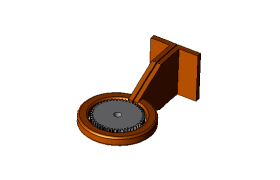
| Module:TR | 2011-02-28 | The large capacity switching gear indicated in the figure produces electrodynamic repulsion force by the current flowing in the contacts during excitation. Therefore, the contact stress needs to be larger than the electrodynamic repulsion force produced by the maximum excitation current. This example presents the use of a magnetic field analysis to obtain the electrodynamic repulsion force of a switching gear from the Lorentz force when a short-circuit current of 100 kA is applied.
|

 | 149 - Analysis of Magnetic Blowout Force Acting on the Arc of a Switching Gear
| Module:TR | 2011-02-28 | Metal vapor is produced from the contacts of a switching gear during cutoff and a plasma arc forms. The structure of the contact rings is innovated to produce a magnetic field that expands the arc and prevents vacuum deposition caused by the arc. The arc expands by the Lorentz force that is produced. This example presents the use of a magnetic field analysis to obtain the current density and Lorentz force of the switching gear and the force expanding the arc.
|

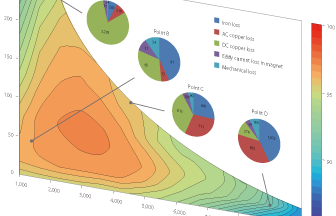
 | 148 - Loss Analysis of a Power Transformer (Flyback Converter) | Module:DP,LS,TR,TS | 2012-08-31 | A flyback converter is a well-known system for small capacity power supplies in the several-dozen W class. They are cheap and have a simple structure, so they are widely used as converters for pressurization in home appliances. In recent years there has been a trend toward making small-scale switching transformers even smaller and higher-frequency, so it is not rare to see converters using the flyback system drive 100 kHz or more. Because of the higher frequencies and smaller scales of transformers, an important challenge of how to control their heat generation has emerged in the design process. The losses that produce heat can be separated into copper loss in the coil and iron loss in the core. Copper loss is distributed inside of the coils because of the proximity effect, which is caused by influence from the skin effect and leakage flux. This means that local heat generation in the coils becomes a problem. Iron loss also has a complex distribution because it depends on the magnetic flux density distribution that accounts for the core's magnetic saturation, so the core's local heat generation becomes a problem as well. A magnetic field analysis simulation based on the finite element method (FEM) can precisely evaluate the complex loss distributions of the coil and core, so it is optimal for an advance study of a switching transformer's thermal design.
|

 | 140 - Analysis of Electromagnetic Repulsion Produced in Small Contact Bridges
| Module:ST | 2012-07-31 | Electromagnetic repulsion is generated in the contact points of switches used in electrical equipment and current inflow points during resistance heating when contact terminals bridge through a small point. It is advantageous to investigate the size of the electromagnetic repulsion when designing a device, or to understand the phenomena that are actually occurring. This Application Note presents the use of a magnetic field analysis to obtain the electromagnetic repulsion when a switch is closed, creating a contact bridge.
|

 | 129 - Characteristic Analysis of a PM Stepping Motor Accounting for Magnetization
| Module:ST,TR | 2011-01-17 | Stepper motors are commonly used for positioning in printers and digital cameras. The magnetization of the magnets used for the PM stepping motor largely affect the motor's characteristics. Therefore, it is advantageous to accurately measure the characteristics of the PM stepping motor by clearly defining the magnetization with an analysis. This example presents the use of magnet field analyses to obtain the induced voltage of a PM stepping motor that combines magnetization distribution, surface flux density, and magnetization of magnets magnetized with a magnetization device.
|

 | 126 - Magnetization Analysis Accounting for Eddy Currents
| Module:ST,TR | 2013-01-28 | A magnet's magnetizing state largely affects the characteristics of a device that uses permanent magnets. A magnetization device performs magnetization by applying an extremely strong magnetic field to a magnet. The capacity of the magnetization power supply is also determined by multiplying the magnetization current by time. The production process requires that magnetization be performed by running a large current through a magnetization coil in an extremely short period of time. However, eddy currents are generated in the magnetization yoke when the currents time variations are too severe, opening the possibility that the intended magnetizing field cannot be obtained. On the other hand, when the current changes too slowly the magnetizing device's capacity needs to be expanded, leading to an increase in production cost. This is why the trade-off between the magnetizing device's performance and whether sufficient magnetization can be carried out needs to be studied. A magnetic field analysis using the finite element method (FEM) can handle the nonlinear magnetic properties of materials and eddy currents that are generated in the magnetization yoke when current flows through the coil. This makes it possible to discover how the magnetizing field will be generated and what effect it will have on the magnetization distribution. This Application Note compares a magnet's internal magnetization distribution and surface magnetic flux density from differences in its magnetizing state when the magnetization yoke is entirely composed of a laminated steel sheet and a magnetization sheet that does not use a laminated steel sheet at either end.
|

 | 116 - Operating Time Analysis of an Injector by Evaluating the Reduction in Eddy Currents
| Module:TR | 2011-07-12 | A solenoid type injector used in engines opens a valve and injects fuel by moving a plunger with magnetic force created by an electromagnet.The response for the applied voltage is evaluated to improve the fuel consumption by maintaining the flow of fuel dispersed by an injector into an engine.Evaluating ways to reduce the eddy currents to improve the response characteristics of an injector is advantageous because the eddy currents produced by the currents slow the response of the injector. This example presents the use of a magnetic field analysis to obtain the response characteristics of a solenoid type injector by evaluating ways to reduce the amount of eddy currents.
|

 | 109 - Operating Time Analysis of an Electromagnetic Relay Accounting for Eddy Currents UP!
| Module:TR | 2013-04-26 | Electromagnetic relays are devices that use an electromagnet to physically connect and disconnect contact points. Magnetic flux is generated from the magnetomotive force, which is expressed as the product of the number of turns in the coil and the current that is applied to the coil. This flux produces an attraction force in the movable core, making the relay close. To put it simply, the attractive force is determined from the area of the gap between the movable core and the stator core and the size of the magnetic flux density produced in said gap. With a relay whose movable core does not move linearly, however, it is a difficult problem to predict the magnetic flux density in the gap because it does not become parallel. The nonlinear magnetic properties of the iron core and yoke also affect the magnetic flux density in the gap. With a JMAG magnetic field analysis, it is possible to obtain the attraction force of the movable core while accounting for these factors. One of the reasons that the response is delayed in electromagnetic relays is eddy currents, which are produced when the magnetic flux generated by current flow undergoes time variations. The eddy currents are generated in a direction that inhibits changes in the magnetic flux, causing a delay in the initial rise of the attraction force when the current begins to flow. This reduces the injector's responsiveness. JMAG makes it possible to account for the effects from eddy currents and obtain an electromagnetic relay's responsiveness by running a transient response analysis. This Application Note presents the use of the motion equation function to evaluate the operating time of an electromagnetic relay with DC voltage drive. Eddy currents generated in the core are considered for this purpose.
|

 | 104 - Thrust Force Analysis of a Linear Induction Motor
| Module:TR | 2011-01-17 | A linear induction motor can be constructed at low cost, because the motor can use a primary side made of coil, and secondary side made of a conductor that is not magnetized, such as aluminum or copper. It is important to analyze the thrust force as well as the end effect that causes lower performance at low slip when evaluating the performance of linear induction motors.This example analyzes the thrust force of a linear induction motor.
|

 | 99 - Superimposed Direct Current Characteristic Analysis of a High Current Reactor
| Module:TR | 2011-01-17 | High current reactors with a high-frequency have a superimposed current composed of a high-frequency ripple and direct current. The performance of a reactor is evaluated by a stable inductance in a wide direct current region. The gap that is designed to prevent magnetic saturation from the core largely affects the inductance. The gap is a vital parameter of the reactor's design. This example analyzes the superimposed direct current characteristics of a high current reactor with a high frequency.
|

 | 94 - Analysis of Detent Torque of a PM Stepper Motor
| Module:TR | 2013-02-28 | PM stepper motors are commonly used for positioning of moving parts in small devices such as printers and video equipment. In order for its drive to function with an open loop, the most important characteristics for a stepper motor are controllability and holding torque, and not the motor's output. Therefore, the desired characteristics are detent torque, which is a non-excitation holding torque, and stiffness torque, which is an excitation holding torque. A PM stepper motor is made up of a multi-pole magnetized rotor and offset inductors for each phase. In order to reduce their size and number of parts, claw pole inductors are made from folded steel sheet. Because of this, the flow of magnetic flux is three dimensional, so it is necessary to carry out a 3D electromagnetic field analysis using the finite element method (FEM) to proceed with an accurate preliminary study. This Application Note describes how the detent torque can be calculated for a PM stepper motor.
|

 | 89 - Stiffness Torque Analysis of a PM Stepper Motor
| Module:TR | 2013-02-28 | PM stepper motors are commonly used for positioning of moving parts in small devices such as printers and video equipment. In order for its drive to function with an open loop, the most important characteristics for a stepper motor are controllability and holding torque, and not the motor's output. Therefore, the desired characteristics are detent torque, which is a non-excitation holding torque, and stiffness torque, which is an excitation holding torque. A PM stepper motor is made up of a multi-pole magnetized rotor and offset inductors for each phase. In order to reduce their size and number of parts, claw pole inductors are made from folded steel sheet. Because of this, the flow of magnetic flux is three dimensional, so it is necessary to carry out a 3D electromagnetic field analysis using the finite element method (FEM) to proceed with an accurate preliminary study. This Application Note describes how the stiffness torque at 0.5 A of current can be calculated for a PM stepper motor.
|

 | 80 - Cogging Torque Analysis of an SPM Motor with Skewed Magnetization
| Module:TR | 2013-02-28 | Reductions in vibration and noise are being sought after because they are a cause of torque variations in motors, and demands for reduction are particularly strong with motors that are used in machine tools and power steering. Cogging torque, which is a torque variation that is produced when there is no current, is generated because the electromagnetic force produced in the gap changes according to the rotor's rotation. This makes it necessary to apply skew to the stator and rotor and come up with innovative geometry for the magnet and stator in order to reduce torque variations by limiting variations in the electromagnetic force. Applying skew reduces the cogging torque, but it also brings disadvantages such as producing force in the thrust direction and generating eddy currents from the magnetic flux that links in the lamination direction. Consequently, in order to accurately evaluate a motor that has skew applied, one needs a magnetic field analysis simulation that uses the finite element method (FEM), which can account for a detailed 3D geometry, instead of studies that use the magnetic circuit method or a 2D magnetic field analysis. This Application Note presents the use of a magnetic field analysis to obtain the flux density distribution, cogging torque, and induced voltage of an SPM motor that has skewed magnetization applied to its magnet.
|

 | 67 - Analysis of AC Loss in a Superconductor
| Module:TR | 2010-08-31 | When superconductors are in the superconducting state, in which temperature, magnetic field and current become lower than a critical value, its electrical resistance becomes zero. Although superconducting wire rod requires a cooling system to maintain a low-temperature state, having features such as high current density and extremely low loss, it has a lot of advantages in terms of energy and environment. The electrical resistance in the superconductor becomes zero, when DC is applied, but when AC is applied, loss is caused in a superconductor. In JMAG, the AC loss in a superconductor can be obtained. This note presents the use of magnetic field analysis to obtain the AC loss in a superconductive filament.
|

 | 65 - Static Thrust Analysis of a Voice Coil Motor
| Module:TR | 2013-01-28 | Linear actuators are used in machine tools because of their high-speed performance, high acceleration and deceleration, and accurate positioning. There are coreless types of linear actuators, as well. They generally have a smaller thrust force than core linear actuators, but they do not produce cogging, so they only have a small amount of thrust variation. Because of this property, they are used in fields where high-accuracy positioning is necessary, like with head drives of packaging machines or the slight movements of precision stages. Static thrust variations at the translation position of the actuator have an effect on determining the position accurately. The static thrust is determined by the amount of current, so its current characteristics need to be obtained. This Application Note explains how to obtain the current characteristics and the translation position characteristics of the static thrust in a voice coil motor, which is a type of coreless linear actuator.
|

 | 64 - Thrust Force Analysis of a Coreless Linear Motor
| Module:TR | 2013-01-28 | Linear motors are widely used for carrier devices and machine tools because of their high-speed performance, high acceleration and deceleration, and accurate positioning. Among them there is a type of motor called a coreless linear motor. Coreless linear motors generally have a smaller thrust force than core linear motors, but they do not produce cogging, so they only have a small amount of thrust variation. They are used for linear motor stages and electronic packaging machines to make use of this property. Because the thrust variations in linear motors are small, they can be hard to predict and measure at the design stage. With the finite element method (FEM), it is possible to obtain thrust variations with accuracy even when they are small, as is the case with a coreless linear motor. This Application Note explains how to obtain the thrust variations in a coreless linear motor when it is driven with a three-phase alternating current.
|

 | 60 - Superimposed Direct Current Characteristic Analysis of a Reactor UP!
| Module:TR | 2013-04-26 | A high-frequency reactor, used in equipment such as DC-DC converters, has a high-frequency current accompanying the switching direct current. The performance of a reactor is evaluated by a stable inductance in a wide direct current region. The gap that is designed to prevent magnetic saturation from the core largely affects the inductance, so it is a vital parameter of the reactor's design. The magnetic resistance is determined by the gap when there is a large gap width, which is used as a parameter for the superimposed direct current of the inductance. This means that the resistance can be evaluated using the magnetic circuit method, but when the gap width is small, the current is large, and magnetic saturation has a large effect on the inductance, an advance study using a finite element analysis (FEA) is an effective tool. This Application Note explains a case example that obtains the superimposed direct current characteristics of a high-frequency reactor when the gap width is changed.
|

 | 54 - Analysis of the Cogging Force of a Moving Coil Linear Motor UP!
| Module:TR | 2013-04-26 | Linear motors have been widely used in carrier devices and the drive units of machine tools due to their capability for high acceleration and deceleration, as well as their accurate positioning. In order to improve performance people are trying to obtain a large thrust force in order to enhance responsiveness, but one also needs to fulfill the demand for the trade-off of reducing thrust force variations and the attraction force. There are also times when skew is added to the magnets because of requirements to reduce thrust force variation. In order to obtain a large thrust force, the material's nonlinear magnetic properties and the magnet's demagnetization characteristics need to be accounted for, and they need to be analyzed after modeling a detailed geometry in order to evaluate thrust force variations. This is why the characteristics need to be studied with a magnetic field analysis simulation based on the finite element method (FEM). This Analysis Note explains how to obtain the magnetic flux density distribution and cogging in a moving coil linear motor with skew applied to its magnets.
|

 | 44 - Resistance Heating Analysis of a Steel Sheet | Module:HT,TR | 2012-08-31 | In treatments like hot formed pressing, a steel sheet needs to be heated uniformly as a part of pre-processing. Resistance heating is a method of uniform heating that uses a steel sheet's electric resistance. In resistance heating, current is run through electrodes placed on both sides of a steel sheet. The joule heat produced from the ensuing electric resistance is then used to heat the steel sheet. However, the uniformity of the range of heat generation changes depending on the arrangement of the electrodes, so whether or not the uniformity satisfies the heating conditions needs to be investigated ahead of time. Unevenness in the current distribution flowing from the electrodes through the steel sheet is determined from the geometry and the material's electric conductivity. Electric conductivity changes according to the temperature, though, so both the electromagnetic phenomena and the heat transfer phenomena need to be analyzed at the same time. This Application Note presents how to obtain the differences in temperature distribution in a steel sheet and temperature increases from applied current.
|

 | 43 - Torque Analysis of a Coreless Motor
| Module:TR | 2013-01-28 | As their name implies, coreless motors have a rotor that lacks a core and is made of only a coil. For this reason, there is no core to produce iron loss in the rotor, and its moment of inertia is small. They can be controlled easily because their characteristics are linear and they have small torque ripples, but they are not versatile enough to produce a large amount of torque. This is why they are often used in small precision equipment that requires high rotation speeds and good responsiveness. The rotor coil is hard to construct because it is made of only a coil. It is important to design the coil's twist angle to be able to produce torque. The model needs to be made precisely because coreless motors are used in compact equipment and because the detailed geometry of the parts can affect the characteristics. In order to carry out these evaluations, the coil's twist needs to be accounted for accurately in three dimensions. An electromagnetic field analysis using the finite element method (FEM) is necessary to accomplish this because it can evaluate the distribution of the electromagnetic force produced in the magnetic circuit in detail. This Application Note presents an evaluation of the torque waveform of a coreless motor when current is running.
|

 | 39 - Torque Analysis of a Three Phase Induction Motor Accounting for the Skew
| Module:DP,TR | 2012-07-31 | An induction motor can utilize skew easily because the cage is constructed by metallic casting such as die casting. When skew is applied, it arranges the variations in the magnetic flux that links to the cage in a sinusoidal wave. This makes it possible to eliminate the harmonic components from the induction current that cause negative torque and contain things like the torque variations caused by influence from the slots. Applying skew generally affects the flow of magnetic flux in the axial direction, making it complex. This is why an analysis that can correctly verify the three dimensional magnetic flux flow is necessary to obtain an advance evaluation of the skew's effects. This Application Note presents a comparison of the torque waveforms of three phase squirrel cage induction motors with and without torque, and introduces the effects of using skew to reduce torque variations. Changes in the higher components caused by skew are also displayed by separating the frequencies of the secondary current, which causes the torque variations.
|

 | 36 - Operating Time Analysis of an Electromagnetic Relay
| Module:TR | 2013-01-28 | Electromagnetic relays are devices that use an electromagnet to physically connect and disconnect contact points. Magnetic flux is generated from the magnetomotive force, which is expressed as the product of the number of turns in the coil and the current that is applied to the coil. This flux produces an attraction force in the movable core, making the relay close. To put it simply, the attractive force is determined from the area of the gap between the movable core and the stator core and the size of the magnetic flux density produced in said gap. With a relay whose movable core does not move linearly, however, it is hard to predict the magnetic flux density in the gap because it does not become parallel. The nonlinear magnetic properties of the iron core and yoke also affect the magnetic flux density in the gap. With a JMAG magnetic field analysis, it is possible to obtain the attraction force of the movable core while accounting for these factors. This Application Note presents the use of the motion equation function to evaluate the operating time of an electromagnetic relay that uses a DC voltage drive.
|

 | 29 - Iron Loss Analysis of an SPM Motor with Overhanging Magnet
| Module:LS,TR | 2013-01-28 | There are times when permanent magnet motors are designed with a magnet made with overhang, in other words made longer than the stator's stack length, in order to strengthen the magnetic field that it creates. A space is necessary in the stator core to supply the coil ends, and there is a wasted space in the rotor if the rotor and stator have the same stack length, so a magnet is placed in this space with the objective of increasing the magnetic flux without making the magnet thicker. However, the magnetic field produced by the overhanging part of the magnet enters the stator at an angle, so magnetic flux is produced in the lamination direction, which creates a possibility of increasing eddy current loss by a wide margin. When the overhang is too big, the magnet's magnetic field goes to waste because it does not reach the stator. For this reason it is necessary to set up the overhang amount properly while looking at the trade-off between an increase in torque and an increase in losses. A magnetic field analysis using the finite element method (FEM), which can obtain the relationship between a three dimensional magnetic field and eddy currents, is an effective method for an advance study. This Application Note presents the use of a no-load iron loss analysis of an SPM motor with and without an overhanging magnet.
|

 | 28 - Magnetic Field Analysis of a Speed Sensor
| Module:TR | 2013-01-28 | Antilock brake systems (ABS) have become a standard feature in vehicles, so speed sensors are attached to each wheel in order to measure their respective speeds. There are several methods of detecting rotation speed, but magnetic sensors are weather resistant and have a small number of parts because there only needs to be a gear on the rotation side, so they are widely used. The challenges from a design standpoint are the angle and relative distance between the gear's teeth and sensor, and how to ensure sensitivity and responsiveness when considering the magnetic influence of the surrounding air. In order to proceed with an advance study like this that considers a precise geometry and material properties, an electromagnetic field analysis using the finite element method (FEM) is effective. This Application Note presents the use of magnetic field analysis to evaluate the variation of the voltage signal of a magnetic speed sensor for a range of air gap distances.
|

 | 27 - Head Field Analysis of a Recording Write Head That Accounts for Eddy Currents
| Module:TR | 2013-02-28 | Magnetic heads are devices that are used to record data on storage media, and are often found in hard disks. A magnetic head has both a recording head that writes data by magnetizing a round magnetic disk and a playing head that reads the data from the magnetic disk's magnetization pattern. For the recording head, the vital thing is an evaluation of the recording head field's responsiveness toward input electrical signals. This evaluation comes from a detailed evaluation of the magnetic flux density distribution around the head. To study these characteristics, the analysis needs to include the effect of eddy currents generate on the yoke. In order to account for eddy current distribution that is produced in the fine part at the tip of the recording write head, a magnetic field analysis using the finite element method (FEM) is most effective. This Application Note shows how to obtain the responsiveness of recording head field that is generated in the magnetic head.
|

 | 26 - Braking Torque Analysis of an Electromagnetic Brake
| Module:TR | 2013-02-28 | An electromagnetic brake is an auxiliary brake device for large-scale vehicles like trucks and buses. It is fit onto the propeller shaft and applies a braking force. There are both hydraulic and electromagnetic types. With an electromagnetic brake, a magnetic field is produced in the stator coil, making eddy currents occur because of time variations in the magnetic flux density linking to the rotor. This, in turn, produces a braking torque. The range in which eddy currents occur in the rotor and the braking torque can vary a great deal according to the current flowing to the stator coil and the rotor's rotation speed. In order to estimate the electromagnetic brake's performance accurately at the design stage, it is best to carry out an electromagnetic field analysis simulation using the finite element method (FEM) because it can approximate the material's nonlinear magnetic properties and can approximate the skin effect caused by current distribution, as well. This Application Note shows how to obtain the braking torque of an electromagnetic brake during drive.
|

 | 25 - Analysis of a Claw Pole Alternator
| Module:TR | 2013-01-28 | Demand for high fuel efficiency in vehicles has been growing every year, and auxiliary machines like power steering and coolant pumps have been switching to electrical operation to support those needs. This is why the amount of electrical power being used in typical gasoline vehicles is increasing with each passing year, and manufacturers are looking for high-output alternators that can supply this level of electricity. They need to increase the output density, however, because they cannot increase the size of the actuator to correspond with the added generation capacity. They also need to achieve higher efficiency. A claw pole alternator generates electricity in the coil on the stator side with the rotor side acting as an electromagnet. The excitation coil on the rotor side is a single phase, and the claw pole is arranged so that it wraps around this coil. The claws that extend from the inside of the coil and the ones that extend from the outside of the coil have poles with different polar characteristics, and they have the same polar structure as a magnet that is arranged with magnetization that alternates between North and South. Because the alternator needs to be designed with a 3D geometry to account for the claw poles and the analysis needs to consider eddy currents generated in the surface of the claw poles, which are made from a metal plate, an electromagnetic field analysis using the finite element method would be the most useful, as it can simulate detailed geometries and account for eddy currents. This Application Note presents the use of an electromagnetic field analysis to evaluate the output capacity of a claw pole alternator operating at 1500 rpm while accounting for eddy currents in the rotor core.
|

 | 24 - Cogging Torque Analysis of an SPM Motor with a Skewed Stator
| Module:TR | 2013-01-28 | Reductions in vibration and noise are being sought after because they are a cause of torque variations in motors, and demands for reduction are particularly strong with motors that are used in machine tools and power steering. Cogging torque, which is a torque variation that is produced when there is no current, is generated because the electromagnetic force, which is produced in the gap, changes in relation to the rotor's rotation, making it necessary to apply skew to the stator and rotor and improvise with the magnet and stator's geometry in order to limit said variations in electromagnetic force as a countermeasure for reducing the torque variations. When applying skew, force in the thrust direction is produced in exchange for a reduction in the cogging torque, meaning that there is the disadvantage of producing eddy currents from the magnetic flux that links in the lamination direction. Consequently, in order to accurately evaluate a motor that has skew applied, one needs a magnetic field analysis simulation that uses the finite element method (FEM), which can account for a detailed 3D geometry, instead of studies that use the magnetic circuit method or a 2D magnetic field analysis. This note presents the use of magnetic field analysis to evaluate the cogging torque of an SPM motor with a skewed stator.
|

 | 22 - Analysis of the Eddy Current in the Magnet of an IPM Motor
| Module:TR | 2013-01-28 | More and more permanent magnet motors are starting to use rare earth magnets, which have a high energy product, in order to achieve higher output density. Neodymium rare earth magnets contain a great deal of iron so they have a high electric conductivity, but when a varying magnetic field is applied they produce Joule loss from eddy currents. Due to the spread of IPM structure adoption and field weakening controls in recent years to speed up rotation, the frequencies and fluctuation ranges of varying fields applied to magnets have increased, and there has been a corresponding increase in Joule loss. By dividing the magnet, like one would a laminated core, to control eddy currents, one can obtain a method of raising the apparent electric conductivity and lowering the eddy currents. Armature reactions in the stator occur before the eddy currents produced in the magnet, so the eddy currents are determined by the slot geometry of the stator core, the geometry of the rotor, the nonlinear magnetic properties of the core material, and the current waveform that flows through the coil. In order to examine these kinds of magnet eddy currents ahead of time, one has to account for things like these geometries and material properties precisely, so a magnetic field simulation using the finite element method (FEM), which can account for them, would be the most effective. This Application Note presents the use of a magnetic field analysis in a state of operation to obtain variations in magnet eddy current losses according to the number of divisions in the magnet.
|

 | 18 - Thermal Analysis of an IPM Motor
| Module:HT,LS,TR | 2012-07-31 | Exactly how to resolve the problem of rising temperatures is a critical issue when trying to achieve an improvement in a motor's efficiency and output. In order to solve this problem it is important to investigate a magnetic design that reduces the losses themselves because they are a source of heat, but it is also important to study a thermal design that improves heat dissipation and does not let the temperature rise. Copper loss in the coils and iron loss in the core are the dominant heat sources, so this analysis mainly evaluates the effects of this heat. Changes in the magnet's properties due to temperature are large and its heat resistance is low, so it is necessary to design while paying careful attention to rising temperatures during operation. During operation, rated evaluations with a continuously operated constant load are run until a thermal balanced state has been reached. In addition to these rated evaluations, however, thermal transient evaluations that add a thermal cycle with an intermittently operated electrical overload are performed, as well. In order to carry out an accurate thermal design, it is necessary to first correctly understand the heat generation amount and location, so it would be advantageous to calculate the losses in a magnetic field analysis simulation using the finite element method, and from there to carry out a thermal analysis using the resulting loss distribution. This Application Note explains how to evaluate a motor's temperature distribution by creating a thermal analysis model that can investigate the loss analysis and temperature distribution in order to obtain the motor's total loss distribution, and then analyzing the elevated temperature process.
|

 | 16 - Analysis of a Hybrid Stepper Motor
| Module:TR | 2013-01-28 | Hybrid stepper motors are used as actuators for equipment where position detection accuracy is required, such as the joints of robots or rotary tables for machine tools. The rotor has a construction that sandwiches a magnet that is magnetized in the axial direction between two rotor cores that have serrated teeth to create salient poles, and the tips of the stator core's teeth are shaped like gears as well. The rotation resolution is determined by the number of gears in the rotor and the number of phases in the drive coil, so the number of gears is set to rather large numbers like 50 and 100 to raise the angle resolution. The most important characteristics for a stepper motor are the controllability, the detent torque, which is a non-excitation holding torque, and the stiffness torque, which is an excitation holding torque, and not the motor's output. The two-plated rotor core of a stepper motor has an N pole on one side and an S pole on the other, so a multipole magnet is achieved by deviating the saliency of the gear condition by 1/2 pitch. Consequently, the magnetic circuit is 3D. There are also times when the division pitch geometry of the teeth is complicated, so it is necessary to carry out a 3D electromagnetic field analysis using the finite element method (FEM) to proceed with an accurate preliminary study. This Application Note describes how the detent torque and stiffness torque can be calculated for a hybrid stepper motor.
|

 | 15 - Cogging Torque Analysis of an SPM Motor with a Step Skewed Magnet
| Module:TR | 2013-01-28 | Reductions in vibration and noise are being sought after because they are a cause of torque variations in motors, and demands for reduction are particularly strong with motors that are used in machine tools and power steering. Cogging torque, which is a torque variation that is produced when there is no current, is generated because the electromagnetic force, which is produced in the gap, changes in relation to the rotor's rotation, making it necessary to apply skew to the stator and rotor and improvise with the magnet and stator's geometry in order to limit said variations in electromagnetic force as a countermeasure for reducing the torque variations. When applying skew, force in the thrust direction is produced in exchange for a reduction in the cogging torque, meaning that there is the disadvantage of producing eddy currents from the magnetic flux that links in the lamination direction. Consequently, in order to accurately evaluate a motor that has skew applied, one needs a magnetic field analysis simulation that uses the finite element method (FEM), which can account for a detailed 3D geometry, instead of studies that use the magnetic circuit method or a 2D magnetic field analysis. This Application Note presents the use of magnetic field analysis to evaluate the magnetic flux density distribution and cogging torque in each part of an SPM motor with a step skewed magnet.
|

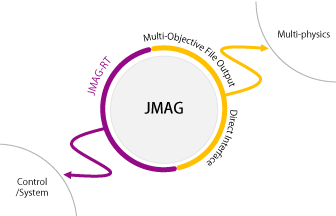
 | 11 - Pull-in/pull-out Analysis of a PM Stepper Motor Using a Control Simulator and the JMAG-RT | Module:RT,TR | 2012-04-10 | Stepper motors are commonly used for positioning in printers and digital cameras. With a PM stepper motor, there are excitation types such as one phase excitation, two phase excitation, and one-two phase excitation for the excitation system, and the accuracy for stepper motor positioning changes depending on which system is used. Pull-in and pull-out torques are important indicators that show the transient characteristics of a stepper motor, so it is vital to understand and study them in advance. To measure them, begin to gradually reduce the load on the stepper motor from a stationary state, measure the pull-in torque when it begins to rotate, begin to gradually increase the load in sync with the pulses from a rotating state, and measure the pull-out torque when it loses synchronism. It is necessary to carry out transient analysis while changing the load in order to solve this phenomenon in magnetic field analysis. While it is possible to calculate it using an equation of motion with JMAG's 3D transient response analysis, such calculations take too much time. With JMAG, it is possible to create a motor model that is detailed and conforms to a real machine, and that accounts for spatial harmonics and magnetic saturation characteristics that are included in a stepper motor. By importing this motor model, a "JMAG-RT model," to the control/circuit simulator, it is possible to derive the stepper motor's pull-in and pull-out torques quickly and accurately because it accounts for the motor's magnetic saturation characteristics and spatial harmonics. This note presents how JMAG-RT can be used to calculate holding torque and coil inductance that varies with current. The result is the JMAG-RT motor model used as a reference for a circuit / control simulator that runs a transient analysis to obtain pull-in and pull-out torques of the stepper motor. By also using a single JMAG-RT motor model and changing the circuit on the circuit/control simulator, it is possible to obtain the characteristics of two types of drives: a bifilar winding with a unipolar drive, and a monofilament winding with a bipolar drive. Other parameters are the same for both analyses.
|

 | 10 - Thermal Analysis of a Radiant Heater
| Module:HT,TR | 2012-04-10 | Quartz heaters, which are used in semiconductor manufacturing, are a kind of heating device that uses heat radiation phenomena. Thermal radiation is a mechanism of heat transfer, which is defined as the transport of heat through the transmission of electromagnetic waves between objects that have different temperatures, making transfer possible even through a vacuum. This objective is to transfer heat to a heated body uniformly by placing it near the heater, which has been heated by running current through the coil. It is necessary to properly handle the effects of the 3D geometry of the heated body or the heat generated from the heater in order to see whether it is raising the temperature uniformly, so a thermal analysis is carried out. This Application Note explains how to carry out a thermal analysis using the thermal radiation phenomenon between a heater and a heated body to obtain the differences in temperature distribution in the heated body with and without a shield.
|

 | 9 - Sound Pressure Analysis of a Loudspeaker UP!
| Module:DS,TR | 2013-04-26 | A loudspeaker produces sound when the voice coil makes the vibrator vibrate. The general requirement of the loudspeaker is to produce uniform sound over a wide range of the frequencies. Lorentz force is generated in the coil when the magnetic field of a permanent magnet acts on the current flowing through the voice coil, and produces sound by making the vibrator vibrate. In order to evaluate the sound with good accuracy, it is necessary to handle the resonance phenomenon between the Lorentz force and the speaker's eigenmode properly. The eigenmode and Lorentz force distribution change depending on the place where the core and coil are wound, so high accuracy calculations need to be carried out using the finite element method (FEM). This Application Note presents how the frequency characteristics of sound pressure can be obtained using the constant Lorenz force on the voice coil, regardless of the frequency.
|

 | 8 - Analysis of an Axial Gap Motor
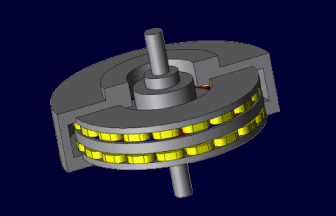
| Module:TR | 2013-02-28 | Unlike typical cylindrical motors such as radial gap motors, axial gap motors have a structure in which the stator and the rotor, which is arranged on a disk, face each other and produce rotation. For that reason, because it is possible to arrange thinner parts than with a radial gap motor, they can respond to demands for miniaturization of equipment. With axial gap motors, evaluations using the magnetic circuit method and empirical data are difficult because the magnetic flux that passes through the rotor and stator, which face each other, becomes a 3D magnetic circuit, meaning that a 3D electromagnetic field simulation using the finite element method (FEM) is necessary because it can carry out an accurate analysis. This Application Note shows how to use JMAG's 3D magnetic field analysis to carry out a load analysis of an axial gap motor, and then obtain the Speed-Torque curve and the Torque-Current curve.
|

 | 7 - Analysis of a Spindle Motor
| Module:TR | 2013-02-28 | Spindle motors are often used as drive motors where limited space is an issue, as is the case with storage media like hard disks. They employ an outer rotor structure in order to obtain a large torque, but to do so they have to use a great deal of permanent magnets while remaining thin and compact. In order to reduce the number of parts used in their composition, the rotor core has functions that both bear the magnet's flux path and transfer the generated torque, which supports the magnet, to the shaft. For this reason the rotor core is composed of materials that are easy to produce, meaning that there is a possibility that its efficiency as a magnetic circuit will decrease. As motors get smaller, they require a design that accounts for flux leakage because it begins to affect the disc in the rotor. For this reason, spindle motors need electromagnetic field simulations that use the finite element method (FEM), which can account for detailed 3D geometry and magnetic saturation in materials, in order to carry out an accurate evaluation. This Application Note shows how the Speed-Torque curve, the Torque-Current curve and the magnetic flux density distribution of a spindle motor can be obtained.
|

 | 4 - Sound Pressure Analysis of a Reactor UP!
| Module:DS,TR | 2013-04-26 | Reactors are used in a variety of electric power systems. For instance, they fill the role of making the current pulsation between an inverter and a motor more smooth. On the other hand, the sound that originates from a resonance phenomenon between an electromagnetic force and an eigenfrequency can become a problem. The reactor in this analysis has a gap in the magnetic circuit to prevent magnetic saturation. Due to the magnetic fields that occur with high frequency currents, electromagnetic force generates near the gap, and this electromagnetic excitation force in turn causes noise. Vibration and sound grow larger when the electromagnetic excitation force and the transformer's eigenmode resonate. In order to evaluate this phenomenon with good accuracy, it is necessary to find the electromagnetic force distribution and eigenmode in the high frequencies that become particular problems by using the finite element method (FEM). This Application Note shows an example of an evaluation of a reactor's sound pressure when a part of a spacer has been removed.
|

 | 2 - Cogging Torque Analysis of a PM Linear Motor
| Module:TR | 2013-01-28 | Linear motors have been widely used in carrier devices and the drive units of machine tools due to their capability for high acceleration and deceleration, as well as their accurate positioning. As an issue for improving performance, people are trying to obtain a large thrust force in order to enhance responsiveness, but on the other hand it is also necessary to fulfill the demand for the trade-off of wanting to reduce thrust force variations and the attraction force. In order to obtain a large thrust force, the material's nonlinear magnetic properties and the magnet's demagnetization characteristics need to be accounted for, and in order to evaluate thrust force variations, they need to be analyzed after modeling a detailed geometry. This is why they need to be studied with a magnetic field analysis simulation based on the finite element method (FEM). This note presents how to obtain cogging torque, a cause of thrust variation, and evaluate the thrust force and attraction force during drive.
|

|