



* The contents of the program may be subject to change without notice. Wednesday, December 10
Keynote Speech
Numerical Magnetic Field Analysis in Electric Performance Calculation in
Large Rotating Machines.
Dr.Kazumasa Ide , Hitachi LTD.
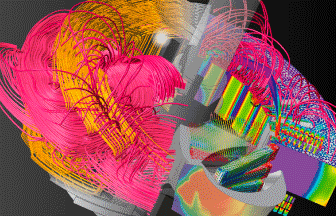
The design technologies of the large capacity rotating machines have been
developed by progress of the analysis oriented R&D, due to difficulty
of trial manufacture. The electrical properties have been analyzed by not
only using the numerical electromagnetic field calculation but also using
the cooperation with concentrated magnetic circuit model, dq-axis equation
and so on. In the presentation, the present analysis technologies will
be introduced with consideration of historical and technical features of
the large capacity machines.
Motor Session
modeFRONTIER as a Strategic Tool for Improving Electromagnetic CAE and
Supporting Decision Making
Dr.Yasushi Fujishima , CD-adapco JAPAN Co.,LTD.
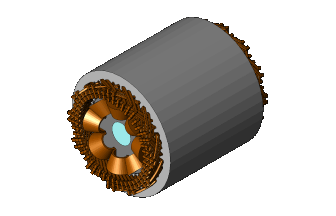
Electromagnetic CAE process that requires a number of trials by changing
design parameters such as sensitivity analysis, data fitting, and design
optimization, spends mostly on the series of unessential tasks for design
engineers. It contains changing geometry parameters, mesh generation, building
analysis model and so on. These should be automated without human intervention
to improve CAE process for design engineers. In this session, the automated
procedure of electromagnetic CAE will be introduced by showing several
application example to describe the merits of CAE process automation. Furthermore,
modeFRONTIER also has various post-processing functionsthat support decision
making for design engineers. The availability of this functions and effectiveness
will be also described.
Motor Session
Electromagnetic Field Analysis on Giant Magnetostrictive Actuator by using
JMAG
Ph.D.Hisashi Yajima , SMC Corporation
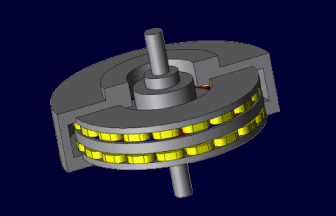
The giant magnetostrictive material is electromechanical transformation
one with large magnetpstriction and electro-mechanical coupling factor.
We developed the actuator by it; Giant Magnetostrictive Actuator. This
paper describes the magnetic field analysis on the actuator by using the
finaite element method.
Induction heating session
Finite Element Analysis of a Steering Rack Shaft Subjected to the High-Frequency
Induction Hardening Process
Mr.Manabu Fukumoto , Sumitomo Metal Industries, Ltd.
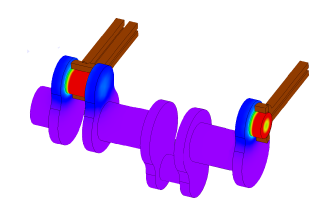
The main purpose of this work is to develop a simulation technique to predict
the deflection after the induction resistance heating process, and to utilize
it to choose an appropriate process condition before manufacturing. In
our simulation model, transient heat generation by ohmic heating and induction
heating are calculated using Abaqus with coarse FE mesh and JMAG with fine
FE mesh, respectively. Then obtained total heat is used as an input to
simulate mechanical response on Abaqus again. Our numerical results, such
as temperature histories and residual deflections, show good agreement
with the measurements. In addition, the dual- frequency induction heating
process is examined numerically.
Expanding the Use of JMAG in a Company
Evaluation of eddy current characteristic for applied high frequency voltage
to the giant magnetrostrictive material.
Mr.Masayuki Sugasawa , Sony EMCS Corporation
The giant magnetostrictive material(GMM) has some characteristics of very
large strain of more than 1000 ppm, high energy density, and high responsibility.
So it is expected to be used for fine positioning device or braking system,
and so on. Micro actuator using this equipped with iron yoke and winding
coil, therefore, has advantages over PZT type, in simple low voltage driving,
high robustness and wide temperature operation range. This paper describes
the performance of some divided elements improved the loss of eddy current
for applied high frequency voltage to the GMM. The eddy current problem
occurred in high frequency driving will be reduced with the size. Quantitative
analysis of high frequency dynamic power loss in GMM is calculated by finite
element method. Especially divided element counts are depend on skin effect.
The calculated results based on the theory shows theeffect of dividing
the element of GMM.
Expanding the Use of JMAG in a Company
Introduction of the Use of JMAG as CAE among Our Users
Mr.Yusaku Suzuki , JSOL Corp.
As the magnetic field analysis CAE is widely used, the purpose and application
of CAE become more diversified. Fortunately, I had opportunities to hear
from our users about the use of CAE for their products, and also their
history of using CAE. In this presentation, I will introduce the services
we provide along with the CAE experience of our users. I hope to assist
you in your approach to CAE and your vision for the future products.
Thursday, December 11
Fast Large-Scale Analysis Session
Speeding Up JMAG's Solver for Large Scale Problems.
Mr.Kazuki Semba , JSOL Corp.
The calculation speed is the key factor in addressing large-scale electromagnetic
field problems. This presentation will discuss the results of speeding
up JMAG's solver by SMP parallel calculation and the enhancement of algorithms
using specific examples.
The current attempts to develop a faster solver will also be presented.
Fast Large-Scale Analysis Session
Technology for accelerating electromagnetic field analyses.
Dr.Takeshi Iwashita , Kyoto University
Currently, computational environments on which electromagnetic field analyses
are performed move to parallel computers based on multi-core processors.
I discuss whether these multi-core processors have possibility of accelerating
the electromagnetic field analysis. Furthermore, in the context of FEM
analyses, I introduce some new techniques for fast linear solvers. The
examples of the electromagnetic field analyses using a multigrid method
and IDR(s) method are shown. Finally, I give a brief comment on further
acceleration of electromagnetic field analysis in future.
Fast Large-Scale Analysis Session
Scaling ICCG Performance in Multicore: The Current and Future Perspective.
Dr.Shigeki Gunji , Sumisho Computer Systems Corporation
Efficient utilization of emerging multicore systems remains one of the
most challenging questions in several decades. In this talk, I present
a brief architectural description of several multicore systems followed
by a detailed JMAG scalability analysis on them. Some benchmark results
of up-to-date and upcoming multicore systems are also included.
Transformer session
Estimation of Dispersion in Inductance in Small, Low Profile Transformers.
Mr.Masahiro Shima , COSEL CO., LTD.
With the increased trend for the miniaturization of DC/DC converters, small
transformers are commonly required as they directly affect the product
form. To make a transformer smaller and thinner, it is essential to reduce
the size of the core. However, errors in the shape of the ferrite cores
that occur in the course of processing cause their properties to vary from
one another. The uniform, stable properties for the ferrite cores can be
achieved by estimating the inductance based on the dispersion of the core
measurements, and reducing it. In this study, a transformer with the excitation
winding near the gap was used to investigate the dispersion in inductance,
taking into the account the current distribution in the winding, which
is caused by leakage flux.
Transformer session
Effective Use of JMAG Software for Analyzing Switching Transformers
Mr.Hideo Matsumoto , TABUCHI ELECTRIC CO.,LTD.
High-frequency switching transformers, since they are compact and capable
of handling greater capacity, are expected to be used in a variety of products
for multiple purposes. Optimizing the design of switching transformers
requires the sophisticated magnetic field analysis, thermal analysis, and
structural analysis. We present the analysis examples of switching transformers
regarding the following most required specification, and provide solutions.
1. Staircase-shape L-I characteristics of a switching transformer with
a staircase-type gap
2. Thermal stress caused by high or low temperature due to the material
of the spacer of a switching transformer
Transformer session
Efficiency improvement of non-contact power supply systems
Mr.Hiroyasu Tomita , MURATA MACHINERY,LTD.
A non-contact power supply system (NCPS) is a power device which, unlike
a trolley, generates electrical power using a magnetic coupling. It is
mainly used for the devices for which eco-friendliness is an important
factor such as semiconductor overhead transfer systems (OHT) and liquid
crystal panel transfer systems. Our company analyzes the secondly power
receiving core of NCPS for more efficient design of magnetic circuits.
I will describe the properties of a secondly power receiving core and the
related issues obtained from the analysis run with JMAG-Studio and JMAG-ELii.
Educational Session
Supervision for students in the electrical machinery using JMAG.
Dr.Kenji Nakamura , Tohoku University
In Ichinokura and Nakamura Laboratory of Tohoku University, a general purpose
electromagnetic field analysis software JMAG has been introduced from 2003.
We use JMAG to design and analyze various inductors and rotating machinery,
and also to verify Reluctance Network Analysis (RNA) which is our original
analysis method. In this presentation, I will describe the supervision
for students in the electrical machinery using JMAG referring to examples
of success and failure.
Educational Session
Practice work of JMAG by e-learning.
Dr.Edmund Soji Otabe , Kyushu Institute of Technology
Learning by using PC is more and more common even in University as well
as high school. JMAG is known as specialized software and difficult to
learn. Therefore, practice of JMAG by e-learning is considered to be very
effective. In this presentation, e-learning in University is introduced
and the example of e-learning system for JMAG is presented. Many students
could learn how to use JMAG by themselves, and they could solve some practices.
Hence, it is very useful to use e-learning system for learning specialized
software such as JMAG.
Motor Session
Comparison of IPM and SPM by experimental and analysis results.
Dr.Kan Akatsu, Tokyo University of Agriculture and Technology
Output characteristics comparison result of IPM and SPM by using experimental
and analysis results are reported. Both machine used a same stator and
only rotor construction were changed. Iron loss estimation method and measurement
result are especially discussed, the accuracy of the analysis results are
also discussed. Adding that, the difference between both results including
challenging works are reported.
*The product and service names contained herein are the trademarks or registered
trademarks of their respective owners.