Overview
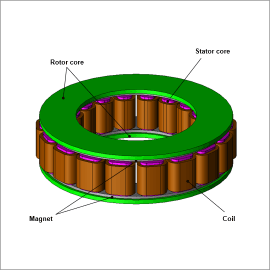
A Halbach array is one example for orienting the directions of magnets in an axial gap motor. The Halbach array is a unique magnet arrangement that produces a smooth sinusoidal distribution of magnetic flux by orienting the magnets in a helical pattern. JMAG can use magnetization patterns to set the orientation direction of the magnets without running a magnetization analysis (simulation used to magnetize non-magnetic materials).
This case study sets the magnetization pattern for a Halbach array for a three-dimensional axial gap motor, and then compares it against a standard magnet arrangement. The results demonstrate that a Halbach array provides at least equivalent torque and a lower torque ripple than a standard magnet arrangement.
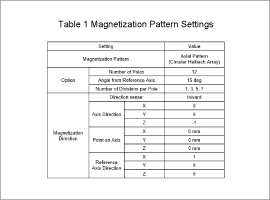
Magnetization Pattern Settings
Table 1 outlines the magnetization pattern settings.
Fig. 1 presents the magnetization direction for the [Number of Divisions per Pole] settings. One division per pole matches the existing axial pattern (circular direction) when [Number of Divisions per Pole] is set to 1.
The magnetization direction varies more consistently as the number of divisions per pole increases.
![Fig. 1 Magnetization Direction for [Number of Divisions per Pole] Settings](/images/catalog/e315-2.gif)
Torque Characteristics
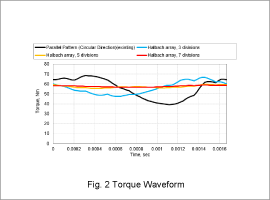
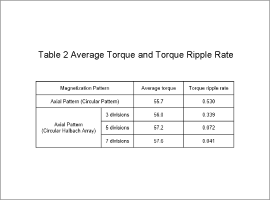
Fig. 2 illustrates the torque waveform for each magnetization pattern. The torque waveforms can show whether a magnetization pattern helps suppress torque ripple. Table 2 outlines the average torque and torque ripple rate of each magnetization pattern. All three cases using a Halbach array have an average torque of at least 56.0 compared to the average torque of 55.7 for the existing axial pattern (circular direction). We can also see that a higher number of divisions per pole increases the average torque. The torque ripple drops to 0.340 or less when using a Halbach array compared to 0.530 for the existing axial pattern (circular direction). This equates to an at least 3.5% reduction in the torque ripple. These results indicate an axial gap motor using a Halbach array can significantly decrease the torque ripple while maintaining the average torque.