
Contents
1. Introduction
2. Material modeling of superconductor
3. Evaluation of simulations accounting for anisotropy
3.1 Critical current density distribution
3.2 Current density distribution
3.3 Alternating current loss
4. Conclusion
5. References
1. Introduction
Medical, transport, energy, and a wide range of other fields are optimistic about applications for high-temperature superconductors that can realize superconductivity at liquid nitrogen temperatures. Unfortunately, prototypes of superconducting machines to verify performance are not only costly but also require time and come with the risk of quenching and structural damage. That is why the use of simulations is critical when evaluating designs.
Rare-earth Barium Copper Oxide (REBCO) tape wire has critical current characteristics with a particularly high critical temperature compared to other high-temperature superconductors. However, REBCO does have critical current density characteristics that vary with the direction of the magnetic field due to the anisotropy of the crystal structure. The critical current density is higher when the magnetic field is on the ab plane (inner tape plane) and lower when on the c-axis (perpendicular to tape plane).
Simulations that ignore anisotropy can have serious adverse effects on the accuracy of designs. For instance, an analysis will overestimate the critical current flowing in the superconductor when only accounting for characteristics for the in-plane direction, or underestimate the critical current when only accounting for characteristics perpendicular to the plane. Results from these analyses can overestimate or underestimate the risk of quenching or lead to mistakes in the limit design. This makes material modeling that can precisely reproduce the actual phenomena indispensable to high-fidelity analyses.
This paper examines the need to account for anisotropy in electromagnetic field simulations through the analysis of the CORC cable presented in Fig. 1. This case study evaluates the critical current density distribution, current density distribution, and alternating current losses when applying a uniform alternating magnetic field.
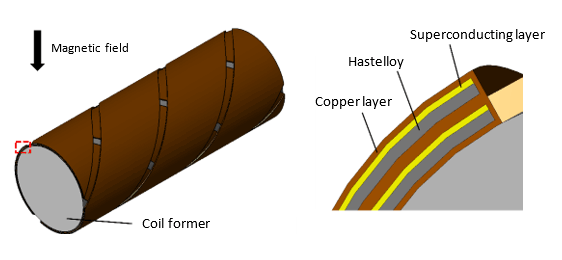 Fig. 1 CORC Cable Used in Case Study – Left: Full Model; Right: Enlarged Tape Cross-section
2. Material modeling of superconductor
An approximate model that uses the power-law distribution as a formula to account for superconductivity characteristics (n-value model) uses the equation below to derive the electrical conductivity \(\sigma\).

\(E\) and \(B\) denote the electric field and magnetic flux density, respectively. \(T\) represents the temperature, and \(E_C\) is the reference value that defines the critical current density \(J_C\) of the superconductor. Index \(n\) is known as the n-value, which is a parameter that expresses the nonlinearity of superconductors.
You need to sign in as a Regular JMAG Software User (paid user) or JMAG WEB MEMBER (free membership).
By registering as a JMAG WEB MEMBER, you can browse technical materials and other member-only contents for free.
If you are not registered, click the “Create an Account” button.
Create an Account Sign in