*Please prepare a license ID and password for the license administrator.
*It is different from the service for JMAG WEB MEMBER (free membership). Please be careful.
Overview
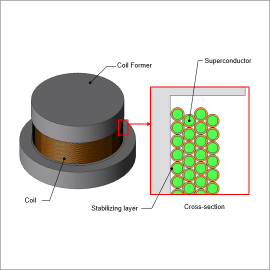
Magnetic Resonance Imaging (MRI) requires a highly consistent and stable magnetic fields. However, NbTi, Nb3Sn, and other low-temperature superconducting magnets come with the risk of unforeseen quenching due to the low thermal stability of liquid helium cooling.
A no-insulation structure is one solution to this issue that has been gaining traction. The electrical contact between turns can reroute the current to a neighboring turn when localized quenching occurs to prevent the damage caused by overheating. Although it does reduce the risk of quenching, no-insulation structures can also cause instability in the charging behavior or magnetic field characteristics. That is why it is critical to run precise analyses during the design stage.
In this example, an NbTi superconducting magnet for an MRI machine that has a no-insulation structure that has a stabilizing layer with contact between turns and an insulation structure that does not have contact. The results verify the phenomenon that causes a delay in charging when the current flows between turns.
A no-insulation structure is one solution to this issue that has been gaining traction. The electrical contact between turns can reroute the current to a neighboring turn when localized quenching occurs to prevent the damage caused by overheating. Although it does reduce the risk of quenching, no-insulation structures can also cause instability in the charging behavior or magnetic field characteristics. That is why it is critical to run precise analyses during the design stage.
In this example, an NbTi superconducting magnet for an MRI machine that has a no-insulation structure that has a stabilizing layer with contact between turns and an insulation structure that does not have contact. The results verify the phenomenon that causes a delay in charging when the current flows between turns.
Voltage Characteristics
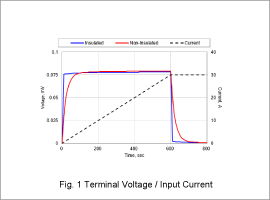
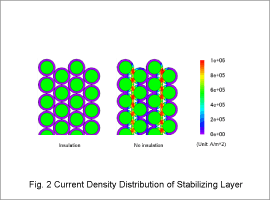
Fig. 1 outlines the terminal voltage and input current for the coil with insulation and the coil without insulation. Fig. 2 illustrates the current density distribution of the stability layers of both coils after 600 seconds.
The coil without insulation in Fig. 1 has more of a charging delay than the coil with insulation. The coil with insulation in Fig. 2 has no current flowing in the stabilizing layer, while the coil without insulation has current flowing between the turns. The coil without insulation has a relatively longer delay in producing the magnetic field because current flows in multiple directions.