*Please prepare a license ID and password for the license administrator.
*It is different from the service for JMAG WEB MEMBER (free membership). Please be careful.
Overview
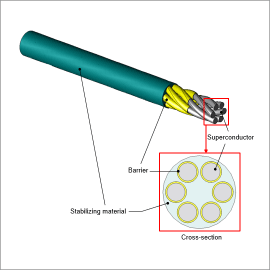
NbTi superconducting cables are a practical conductor used in Magnetic Resonance Imagining (MRI), accelerators, and other basic devices.
However, external magnetic fields or operating conditions using alternating current can lower superconductivity and increase the AC losses. That is why it is critical to run precise analyses during the design stage.
Design elements from the twisted-stack structure and pitch to the barrier material greatly affect the losses. Evaluations at an early stage of the design process using analytical analysis are key to reducing costs and the development timeline as well as optimizing designs.
This case study evaluates the AC losses of a straight-stack and twisted-stack NbTi cable to verify how the different cable structures affect the size and mechanisms of the losses.
However, external magnetic fields or operating conditions using alternating current can lower superconductivity and increase the AC losses. That is why it is critical to run precise analyses during the design stage.
Design elements from the twisted-stack structure and pitch to the barrier material greatly affect the losses. Evaluations at an early stage of the design process using analytical analysis are key to reducing costs and the development timeline as well as optimizing designs.
This case study evaluates the AC losses of a straight-stack and twisted-stack NbTi cable to verify how the different cable structures affect the size and mechanisms of the losses.
Losses in the Superconductors
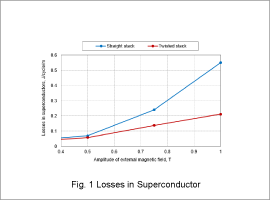
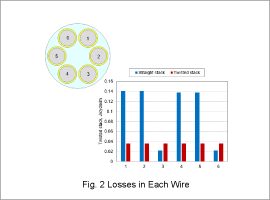
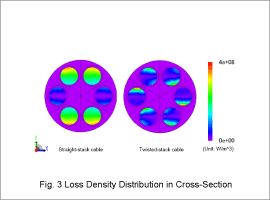
Fig. 1 outlines the losses of the straight-stack and twisted-stack superconducting cables for each external field. Fig 2 indicates the average losses over one full period for each cable under a 50 Hz external field. Fig. 2 indicates the average loss density distribution in the cross-section over one full period for each cable under a 50 Hz external field.
As shown by Fig. 1, the twisted-stack cable has lower losses than the straight-stack cable under every external field.
As illustrated by Fig. 2 and Fig. 3, the straight-stack cable has a loss density with significant bias, while the twisted-stack cable has a lower loss density with less bias. These results indicate that the twisted-stack cable better mitigates losses.