
Ryota Otaki
Electric PT Development Section, Powertrain Development Center,
YAMAHA MOTOR CO., LTD.
Abstract
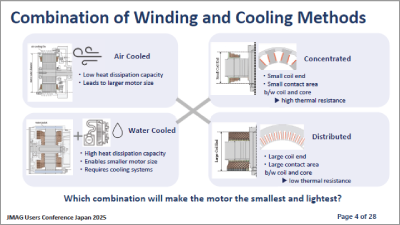
In commercially available electric motorcycles, there is a notable shift in the cooling method, moving from air cooling to water cooling, and in the winding method, moving from concentrated winding to distributed winding, as the output increases. This shift occurs around 8 to 10 kW. However, there is a paucity of empirical investigations examining these combinations to ascertain their optimality.
In order to verify this trend, a verification model utilizing 1D thermal analysis has been constructed which allows for the comparison of the capacity and weight of the motor and cooling system according to the vehicle’s required output and thermal performance. This model reproduces the thermal resistance of each part of the motor, as well as cooling by the radiator and traveling wind, using JMAG’s thermal network, allowing comparison of differences in transient temperature rise according to the motor’s size, weight, and generated losses. A comparison and verification of the combinations of winding methods (concentrated winding or segment conductor distribution winding) and cooling systems (water-cooled or air-cooled) was conducted using the model that had been constructed.
In the motor designed for this study, when the maximum output of the vehicle was 35 kW or less (European A2 license), the total volume of the motor and cooling system was found to be the smallest for the air-cooled concentrated winding motor. However, in the 15 kW and above range, it was found that the volume of the water-cooled Segment conductor (SC) winding motor, including the cooling system (radiator, hoses, pump, reservoir tank, cooling water), was approximately 110% of the air-cooled concentrated winding motor, and the weight was approximately 65% or less. In this study, we used a SC winding motor as a type of distributed winding motor for verification. The characteristics of distributed winding motors include a large number of slots that provide a large contact area with the winding and high heat dissipation. These characteristics are the same regardless of the type of winding. Therefore, these findings are generally consistent with the observed trend of an increasing adoption of water-cooled distributed-winding motors in commercially available electric vehicles (EVs) with a power rating of approximately 10 kW.
You need to sign in as a Regular JMAG Software User (paid user) or JMAG WEB MEMBER (free membership).
By registering as a JMAG WEB MEMBER, you can browse technical materials and other member-only contents for free.
If you are not registered, click the “Create an Account” button.
Create an Account Sign in