


New JMAG Ver.25.2 Out Now
We are pleased to announce the release of JMAG-Designer Ver.25.2 in October 2026.
JMAG is being developed towards design automation. To this end, Ver. 25.2 enhances functions in six areas: Fast global exploration, Multi-disciplinary evaluation, Open to designers (JMAG-Express), System integration, Fast solvers, and Materials and Applications.
Here, we introduce some of the functional improvements and new features in Ver.25.2.
Key Highlights of Ver.25.2
Fast global exploration
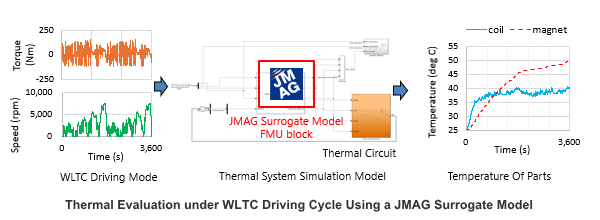
For optimization, the pole-slot combination and dimension parameters can now be optimized simultaneously. This gives a better Pareto front than optimizing each pole-slot combination separately with an equivalent number of calculation cases. The automatic constraint algorithm has also been improved, so a wide design space can be explored without breaking even complex geometries. With the new Through Point Spline, you can create smooth shapes intuitively just by moving the points. Using the point coordinates as design variables also enables a wide range of shape exploration. JobSystem supports the massive-case calculations in these optimizations, and its distributed execution on Windows is now more stable. FMI support for JMAG surrogate models makes it easier to connect to MILS/HILS platforms. We are also releasing JMAG-SBO, a new tool for quick optimization using surrogate models.
Multi-disciplinary evaluation
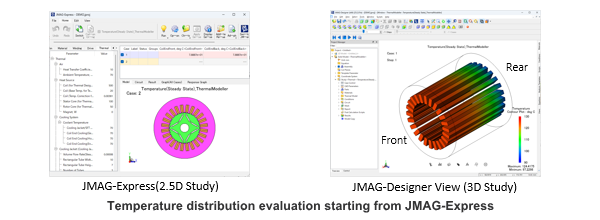
Motor thermal design functions have been further enhanced. Thermal model results can now be displayed on the motor view, so you can check part temperatures and temperature differences between parts at a glance. In JMAG-Express, a 2.5D study for thermal analysis can be converted to a 3D study with one click. This makes it easy to evaluate temperature distributions from spray cooling and similar methods. The coolant flow rate can depend on time or rotation speed, so flow rate control can follow the drive cycle. For EESM, JMAG now supports N-T curve and efficiency map calculation considering field coil temperature constraints, as well as drive cycle evaluation.
System integration
File I/O during RTT file generation in JMAG-RT has been reduced and made asynchronous. As a result, generation time on many cores is 17% shorter than in Ver. 25.1.
Fast solvers
The iterative solver improved in Ver. 25.1 now uses MPP. As a result, large-scale simulations such as coil-end AC losses and eddy current losses in the laminated core can be evaluated in a practical time.
Materials and Applications
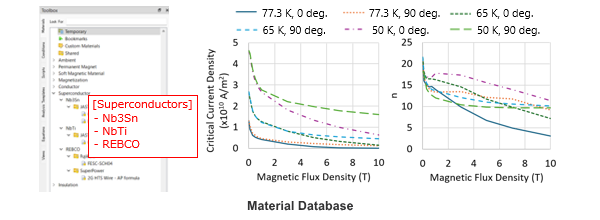
Superconducting materials from SuperPower(Furukawa Electric), Fujikura, and JASTEC are now built into the material database as standard. You can verify design ideas instantly, even without your own material data. Meshing for multi-layer twisted structures such as VIPER conductors is also simpler. In addition, an impedance probe works like an LCR meter: it obtains electrical characteristics such as impedance, equivalent circuit parameters, and quality factor over a wide frequency band, supporting the design of high-frequency devices.
JMAG+AI
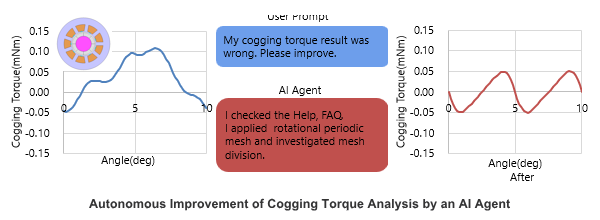
As part of the JMAG+AI initiative, we are newly providing JMAG Agent Skills (available only through individual distribution). With these skills, AI agents such as Claude Code or Codex can autonomously operate JMAG and support users' analysis workflow toward design automation. In addition, over 100 script examples are publicly available in the Script Library as a knowledge source for AI.
For a comprehensive list of features and technical details, please visit our official release page:
Please feel free to forward this e-mail to your colleagues.
- Learning How to Use JMAG
Are you interested in JMAG, but don’t know where to start? Want to find out more?
"Learning how to use JMAG" is an introductory guide that will take you through a step-by-step process on how to start and use JMAG for the first time.