
In October 2026, we released JMAG-Designer Ver. 25.2.
JMAG is being developed towards design automation. To this end, Ver. 25.2 enhances functions in six areas: Fast global exploration, Multi-disciplinary evaluation, Open to designers (JMAG-Express), System integration, Fast solvers, and Materials and Applications. This document introduces the improved and newly added functions in Ver. 25.2 and highlights several of them.
- Fast global exploration
For optimization, the pole-slot combination and dimension parameters can now be optimized simultaneously. This gives a better Pareto front than optimizing each pole-slot combination separately with an equivalent number of calculation cases. The automatic constraint algorithm has also been improved, so a wide design space can be explored without breaking even complex geometries. With the new Through Point Spline, you can create smooth shapes intuitively just by moving the points. Using the point coordinates as design variables also enables a wide range of shape exploration. JobSystem supports the massive-case calculations in these optimizations, and its distributed execution on Windows is now more stable. FMI support for JMAG surrogate models makes it easier to connect to MILS/HILS platforms. We are also releasing JMAG-SBO, a new tool for quick optimization using surrogate models. - Multi-disciplinary evaluation
Motor thermal design functions have been further enhanced. Thermal model results can now be displayed on the motor view, so you can check part temperatures and temperature differences between parts at a glance. In JMAG-Express, a 2.5D study for thermal analysis can be converted to a 3D study with one click. This makes it easy to evaluate temperature distributions from spray cooling and similar methods. The coolant flow rate can depend on time or rotation speed, so flow rate control can follow the drive cycle. For EESM, JMAG now supports N-T curve and efficiency map calculation considering field coil temperature constraints, as well as drive cycle evaluation. - System integration
File I/O during RTT file generation in JMAG-RT has been reduced and made asynchronous. As a result, generation time on many cores is 17% shorter than in Ver. 25.1. - Fast solvers
The iterative solver improved in Ver. 25.1 now uses MPP. As a result, large-scale simulations such as coil-end AC losses and eddy current losses in the laminated core can be evaluated in a practical time. - Materials and Applications
Superconducting materials from SuperPower(Furukawa Electric), Fujikura, and JASTEC are now built into the material database as standard. You can verify design ideas instantly, even without your own material data. Meshing for multi-layer twisted structures such as VIPER conductors is also simpler. In addition, an impedance probe works like an LCR meter: it obtains electrical characteristics such as impedance, equivalent circuit parameters, and quality factor over a wide frequency band, supporting the design of high-frequency devices. - JMAG+AI
As part of the JMAG+AI initiative, we are newly providing JMAG Agent Skills (available only through individual distribution). With these skills, AI agents such as Claude Code or Codex can autonomously operate JMAG and support users' analysis workflow toward design automation. In addition, over 100 script examples are publicly available in the Script Library as a knowledge source for AI.
Many other improvements and new functions have also been added, including showing where variables and equations are used, adding material data to the material database, and expanding supported CAD versions. We hope you will make full use of the new JMAG.
What is JMAG-Designer Ver.25.2 ?
INDEX
- Leveraging Surrogate Models
- Enhanced Geometric Flexibility in Optimization Calculations
- Improved Stability for Multi-Case and Optimization Calculations
- Visualization of Motor Temperature Distribution
- Efficiency Map of an Electrically Excited Synchronous Motor (EESM)
- Update Superconductor’s Analysis
- JMAG+AI
1. Leveraging Surrogate Models
Quick optimization with surrogate models is available.
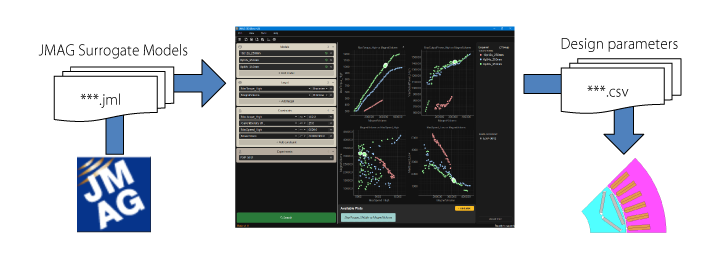 Optimization using JMAG-SBO
Optimization is performed to minimize magnet volume and maximize torque with three types of motor surrogate models. Based on the results for each motor, the design parameters which satisfy the requirements are exported to csv files. Further characteristics such as torque ripple can be evaluated in JMAG-Designer after importing the csv files.
Connect JMAG surrogate models to various MILS/HILS platforms through FMI.
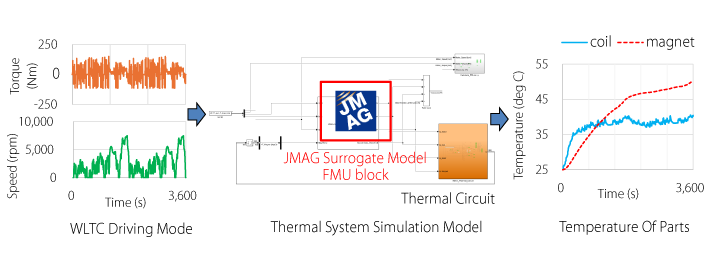 Thermal Evaluation under WLTC Driving Cycle Using a JMAG Surrogate Model
Motor loss data is exported as an FMU base JMAG surrogate model and coupled with a thermal network in MATLAB/Simulink to evaluate parts temperature over the WLTC driving cycle.
2. Enhanced Geometric Flexibility in Optimization Calculations
Automatically generates robust and highly flexible dimensional constraints for complex geometries.
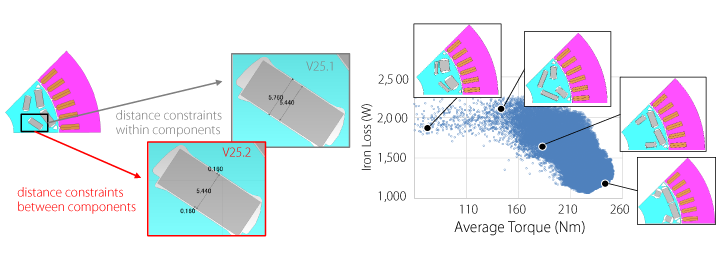 Automatic constraint improvement examples and optimization results
The improved automatic constraint algorithm automatically generates distance constraints not only within components but also between components, making geometries more robust. Optimization of the auto-constrained geometry for torque maximization and iron loss minimization resulted in diverse shapes, demonstrating broad design space exploration.
Create smooth shapes easily and use them in optimization.
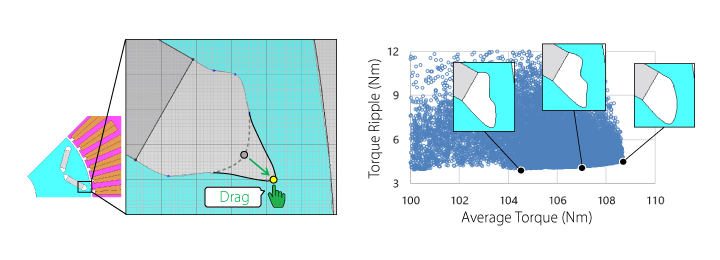 Flux barrier created with the Through Point Spline and its optimization results
The left figure shows a flux barrier outline created with the Through Point Spline; the shape follows as the points move, enabling the creation of a smooth geometry. The right figure shows the optimization result with the point coordinates as design variables. The three shapes picked up lie on the Pareto front and vary widely while staying smooth, indicating a broad shape exploration.
3. Improved Stability for Multi-Case and Optimization Calculations
Reduces the calculation interruption risk through issue detection and auto-recovery.
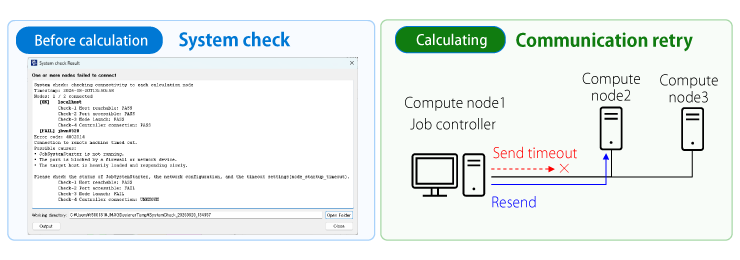 System check and communication retry
Connection issues can be detected by the system check function before calculation. The communication retry function reduces the risk of calculation interruptions caused by temporary communication failures, enabling the stable execution of long-running calculations.
4. Visualization of Motor Temperature Distribution
Visualize part temperatures and temperature differences on the motor view.
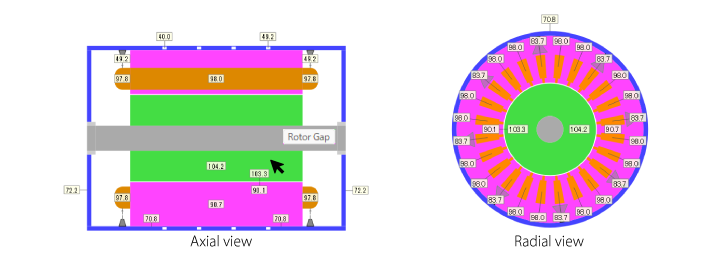 Motor view and temperatures of each part
The part temperatures with jacket cooling and spray cooling are shown. Looking at the air gap in the axial view, the rotor side is about 10 deg C hotter, indicating that shaft cooling should be considered for further improvement. In the radial view, the coils to which the spray(indicated by triangles) is applied, show lower temperatures.
Easily evaluate temperature distribution starting from JMAG-Express.
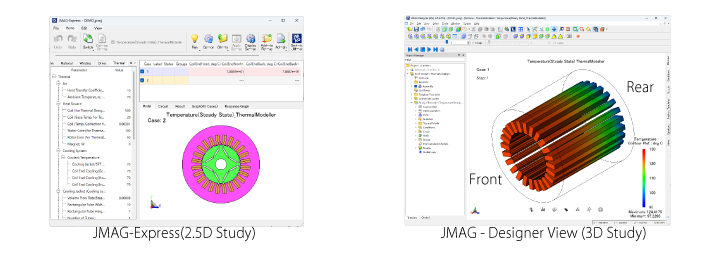 Temperature distribution evaluation starting from JMAG-Express
Build the model in JMAG-Express, convert the 2.5D study to a 3D study with one click. Run the analysis to obtain the temperature distribution. In this example, only the rear coil end is spray-cooled, resulting in an axial temperature distribution in the coils. This can also be done directly in JMAG-Designer.
5. Efficiency Map of an Electrically Excited Synchronous Motor (EESM)
Fast evaluation of EESM performance under thermal constraints.
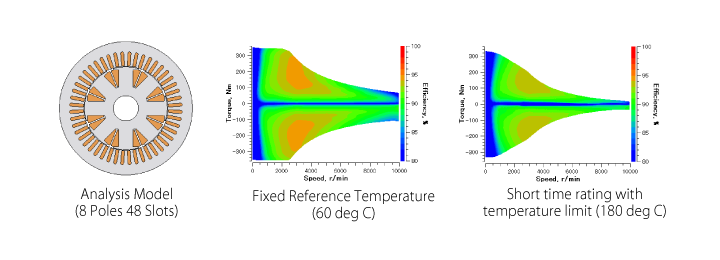 N-T and Efficiency Map Calculation Considering Temperature Constraints
JMAG visualizes the operating region reaching the temperature limit (180 deg C) of the field and armature coils under a 3 min short-time duty rating. This allows users to evaluate the achievable N-T characteristics and efficiency distribution under thermal constraints. The calculation time was 57 min using a 10 cores PC.
Fast evaluation of EESM temperature history over drive cycles.
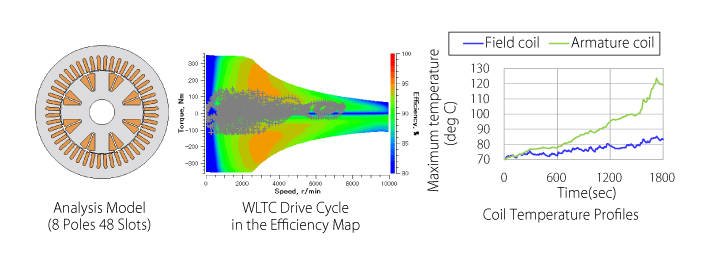 Coil Temperature Profiles During the WLTC Driving Cycle
Multiple cooling systems (spray, cooling jacket, and hollow shaft cooling) were applied to the motor. With an initial temperature of 70 (deg C), the peak temperatures of the armature winding and field winding were below 130 (deg C) and 85 (deg C), respectively. The calculation time was 7 min using a 10 cores PC.
6. Update Superconductor’s Analysis
Verify design ideas instantly, even without your own material data.
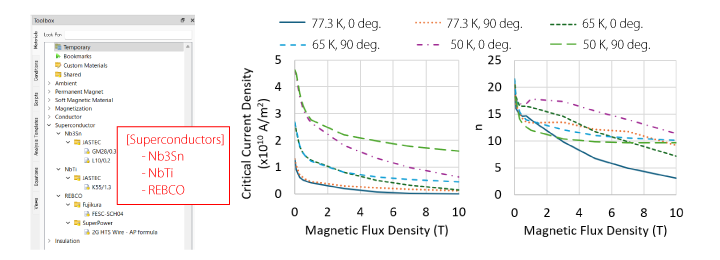 Material Database
The built-in material database contains properties (critical current density and n-value) from major manufacturers, accounting for temperature and magnetic field angle (deg.) dependencies.
Simplify meshing for multi-layer twisted structures like VIPER conductors.
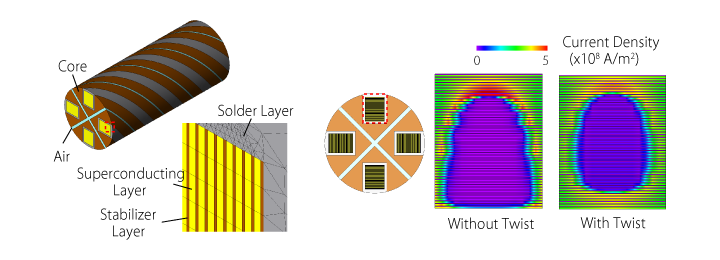 Current Distribution Analysis of a VIPER Conductor
Comparison of current distribution in a multi-layer tape superconducting cable with and without twist. The twist reduces the proximity effect and distributes current to the superconducting layers near the center of the conductor.
7. JMAG+AI
Publicly available Script Library accelerate JMAG automation.
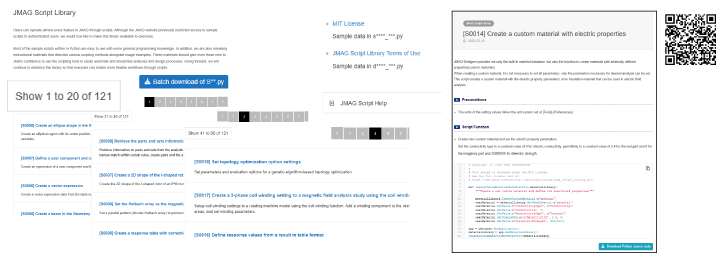 JMAG Script Library
Over 100 examples covering a wide range of JMAG operations and API reference are now available. Each example includes an overview and preconditions alongside the source code to be easily understood by both humans and AI. The source codes are available for batch download.
AI agents autonomously operate JMAG to support users’ analysis workflow.
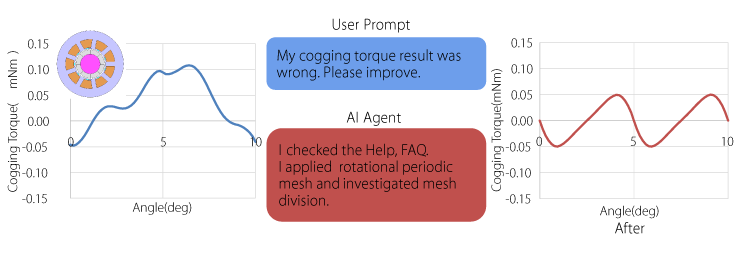 Autonomous Improvement of Cogging Torque Analysis by an AI Agent
An example of improving the cogging torque waveform of an 8 poles, 9 slots motor. Using JMAG Agent Skills, the AI agent autonomously identified the issue,selected the appropriate functions, and adjusted the mesh to improve analysis accuracy.
The new functions and Features
For details, please see the following function introduction. (PDF, 2.98 MB: User authentication)
Introducing New Functions of JMAG-Designer Ver. 25.2
Documents
These are created using the functions in JMAG-Designer Ver.25.2 and later. Please feel free to use them.
Fast Global Exploration
Multi-disciplinary Evaluation
- [JFT217] Motor Thermal Analysis Model Configuration Using the Thermal Modeling Feature
- [JFT221] Evaluation of Temperature Distributions Based on 2.5D Studies for Thermal Analysis
- [JAC305] Loss Analysis of IPM Motor During Driving Cycle Considering Temperature Variation
- [JAC326] Drive Cycle Loss Analysis of a Wound-field Synchronous Motor Accounting for Temperature Variations
- [JAC327] Efficiency Map Creation for a Wound-field Synchronous Motor Accounting for Continuous Operation
Application
- [JAC325] Current Distribution Analysis of HTS Assembled Conductors for Fusion Applications
- [JAC311] Analysis of Impedance-Frequency of Chopper Inductors
- [JAC312] Impedance Analysis of a Transformer for an LLC Resonant Converter
Module Download
The latest version of JMAG modules are available.
In addition, version information, release notes, manuals, etc. can be used. ( User authentication)
Update to LM-X license server 5.5.11 or later when using JMAG-Designer Version 24.0 or later.
Click here for more information on LM-X License Server Installer and License Update Manual ( User authentication)
Introducing JMAG-Designer Ver.17.0 – Ver.25.2
Articles about JMAG-Designer that have been released previously are available.- JMAG-Designer Ver.25.0 / Ver.25.1 / Ver.25.2
- JMAG-Designer Ver.24.0 / Ver.24.1 / Ver.24.2
- JMAG-Designer Ver.23.0 / Ver.23.1 / Ver.23.2
- JMAG-Designer Ver.22.0 / Ver.22.1 / Ver.22.2
- JMAG-Designer Ver.21.0 / Ver.21.1 / Ver.21.2
- JMAG-Designer Ver.20.0 / Ver.20.1 / Ver.20.2
- JMAG-Designer Ver.19.0 / Ver.19.1
- JMAG-Designer Ver.18.0 / Ver.18.1
- JMAG-Designer Ver.17.0 / Ver.17.1