
Overview
Motor development must pursue a wide range of performance and other requirements from greater miniaturization, higher efficiency and heat management to reductions in costs and lead times. High-speed analyses and evaluations of the entire drive system are necessary to satisfy each and every requirement. However, conventional design processes force cooling system designers to assess the cooling system after motor designers decide on the magnetic circuit. Only then can vehicle system designers run thermal analyses, which leads to rework and inefficiency. It is essential for the motor design to take into account the temperature of each motor part during the drive cycle.
JMAG easily configures thermal analysis models by incorporating motor cases, cooling systems, and other parts into the equivalent thermal circuit. These models achieve system-wide simulations that can predict temperature rises of parts in the motor design to anticipate drops in performance and appropriate cooling design.
This case study simulates the temperature changes over time in a nabla-shaped IPM motor during the WLTC drive cycle while varying the coolant flow rate. Analyses of three different patterns showed a greater drop in the part temperatures as the coolant flow rate becomes faster. The evaluation also examines a cooling system suitable for the usage conditions as well as a magnetic circuit that can reduce the losses based on these results.
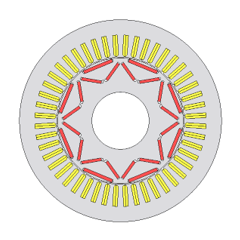
IPM Motor
Cooling Specifications
| Cooling system | Cooling jacket, hollow shaft cooling, and spray cooling of coil ends |
| Coolant | Oil |
| Flow rate | 0.5, 2.0, and 10.0 L/min |
Fig. 1 IPM Motor and Cooling Specifications
The simulation analyzes tempeature variations in the coil and magnets during the drive cycle of an nabla-shaped IPM motor with 8 poles and 48 slots. The cooling system utilizes a cooling jacket and hollow shaft cooling combined with spray cooling for the coil ends.
You need to sign in as a Regular JMAG Software User (paid user) or JMAG WEB MEMBER (free membership).
By registering as a JMAG WEB MEMBER, you can browse technical materials and other member-only contents for free.
If you are not registered, click the “Create an Account” button.
Create an Account Sign in