
Overview
A broad range of fields are advancing the development and practical use of superconducting coils to reduce size and weight as well as increase the efficiency of various machines from nuclear fusion and MRI to power cables and maglev trains. Quenching is one major obstacle to the practical applications of superconducting machines, which happens when a section of coil transitions from a zero-resistance to normal-conducting state. That is why simulations to accurately predict the quenching behavior that can damage superconducting machines is vital.
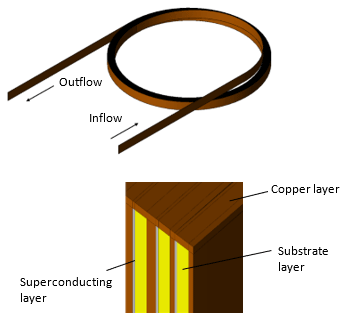
This case study runs an overcurrent analysis of a no-insulation pancake coil that uses rare-earth barium copper oxide (REBCO) tape as a high-temperature superconductor to predict quenching behavior. The results pinpoint sections of coil that experience a temperature rise due to quenching and verify the current branching from the superconductor to copper layer to avoid those sections of coil.
| Inner diameter | 60 mm |
| Outer diameter | 66 mm |
| Turns | 3 |
| Tape width | 4 mm |
| Thickness of copper layer | 20 μm |
| Thickness of substrate layer | 50 μm |
| Thickness of superconducting layer |
10 μm |
| n value | 29 |
Fig. 1 No-insulation Pancake Coil Model
The top left is a full view of the no-insulation pancake coil model with REBCO tape.
The bottom left illustrates the coil cross-section. The right table provides the coil specifications.
You need to sign in as a Regular JMAG Software User (paid user) or JMAG WEB MEMBER (free membership).
By registering as a JMAG WEB MEMBER, you can browse technical materials and other member-only contents for free.
If you are not registered, click the “Create an Account” button.
Create an Account Sign in