
Overview
Medical, transport, energy, and a wide-range of other fields are optimistic about applications for high-temperature superconductors that can realize superconductivity at liquid nitrogen temperatures. Unfortunately, prototypes of superconducting machines to verify performance are not only costly but also require time and come with the risk of quenching and structural damage. That is why the use of simulations is critical when evaluating designs.
Rare-Earth Barium Copper Oxide (REBCO) tape wire offers critical current density with a particularly high critical temperature compared to other high-temperature conductors for use in Tokamak fusion reactors and other such machines. However, REBCO tape does have critical current density characteristics that vary with the magnetic flux density and temperature. Simulations cannot ignore this anisotropy.
This case study compares the critical current density distributions of CORC cable formed by helically winding REBCO tape around a core obtained through simulations with and without the anisotropy of the magnetic flux density. The results demonstrate the importance of precisely modeling anisotropic materials to accurately reproduce the actual phenomenon.
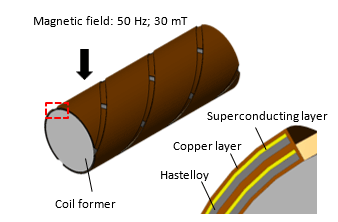
| Coil former diameter | 6.3 mm |
| Pitch | 19 mm |
| Coil layers | 2 |
| Tape sheets per coil layer | 3 |
| Tape width | 4.0 mm |
| Superconducting layer thickness |
20 μm |
Fig. 1 CORC Cable Model
A full view of the CORC cable model is on the top left and an enlarged view of the cross-section on the bottom right. The table on the right outlines the cable model specifications. The critical current density takes into account characteristics influenced by the amplitude of the magnetic flux density and angle from the fundamental axis to account for the anisotropic magnetic field.
You need to sign in as a Regular JMAG Software User (paid user) or JMAG WEB MEMBER (free membership).
By registering as a JMAG WEB MEMBER, you can browse technical materials and other member-only contents for free.
If you are not registered, click the “Create an Account” button.
Create an Account Sign in