
Taha El Hajji, Lars Sjöberg
Alvier Mechatronics AB
Helsingborg, Sweden
Contents
Abstract
Index Terms
Ⅰ. INTRODUCTION
Ⅱ. SMC MATERIAL BACKGROUND
A. Material Evolution
B. Material Comparison
Ⅲ. MOTOR DESIGN AND MODELING SETUP
A. Motor Topology
B. FEA Methodology and Control Strategy
Ⅳ. ELECTROMAGNETIC PERFORMANCE COMPARISON
A. Back EMF (No Load)
B. Efficiency Map
C. Summary
Ⅴ. CONCLUSION
REFERENCES
Abstract
The relentless push for higher power density and efficiency in electric vehicle traction has driven the rapid adoption of axial flux permanent magnet motors. Soft Magnetic Composites (SMCs) are uniquely suited for these topologies due to their isotropic magnetic properties and ability to realize complex three-dimensional flux paths. This paper presents an investigation into the new-generation SMC material: Somaloy 700 7P. A comprehensive finite element analysis is conducted on a 150 kW dual-rotor, single-stator axial flux motor to benchmark the new 7P material against its predecessors, Somaloy 700HR 3P and Somaloy 700HR 5P. While low-speed torque characteristics remain identical due to equivalent magnetic saturation limits, the advanced coating and annealing process of the 7P grade drastically reduces high-frequency eddy current losses. The results demonstrate that the motor equipped with the 7P material achieves superior high-speed efficiency, and an elevated active power density, cementing its role as a key enabler for next-generation high-performance e-mobility applications.
Index Terms
SMC, Somaloy 700 7P, axial flux motor, efficiency map, CPSR, power density
Ⅰ. INTRODUCTION
The rapid acceleration of transport electrification, driven by the global push for decarbonization, has placed unprecedented demands on electric machine technology. To meet the stringent requirements for efficiency, high power density, and cost-effectiveness in modern electric vehicles and aircraft, engineers are increasingly turning to advanced materials and novel magnetic core topologies. Axial flux permanent magnet (AFPM) motors have emerged as a premier choice, offering substantial improvements in torque density and compact packaging.
For the stator core of these AFPM machines, Soft Magnetic Composites (SMCs) have proven to be exceptionally ad-vantageous. Manufactured via powder metallurgy, SMCs consist of high-purity iron particles individually coated with an insulating layer and compacted into net-shape components. This structure provides unparalleled isotropic magnetic properties, allowing for the creation of complex, three-dimensional flux paths that are virtually impossible to achieve otherwise. Furthermore, the inherent particle-level insulation naturally suppresses eddy currents, making SMC materials highly resilient to the elevated operational frequencies common in modern high-speed traction motors.
Since the past decade in which SMC has shown its application in axial flux motors for automotive application, there have been continuous improvements of the performance boundaries of SMC-based motors, material formulation and processing techniques. We evaluate the electromagnetic capabilities of the Somaloy 700 7P against the established Somaloy 700HR 3P and Somaloy 700HR 5P. Support for the newly introduced Somaloy 700 7P will be officially included in the JMAG version 26.0 material database for electromagnetic simulations. The benchmark is conducted on material-level and system-level performances for an electric motor dedicated for automotive traction.
Ⅱ. SMC MATERIAL BACKGROUND
The evolution of SMC has historically been defined by a fundamental trade-off between magnetic permeability and high-frequency core losses and mechanical strength.
A. Material Evolution
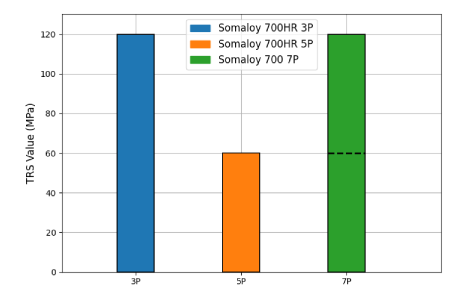
Somaloy 700HR 3P: This grade utilizes a steam-atmosphere heat treatment that forms a magnetic oxide network between particles. This yields excellent mechanical strength, achieving a Transverse Rupture Strength (TRS) of 120 MPa, alongside a high maximum permeability of 770. However, the particle-to-particle oxide connections allow for larger local eddy current paths, leading to higher core losses at elevated electrical frequencies (e.g., 45 W/kg at 400 Hz and 1 T).
Somaloy 700HR 5P: To cater to the high-frequency requirements of electric vehicle traction, the 5P grade was introduced. It leverages a specialized coating and a high-temperature nitrogen annealing process. This treatment maintains strict electrical isolation between the iron particles, drastically minimizing the eddy current loss component down to 30 W/kg at 400 Hz and 1 T. The trade-off is a measurable reduction in maximum permeability (dropping to 600) and physical strength (TRS of 60 MPa) compared to the 3P grade.
Somaloy 700 7P: In the latest advancement, a new coating formulation alongside optimized compaction and advanced annealing processes is applied to the 7P material. This allows achieving low eddy current loss (29 W/kg at 400 Hz and 1 T) while recovering a high physical strength (up to 120 MPa) with a slight reduction in permeability (500). The parameters and B-H curves for the Somaloy 7P material model referenced in this study are natively supported beginning with JMAG version 26.0, allowing engineers to assign this material directly from the software’s built-in library.
B. Material Comparison
For a fair comparison, the same density (7.5 g/cm³) is considered for the three grades. Because the saturation flux density depends purely on the compacted volumetric density, the performance comparison focuses strictly on permeability and core losses.
Fig. 1 summarizes the benchmark of the three grades across three distinct axes: Maximum Permeability, Low Loss Score, and Transverse Rupture Strength (TRS). The 7P material envelops the best traits of its predecessors especially when considering its use in the stator since the TRS is of less interest. The BH curve, the relative permeability, the losses, and the TRS of the three grades are represented in Fig. 2a, Fig. 2b, Fig. 2c, and Fig. 2d, respectively.
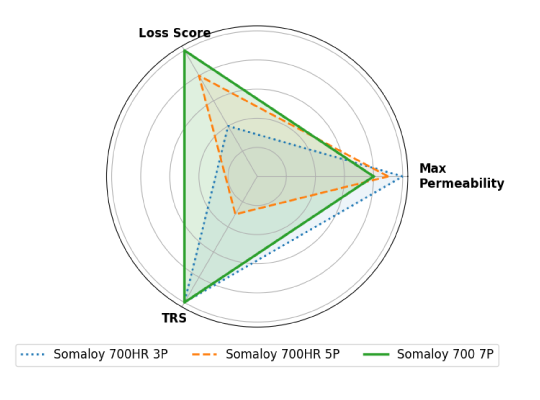 Fig. 1: Radar chart comparing relative properties of Somaloy 700HR 3P, 700HR 5P, and 700 7P at a density of 7.5 g/cm3
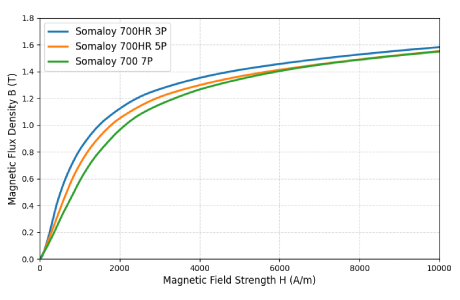 (a) BH curves
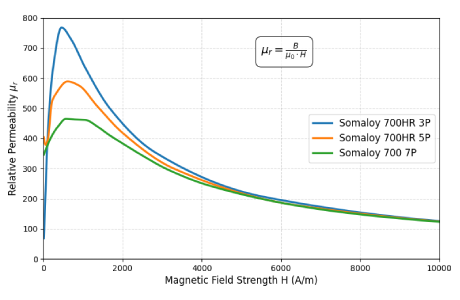 (b) Relative permeability
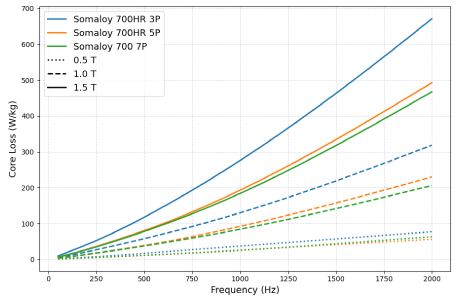 (c) Losses
 (d) TRS
Fig. 2: Magnetic and mechanical properties of the SMC Somaloy 700HR 3P, Somaloy 700HR 5P and Somaloy 7P
Ⅲ. MOTOR DESIGN AND MODELING SETUP
A. Motor Topology
The motor used for this investigation is the iDs Ax, an axial flux permanent magnet synchronous machine featuring a single-stator, dual-rotor configuration, analogous to the Yokeless And Segmented Armature (YASA) topology. The iDs Ax refers to Alvier Mechatronics AB’s internally developed motor, designed to meet the performance targets of the Volkswagen ID.3.
You need to sign in as a Regular JMAG Software User (paid user) or JMAG WEB MEMBER (free membership).
By registering as a JMAG WEB MEMBER, you can browse technical materials and other member-only contents for free.
If you are not registered, click the “Create an Account” button.
Create an Account Sign in
Related Documents
- Soft Magnetic Composite Application Examples – Single Sided Axial Flux Machines –
- Soft Magnetic Composite Application Examples – Double-Sided Axial Flux Machines –
- Somaloy®Soft Magnetic Composite (SMC) material for electromagnetic applications, by Höganäs AB (PDF:641KB)
- Alvier Mechatronics