The Endeavor of Innovative Research:
Breathing New Life into the Long History of Electric Machine Research
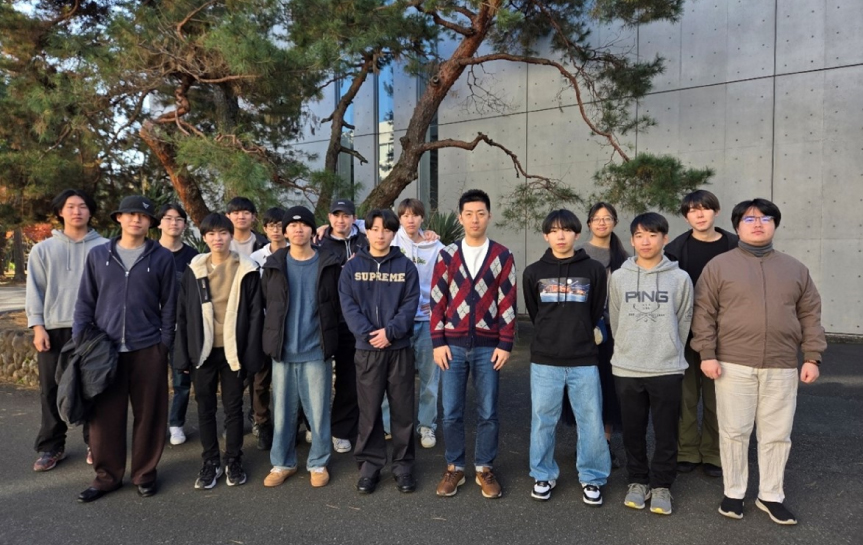
The Hane Research Laboratory is a new research wing launched in 2024.
Yoshiki Hane capitalized on the freedom that comes with launching a new laboratory to put in place an environment that encourages student ingenuity through a trial-and-error approach.
In this interview, we had the chance to discuss not only their current work but also research themes that aim to further enhance the efficiency of motors, transformers and other electric machines.
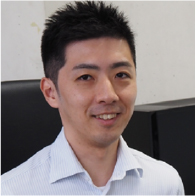
I joined Tohoku University as an assistant professor after graduating from the School of Engineering and earning Master’s and Doctorate there in March 2021. Throughout my time as a student and assistant professor, I was part of the Nakamura Lab run by Professor Kenji Nakamura. In April 2024, I made my way over to the Department of Electrical and Electronic Engineering at Toyo University before starting to teach and conduct research as an associate professor in April 2025. My research primarily focuses on iron loss analyses of electric machines.
Currently, rapid advancements from eco-friendly and energy-saving standpoints are driving forward solar power, wind power and other renewable energies as well as the electrification of drive systems demonstrated by the strong shift from gasoline to electric vehicles. My research lab strives to conduct research that responds to these social demands by enhancing the efficiency of motors, transformers and other electric machines as a way to help tackle environmental and energy issues.
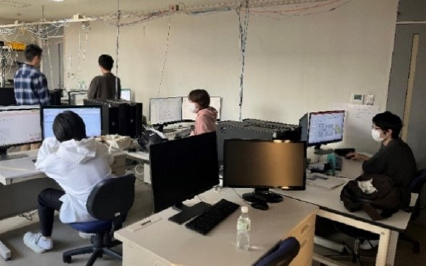
As of January 2026, my research lab has three graduate students (Master’s candidates) as well as twelve university students, made up of three juniors (assigned on a temporary basis) and nine seniors. Each student has their own desk and personal computer in a shared student office where they can work on their research projects. There is a separate faculty space, but I also have a desk in the student office, which is where I try to spend most of my time. Every day, I do my best to create an atmosphere accommodating effortless communication where these students can mix in some small talk while discussing their research with me.
Many of my students are researching the analysis and design of PM motors, SR motors, transformers and other machines using JMAG. I have students taking on research themes to advance and experiment with various analyses technologies as well. Since I launched my research laboratory in fiscal 2024, we are still in the process of developing much of the testing environment despite already having most of the computers, software and other analysis system already in place. While some equipment was simply set up, the students running experiments are developing testing systems from scratch. It wasn’t always easy, but the start of a lab offers a lot of freedom and room for innovation, which I think makes things more fun and motivating. I also hold weekly research roundtables. Each student presents the progress of their research about once every two weeks. These discussions leave time for other students to ask questions, which helps foster better understanding outside of one’s own research topic and cultivates better communication skills. I present the progress of my own research at the same pace as the students do too. I hope this helps them gain more specialized knowledge and improves their presentation skills.
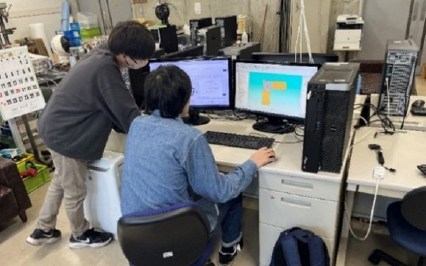
As I said, many of the students in my lab are using JMAG in their research. We use JMAG because of the comprehensive material database and wealth of features dedicated to motor analyses. It also provides a user-friendly platform that students can learn from. Another major benefit of JMAG when used as an educational tool is the ability to take advantage of the magnetic field analyses to teach everything from the basics to practical considerations of electric machine design. Let me provide a quick overview of some research case studies by students using JMAG.
1) Efficiency Map Evaluations Using Three-dimensional Analyses of Motors for Automotive Applications
This case study is the senior thesis of one of my students. The research created efficiency maps using three-dimensional analyses in JMAG to further drive the efficiency of motors in automotive applications. The case study utilized a radial gap IPM motor as a benchmark model to compare iron cores fabricated from non-oriented silicon steel sheet and soft magnetic composite. The evaluation verified that the non-oriented silicon steel sheet offered superior maximum torque and efficiency in the low-speed region, while a soft magnetic composite core provided higher efficiency in the high-speed region because of the low iron losses in the high-frequency domain. The next step will aim to develop a high-torque, high-efficiency motor by capitalize on unique geometric freedom of soft magnetic composite cores to devise a three-dimensional core design using 3D-CAD software.
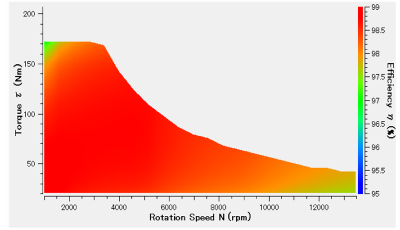 (a) Non-oriented silicon steel sheet
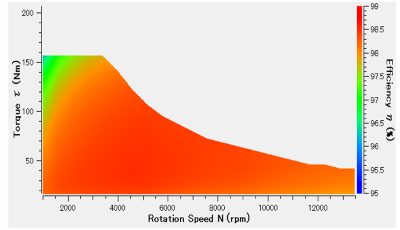 (b) Soft magnetic composite core
Fig. 1 Comparison of Efficiency Maps for Each Core Material
2) Large Capacity Power Transformer with a Step-lap Joint Structure
This case study is another senior thesis of one of my students. Large capacity power transformers typically take advantage of a step-lap joint structure that staggers and layers each electric steel sheet. This case study aims to reduce the vibrations and noise produced by the electromagnetic force and magnetostriction in the joints. This student is evaluating various structures through both JMAG analyses and tests on a small prototype. The case study will vary the gap length, distance of overlap, number of steps and several other parameters of the joint in an effort to establish guidelines for the ideal joint design.
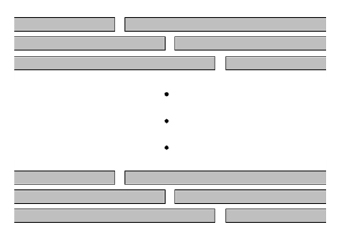 (a) Step-lap joint cross-section
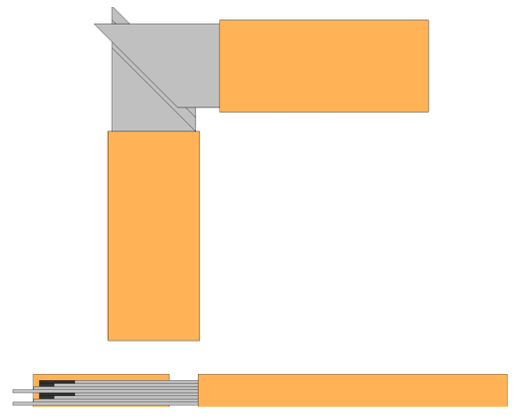 (b) Analysis model (1/4 model)
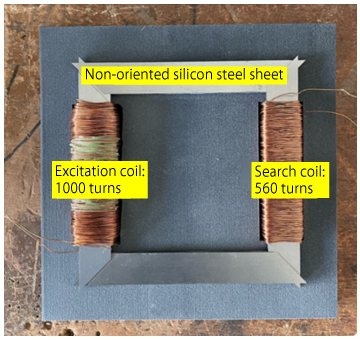
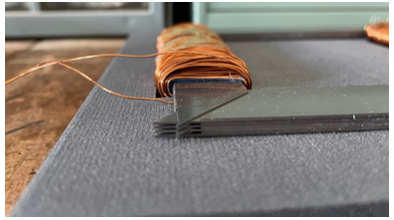 (c) Small prototype made by the student
Fig. 2 Large Capacity Power Transformer with a Step-lap Joint Structure
I would also like to introduce some of the successful research that I did at the Nakamura Lab at Tohoku University.
3) Development of a High-speed Analysis Method for Electric Machines
My research primarily focuses on developing high-speed analysis methods for electric machines using reluctance network analyses (RNA), which is a more sophisticated magnetic circuit method. My research is expanding the evaluations of designs by selects and runs finite element analysis (FEA) and RNA according to the purpose of an evaluation. JMAG not only validates RNA but also obtains any necessary reference data from high-fidelity simulations, such as three-dimensional magnetic field analyses and the behavior of non-linear materials.
RNA simulates the magnetic circuit network throughout the entire analysis model by connecting the reluctances and magnetomotive force components obtained from the dimensions of each part and the magnetic properties of the materials. While the finite element method runs analyses according to the division of mesh elements, RNA is unique because it can run high-speed analyses using simpler models. Moreover, this approach makes it simpler to run simulations that couple three-dimensional analyses, control systems and equations of motion. For example, the RNA can evaluate the model illustrated in Fig. 3(c) in just 15 seconds. By combining FEA and RNA in the right way, engineers can increase analysis efficiency and reliability.
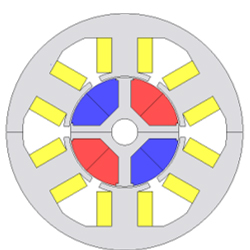 (a) PM motor exterior
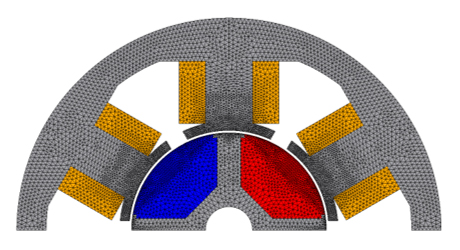 (b) JMAG mesh model
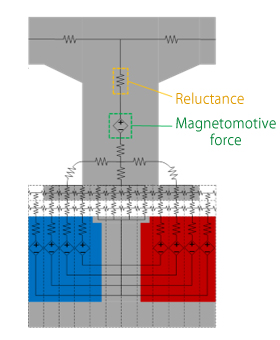 (c) Conventional RNA model (single pole)
Fig. 3 Analysis Models of the PM Motor
I have also proposed a method for a high-speed and high-accuracy RNA analysis of motor iron losses. To calculate iron losses with high precision, the analysis needs to model the complex electromagnetic phenomenon of magnetic hysteresis, the skin effect and anomalous losses as well as increase the number of time steps in order to take into account the carrier harmonics. Generally, iron loss analyses using the finite element method require time to directly run the calculations because these calculations are done during the post process of a magnetic field analysis. The practical approach that I am proposing can run direct calculations to obtain the iron losses in about 60 minutes. Moreover, this method has achieved high accuracy with an error rate between the analysis and measured results that is less than 10% across all evaluation points. My paper on the subject, Reluctance Network Model of IPM Motor Representing Dynamic Hysteresis Characteristics for High-Accuracy Iron Loss Calculation Considering Carrier Harmonics, received the MSJ Distinguished Paper Award from the Magnetic Society of Japan.
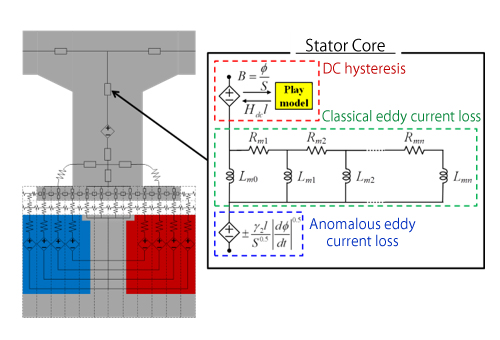
(a) Proposed RNA model (single pole)
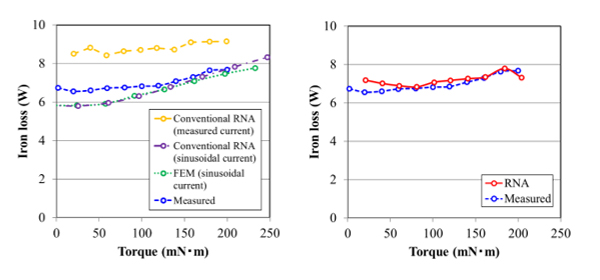 (b) Iron loss comparison of analysis and measured results
(Left: Conventional RNA & FEA; Right: Proposed RNA)
Fig. 4 RNA Model of a PM Motor for High-speed/High-accuracy Iron Loss Analysis
(*Measured results taken by the Nakamura Lab at Tohoku University)
Right now, I am most focused on research that aims to incorporate RNA into model-based development (MBD). MBD currently runs FEA for only the motor from the initial through high-fidelity design, and then runs a simulation using a plant model configured based on those results. My approach proposes the use of RNA to move forward with the initial motor design at the same time as the full system design. If successful, this method could drastically reduce the evaluation cycle during the research phase, enhance competitiveness though higher development efficiency and help create even better products. This research also has significant potential for cooperation with industry. I hope to actively engage in joint research with companies to establish a new design workflow that combines RNA and JMAG.
However, one current challenge is the roughly 60 minutes it takes to run RNA to obtain the iron losses with high accuracy. Although 60 minutes is viable for the initial design of the motor, RNA needs to run calculations even faster because it is still too long to incorporate into system-level simulations.
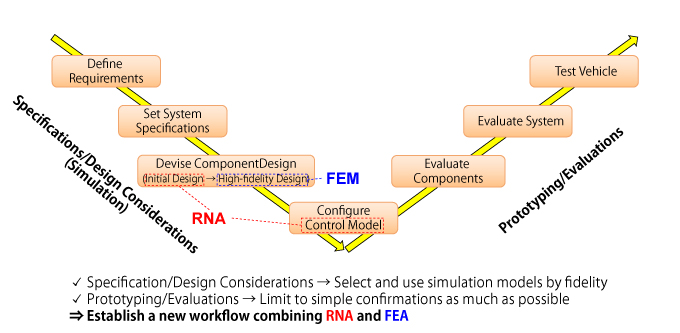
Fig. 5 New Design Workflow Combining RNA and FEA
Research into motors, transformers, and other electric machines is still actively underway despite having a roughly 200-year history. Even with daily advancements in this field, there are still many technical challenges to overcome. On the flip side of that, anyone who is jumping into research in the future also has a tremendous opportunity to inspire new ideas that can be shaped into something real. I hope everyone will persevere in innovative research that goes beyond convention to breathe new life in this field.
Interviewee
Associate Professor
Hane Lab Website:
https://www.toyo.ac.jp/nyushi/undergraduate/sce/deec/laboratory/hane/

You need to sign in as a Regular JMAG Software User (paid user) or JMAG WEB MEMBER (free membership).
By registering as a JMAG WEB MEMBER, you can browse technical materials and other member-only contents for free.
If you are not registered, click the “Create an Account” button.
Create an Account Sign in