Contents
1. Introduction
2. Challenges with the Conventional Method
3. Technology for Addressing the Problem
4. Test Cases
5. Test Results
5.1 Increase in the Number of Converged Cases
5.2 Reduction in Analysis Time
6. Performance Enhancement through Parallel Processing
7. Conclusion
8. References
1. Introduction
Applications such as AC loss analysis of electric motors, induction heating (IH), wireless power transfer, and superconducting analysis require the evaluation of eddy-current losses in coils. In JMAG, FEM conductor circuit elements are used to couple electric circuits with finite element analysis while accounting for eddy currents in the coils.
However, the use of FEM conductors can degrade the convergence of the ICCG iterative solver, potentially resulting in extremely long computation times or, in the worst case, preventing meaningful results from being obtained.
To overcome this challenge, a technique for improving the convergence of the iterative solver was proposed in previous research. In this study, the technique was evaluated using numerous practical application models, demonstrating dramatically improved convergence. Furthermore, by combining the technique with MPP parallel processing, substantial speedups were achieved for large-scale models.
2. Challenges with the Conventional Method
In electromagnetic finite element analysis (FEA) considering eddy currents, the A-φ formulation combined with the ICCG iterative solver is commonly used. This approach is referred to here as the conventional method.
When FEM conductors are included, however, the convergence of the ICCG solver may deteriorate significantly, leading to a dramatic increase in the number of iterations and, consequently, extremely long computation times. This issue becomes particularly pronounced when there are many finite elements between the inflow and outflow surfaces of an FEM conductor.
Figure 1 shows a simple cylindrical conductor. Assign FEM conductor to the conductor. Perform a frequency response analysis with current flowing in through one circular end and out through the opposite circular end. Set the power supply frequency to 30 kHz. Table 1 summarizes the number of ICCG iterations obtained using the conventional method. Even for this simple geometry, the number of ICCG iterations increases dramatically with the number of mesh layers between the inflow and outflow surfaces when an FEM conductor is used.
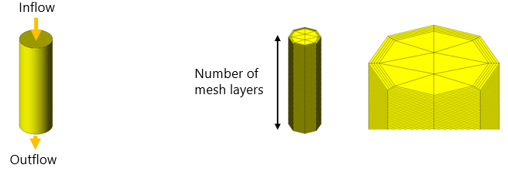 Fig.1 Cylindrical Conductor (Left: Model; Right: Mesh and Close-up of the Current Inlet Surface)
Table 1 Number of ICCG Iterations versus Mesh Layers between the Inflow and Outflow Surfaces
| Number of mesh layers | ||||
| 1 | 10 | 60 | 237 | |
| Number of ICCG iterations | 29 | 61 | 160 | 50,424 |
3. Technology for Addressing the Problem
Previous research proposed an improved preconditioning technique to enhance the convergence of the linear iterative solver. The technique applies different preconditioners to the matrix associated with the magnetic vector potential A and to those associated with the electric scalar potential φ and the electric circuit after FEA discretization. In particular, a stronger preconditioner than the conventional IC preconditioner is applied to the latter, significantly improving the convergence of the iterative solver. This approach is hereafter referred to as the proposed method.
Figure 2 shows the residual histories of the linear iterative solver as an example of the convergence improvement achieved by the proposed method. This result was obtained by solving the cylindrical conductor model shown in Fig. 1. While the conventional method fails to converge even after 5,000 iterations, the proposed method achieves convergence in approximately 700 iterations. In the following sections, we evaluate the performance of the proposed method by applying it to a variety of practical models.
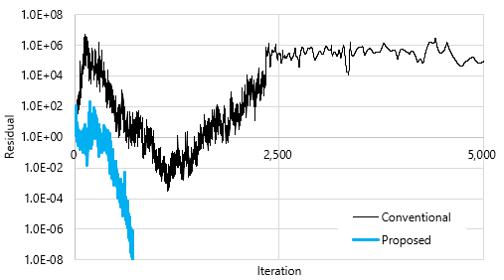 Fig.2 Example of Improved Linear Solver Residual History (Cylindrical Conductor, 237 Mesh Layers)
You need to sign in as a Regular JMAG Software User (paid user) or JMAG WEB MEMBER (free membership).
By registering as a JMAG WEB MEMBER, you can browse technical materials and other member-only contents for free.
If you are not registered, click the “Create an Account” button.
Create an Account Sign in