




 Induction motor
| 177 - Torque Characteristic Analysis of a Three Phase Induction Motor | Module:DP,LS | 2012-08-31 | An induction motor is a motor in which the rotating magnetic field of the stator coils causes induced current to flow in an auxiliary conductor, which exerts force on the rotor in the rotational direction and causes it to spin. Induction motors are widely used in everything from industrial machines to home appliances because they have a simple construction and are small, light, affordable, and maintenance-free. It is possible to drive an induction motor so that its slip is constant by adjusting the voltage or current against load variations. When this happens, each characteristic changes with influence from magnetic saturation and leakage flux because of the excitation variations in a specific slip. This Application Note explains how to obtain the torque characteristics in an induction motor when the current amplitude has been changed in a specific slip.
|

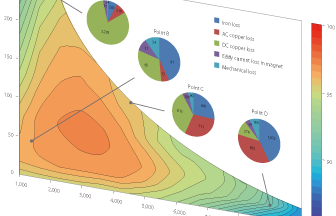
| 176 - Drive Characteristic Analysis of a Three-Phase Induction Motor | Module:DP,LS | 2012-08-31 | An induction motor is a motor in which the rotating magnetic field of the stator coils causes induced current to flow in an auxiliary conductor, which exerts force on the rotor in the rotational direction and causes it to spin. Induction motors are widely used in everything from industrial machines to home appliances because they have a simple construction and are small, light, affordable, and maintenance-free. In an induction motor, the current induced by the auxiliary conductor exerts a large influence on its characteristics. It also causes strong magnetic saturation in the vicinity of the gap, in particular. This is why a magnetic field analysis based on the finite element method (FEM) is useful when investigating the motor's characteristics for a design study. This Application Note explains how to confirm drive characteristics such as torque, loss, and efficiency in an induction motor when its rotation speed changes.
|

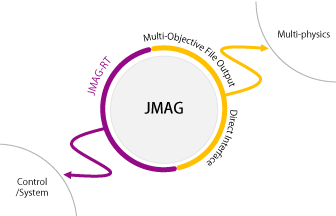
| 166 - Line Start Simulation of an Induction Machine Using a Control Simulator and the JMAG-RT | Module:FQ,RT | 2013-02-28 | Collaborative design is difficult because the controls and motor are designed independently. However, it has become necessary to resolve challenges through high-accuracy simulations at the beginning of the development process in order meet demands for more advanced motors. An effective way of achieving this is for the simulations to be performed while collaborating on the motor design circuit/control designs. An induction motor's characteristics are influenced by leakage reactance and resistance, including resistance on the secondary side. The resistance on the secondary side is affected by the skin effect, so the finite element method (FEM) needs to be used to obtain the distribution of the secondary induced current. With JMAG, it is possible to use a magnetic field analysis to obtain the resistance and leakage reactance, and to create a model of an induction motor, as well. Incorporating this motor model, called a "JMAG-RT model," to a circuit/control simulator makes it possible to use JMAG-RT to run a linked simulation with it. This Application Note explains how to use the JMAG-RT to create a JMAG-RT model of an induction motor, import it to a circuit/control simulator, and run an induction motor line start simulation.
|

| 161 - Line Start Analysis of a Three-phase Induction Machine | Module:DP | 2012-08-31 | The simplest method for starting an induction motor is a line start that connects the motor to a direct power supply. For a line start, the static impedance is small compared to impedance during rated operation, so a large current flows during the initial start-up. The large current flowing through both the primary and secondary sides during start-up causes intense magnetic saturation near the induction motor's gap. This magnetic saturation results in reduced impedance, so the starting current grows even larger. The size of the starting current affects the voltage source capacity connected to the induction motor, as well as both the electromagnetic force and heat capacity that operate on the motor's coils. This is why it is beneficial to investigate the starting performance of an induction motor with the finite element method (FEM), which can account for local magnetic saturation. This Application Note presents an analysis that simulates the line start of an induction motor and obtains the starting performance of its rotation speed variations.
|

| 154 - Calculation of Equivalent Circuit Parameters in a Three-Phase Induction Motor | Module:DP | 2012-08-31 | An induction motor is a motor in which the rotating magnetic field of the stator coils causes induced current to flow in an auxiliary conductor, exerting force on the rotor in the rotational direction and causing it to spin. Induction motors are widely used in everything from industrial machines to home appliances because they have a simple construction and are small, light, affordable, and maintenance-free. An induction motor's characteristics are influenced by leakage reactance and resistance, including resistance on the secondary side. These are referred to as equivalent circuit parameters, and they are important because they characterize a device's properties. Equivalent circuit parameters are greatly affected by both the current distribution induced in the auxiliary conductor and the magnetic saturation near the gap, so a finite element analysis (FEA) needs to be run in order to investigate these characteristics with precision. This Application Note explains how to obtain the secondary resistance, leakage inductance, and excitation inductance of an induction motor when its power supply frequency has been changed with regard to its voltage and current controls.
|

| 119 - Torque Characteristic Analysis of a Three Phase Wound Rotor Induction Motor | Module:DP | 2011-02-28 | A wound rotor induction motor is a motor that produces torque in the secondary coil through the interaction of the rotating magnetic field and the current induced in the secondary coil by the rotating magnetic field of the stator coil. Because an induced current flows through the coil, the electromagnetic force can be utilized and regenerated through a slip ring. The current induced in the secondary coil effects the performance of the wound rotor induction motor.For this reason, it is important to evaluate the current that is induced. This example presents the use of a magnetic field analysis to obtain the current density distribution and the slip versus torque curve of a three-phase wound rotor induction motor.
|

| 74 - Speed Versus Torque Analysis of a Single-Phase Induction Motor | Module:DP | 2012-08-31 | Single-phase induction motors are widely used as small output motors for the drives in household electrical appliances and office machinery, like fans and washing machines, because they can use single-phase AC, the typical power source for home electronics. Unlike three-phase AC, however, single-phase AC cannot create a rotating magnetic field by itself, meaning that it cannot start a motor. For this reason, it needs to use an alternate method to generate a rotating magnetic field to start the motor. The induced current flowing in the secondary conductor largely affect the performance of the motor because the motor rotates by using the interaction between this current and the magnetic field of the stator coils. Strong magnetic saturation distribution is also generated near the gap, so the nonlinear characteristics of the magnetic properties have a big influence on performance, as well. At the step before the design phase, it is helpful to run an analysis and evaluation using the finite element method (FEM) to understand a single-phase induction motor's characteristics by accounting for induced current and magnetic saturation characteristics. This Application Note explains how to obtain the current density distribution and Speed-Torque curve created by auxiliary winding that uses a capacitor.
|

| 68 - Speed Versus Torque Characteristic Analysis of a Three-Phase Induction Motor | Module:DP | 2013-02-28 | An induction motor is a motor in which a rotating magnetic field in the stator coils causes induced current to flow in an auxiliary conductor. This current and magnetic field exert force on the auxiliary conductor in the rotation direction and cause the motor's rotor to rotate. Induction motors are widely used in everything from industrial machines to home appliances because they have a simple construction and are small, light, affordable, and maintenance-free. In an induction motor, the current induced by the auxiliary conductor exerts a large influence on its characteristics. It also causes strong magnetic saturation in the vicinity of the gap, in particular. This is why a magnetic field analysis based on the finite element method (FEM) is useful when investigating the motor's characteristics for a design study. This Application Note explains an analysis that confirms the Speed-Torque curve and current density distribution of an induction motor.
|

| 63 - Analysis of Torque Characteristics of a Cage Induction Motor | Module:FQ | 2013-02-28 | Induction motors have been widely used for a long time in general industries because they have a simple structure, and are affordable, robust and highly efficient. When an induction motor rotates at synchronous speed, no torque is produced. However, when proper slip is caused, the maximum torque can be obtained. Losses are generated in a cage induction motor when current flows through the cage, so the pros and cons of continuous rotation depending on the amount of the heat generated need to be studied. In an induction motor, the current induced by the auxiliary conductor exerts a large influence on its characteristics. It also causes strong magnetic saturation in the vicinity of the gap, in particular. This is why a magnetic field analysis based on the finite element method (FEM) is useful when investigating the motor's characteristics for a design study. This Application Note introduces a case example that obtains the Slip-Torque curve, Torque-Current curve, Current-Voltage curve at maximum torque, and the Current-Joule Loss curve for the cage.
|

| 56 - Torque Characteristics Analysis of a Self Starting Type Permanent Magnet Motor UP! | Module:DP | 2013-04-26 | A self starting permanent magnet motor combines the characteristics of an induction motor and a permanent magnet motor, so it has higher efficiency than an induction motor even without a control device like an inverter. It behaves as an induction motor when it starts, generating torque when the rotor cage first slips against the rotating magnetic field created by the stator and then produces a secondary current. Consequently, this kind of motor has superior starting ability because there is no need to account for the rotor's start-up position or rotation speed. When the rotation speed increases and the motor synchronizes, the permanent magnet begins to generate the magnetomotive force and produce torque instead of the secondary current, so there is no secondary iron loss. This kind of motor has a weak point, however: The torque falls a great deal when the motor deviates from its synchronicity, and it gets out of step as a magnet motor so the torque variations are large. This is why self starting permanent magnet motors can achieve full-voltage starting with household current and are very efficient while in a synchronous state, but have drawbacks like relatively low starting torque and recovery once they have lost synchronization. These factors make it so that a magnetic field analysis simulation based on the finite element method is necessary to investigate whether the motor's characteristics meet the requirements ahead of time. This Application Note shows how to obtain the current density distribution and slip versus torque curve.
|

| 39 - Torque Analysis of a Three Phase Induction Motor Accounting for the Skew | Module:DP,TR | 2012-07-31 | An induction motor can utilize skew easily because the cage is constructed by metallic casting such as die casting. When skew is applied, it arranges the variations in the magnetic flux that links to the cage in a sinusoidal wave. This makes it possible to eliminate the harmonic components from the induction current that cause negative torque and contain things like the torque variations caused by influence from the slots. Applying skew generally affects the flow of magnetic flux in the axial direction, making it complex. This is why an analysis that can correctly verify the three dimensional magnetic flux flow is necessary to obtain an advance evaluation of the skew's effects. This Application Note presents a comparison of the torque waveforms of three phase squirrel cage induction motors with and without torque, and introduces the effects of using skew to reduce torque variations. Changes in the higher components caused by skew are also displayed by separating the frequencies of the secondary current, which causes the torque variations.
|

| 38 - Starting Performance Analysis of a Single Phase Induction Motor | Module:DP | 2013-02-28 | Single phase induction motors are widely used as small output motors for the drives in household electrical appliances and office machinery, like fans and washing machines, because they can use single phase AC, the typical power source for home electronics. Unlike three phase AC, however, single phase AC cannot create a rotating magnetic field by itself, meaning that it cannot start a motor. For this reason, it needs to use an alternate method to generate a rotating magnetic field to start the motor. It is important to verify whether or not torque is generated in the intended direction and continues to rotate stably ahead of time in the design phase. In order to carry out this verification, the conditions where the rotor follows the equation of motion according to the electromagnetic force mechanism and starts up need to be analyzed correctly. The purpose of this Application Note is to introduce an example of a single phase induction motor that uses a capacitor to set up an auxiliary winding and show its rotation speed versus time, torque versus time, and the magnetic flux density distribution and current density distribution in the bar just after the motor starts.
|

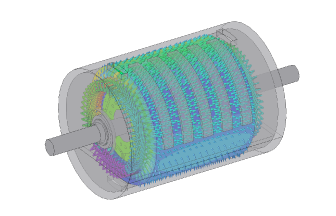
| 1 - Torque Characteristic Analysis of a Three Phase Induction Motor UP! | Module:DP | 2013-04-26 | An induction motor is a motor in which the rotating magnetic field of the stator coils causes induced current to flow in an auxiliary conductor, exerting force on the rotor in the rotational direction and causing it to spin. Induction motors are widely used in everything from industrial machines to home appliances because they have a simple construction and are small, light, affordable, and maintenance-free. In an induction motor, the current induced by the auxiliary conductor exerts a large influence on its characteristics. It also causes strong magnetic saturation in the vicinity of the gap, in particular. With Finite Element Analysis (FEA), it is possible to investigate the characteristics that accurately evaluate the features listed above, so preliminary design evaluations are effective. This Application Note introduces a case example of how to obtain the current density distribution of an auxiliary conductor and its rotation speed versus torque characteristics.
|

|