




 SPM motor
| 163 - Current vs. Torque Analysis of an SPM Motor |
Module:DP |
2011-07-12 |
The relationship between the current and torque is a fundamental characteristic
of motors. The torque produced by the current increases linearly as the
current increases up to a certain point, but the torque produced by the
current decreases by the magnetic saturation when the current is increased
further. Understanding the current versus torque characteristics using
simulation is beneficial for examining the motor design and drive state.
This example presents the use of a magnetic field analysis to obtain the
current and torque characteristics that are fundamental to SPM motors.
|

| 159 - Influence Analysis of Dimensional Tolerance using Morphing |
Module:DP |
2011-02-28 |
The angle of the magnets in SPM motors use a fillet or chamfer. However,
the fillet and chamfer of each product that is manufactured varies because
to completely fabricate the same fillet or chamfer is difficult in the
manufacturing process. Therefore, the dimensional tolerance is set so the
motor performance is not affected by these variations.
This example presents the use of a magnetic field analysis to compare whether
the cogging torque of the SPM motor is influenced by changing geometry
in the tolerance range assuming the dimensional tolerance of the chamfer
is ±0.4 mm.
|

| 124 - Cogging Torque Analysis of an SPM Motor Accounting for an Varied
Stator Diameter |
Module:DS,DP |
2011-02-28 |
When a motor is constructed, the diameter of the stator becomes uneven
because of fabrication errors and shrink fitting. It is advantageous to
investigate the uneven diameter of the stator because it largely effects
the cogging torque.
This example presents the use of a structural and magnetic field analysis
to obtain the cogging torque with stator teeth that have an uniform and
varying diameter based on the displacement obtained with a stress analysis. |

| 120 - Thermal Demagnetization Analysis of an SPM Motor |
Module:DP |
2011-07-12 |
Demagnetization may occur in an SPM motor during rotation because of the
rising temperature caused by the eddy currents, or the reverse magnetic
field produced by the coil in the permanent magnet.The need to evaluate
the demagnetization using a magnet field analysis is becoming more important
because demagnetization reduces the performance of an SPM motor.The mechanical
characteristics need to be evaluated accounting for demagnetization caused
by rising temperatures while the motor is driven, because the demagnetization
is irreversible even after the temperature decreases once the operating
point of the magnet exceeds the knee point.
This example presents the use of a magnetic field analysis to evaluate
the torque waveform and demagnetization of an SPM motor while changing
the temperature of the permanent magnet. |

| 115 - Eccentricity Analysis of an SPM Motor |
Module:DP |
2011-07-12 |
Eccentricity may occur in the motor due to a misalignment of the rotation axis and the center axis of the motor.
Evaluating the effects of eccentricity is often requested because vibration and noise in the motor due to an unbalanced magnetic flux density distribution and electromagnetic force caused by eccentricity.
This example presents the use of a magnetic field analysis to obtain the torque waveform and effects on the electromagnetic force acting on the stator for an SPM.
|

| 114 - Vibration Analysis of an Outer Rotor Motor |
Module:DS,DP |
2011-07-12 |
| An outer rotor motor has a magnetic rotor that rotates around a stator.
An outer rotor motor can produce a larger amount of torque than an inner
rotor motor with the same diameter because the radius of the outer rotor
is larger.Vibrations produced by electromagnetic force can be produced
as the motor rotates. The fabrication of the motor can be modified, such
as adding and fabricating holes in the rotor core to change the eigenfrequency
reducing the amount of electromagnetic vibrations that can cause noise
or damage the motor.This example presentsthe use of a magnetic field analysis
and structural analysis to obtain the sound pressure caused by electromagnetic
vibrations in an outer rotor motor with holes fabricated in the rotor core. |

| 108 - Centrifugal Force Subversion Analysis of a Ring Magnet |
Module:DS |
2011-01-17 |
| The development of motors able to reach high rotation speeds is expanding
as the technology is more widely implemented in the industrial field of
permanent magnet synchronous motors.A magnet will shatter when the amount
of stress surpasses the mechanical strength in an SPM motor that uses a
ring magnet. This problem stems from the centrifugal force produced in
a rotor at high rotation speeds. Analyzing the maximum rotation speed of
a motor through simulation to evaluate methods to prevent the magnet from
shattering, such as designing reinforcement rings, becomes highly advantageous
during the design stage.This example analyzes the tensile stress distribution
of a ring magnet when the permanent magnet synchronous motor is rotated
at high speeds. |

| 103 - Efficiency Analysis of a Permanent Magnet Synchronous Motor |
Module:DP |
2011-01-17 |
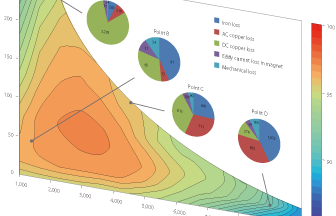
| A permanent magnet synchronous motor rotates by converting electric energy
to mechanical energy.The important thing when converting energy is efficiency
indicated by the power factor for the amount of current effectively used,
as well as the percentage of output versus input.Evaluating the power factor
and input/output characteristics that account for efficiency is necessary
to design a highly efficient motor.This example presents the use of a magnetic
field analysis to evaluate the efficiency of a permanent magnet synchronous
motor. |

| 93 - Cogging Torque Analysis of a Motor with 8 Poles and 9 Slots Accounting for Eccentricity |
Module:DP |
2010-08-31 |
Eccentricity can occur on the center axis or the rotation axis of a motor. It is advantageous to evaluate the effects of eccentricity because it can cause vibrations and noise and break the symmetry of the magnetic flux density distribution and the electromagnetic force.
This example presents the use of a magnetic field analysis to obtain the cogging torque and electromagnetic force with and without eccentricity.
|

| 80 - Magnetization Analysis of an SPM Motor with a Skewed Magnet |
Module:TR |
2011-01-31 |
| Motors are not only required to be more compact and have higher efficiency,
but also to have less noise and vibration. One of the reasons of noise
and vibration is cogging torque, which is caused by the interaction between
the iron core and the permanent magnet. Cogging torque can be reduced by
applying skew. This note presents the use of magnetic field analysis to
evaluate the magnetic flux density distribution and cogging torque of an
SPM motor with a skewed magnet. |

| 46 - Surface Magnetic Flux Density Analysis Accounting for the Magnetization
Direction |
Module:DP,ST |
2011-07-12 |
| Cogging torque is produced as a motor rotates. Problems such as a reduction
in efficiency, vibrations, and noise can be improved by reducing the amount
of cogging torque that occurs. One factor that affects the cogging torque
is the direction the magnets are magnetized. This example presents the
use of a magnetic field analysis to obtain the surface magnetic flux density
for the radial pattern, parallel anisotropy pattern, and the polar anisotropy
pattern of magnets. Furthermore, the flux linkage, induced voltage, and
cogging torque are obtained for an SPM motor that uses magnets with these
magnetization patterns. |

| 40 - Cogging Torque Analysis of an SPM Motor |
Module:DP |
2011-01-17 |
| Cogging torque is produced by the interaction between the permanent magnet
and the stator core when the rotor rotates with no current flow. The cogging
torque prevents the smooth rotation of the rotor, which may lead to vibration
and noise. So the evaluation of the accurate cogging torque can be an important
issue. The period of the cogging torque is determined by the number of
poles and slots, so they are significant factors for evaluating cogging
torque.This note presents the use of magnetic field analysis for evaluating
the cogging torque of an 8-pole, 9-slot SPM motor, which has relatively
small period of the cogging torque. |

| 34 - Demagnetization Analysis of an SPM Motor |
Module:DP |
2011-07-12 |
| When a motor is rotating, the permanent magnet in the motor can be demagnetized
due to the temperature rise caused by the eddy current loss and the reverse
magnetic field generated by the coil. As the demagnetization of the permanent
magnet reduces the motor performance, it is important that the demagnetization
can be evaluated with magnetic field analysis. This note presents the use
of a magnetic field analysis of an SPM motor to evaluate how the demagnetization
caused by the reverse magnetic field change with varying current flow. |

| 31 - Iron Loss Analysis of an SPM Motor Including the Effect of Press-fitting
Stress |
Module:DS,DP,LS |
2011-03-31 |
The laminated structure of the core can be maintained by press fitting
or shrink fitting. When a magnetic steel sheet is used for the core of
a motor, the stress caused by press fitting is known to affect the increase
of iron loss. So, the press-fitting stress needs to be taken into account
in iron loss analysis.
This example presents the use of a structural analysis and magnetic field
analysis to obtain the iron loss density of an SPM motor with and without
press-fitting stress. |

| 30 - Magnetization Analysis of an SPM Motor |
Module:ST,CB |
2011-02-28 |
| A magnetized magnet needs a careful handling at the time of assembling
a motor, so it is useful to magnetize the magnet after placing it in the
motor. When the anisotropic magnet placed in the motor is magnetized, the
effective magnetization field distribution is determined by the magnetization
field and the orientation of the magnet. Magnetizing Tool of JMAG can be
used to obtain the magnetization field distribution, taking into account
the magnetization field of the magnet evaluated in advance. This note presents
the use of magnetic field analysis to obtain the magnetization field used
to magnetize a permanent magnet placed in an SPM motor and also to obtain
the surface magnetic flux density of the magnet. |

| 29 - Iron Loss Analysis of an SPM Motor with Overhanging Magnet |
Module:LS,TR |
2011-01-17 |
| When a motor has magnet overhang, the flux is generated both in the in-plane
direction and the lamination direction, which then increases the iron loss.
To evaluate the loss increases caused by the overhang, those caused by
the flux in the in-plane direction and those by the flux in the lamination
direction need to be separated. This note presents the use of a no-load
iron loss analysis of an SPM motor with and without overhanging magnet. |
| 24 - Cogging Torque Analysis of an SPM Motor with a Skewed Stator |
Module:TR |
2011-02-28 |
| For motors, there is a need of reducing vibration and noise. Cogging torque
is one cause of vibration and noise, so reducing cogging torque is an important
issue. And one way of reducing the cogging torque is to skew either the
rotor or the stator. This note presents the use of magnetic field analysis
to evaluate the cogging torque of an SPM motor with the skewed stator. |

| 21 - Iron Loss Analysis of an SPM Motor Including the Effect of Shrink
Fitting |
Module:DS,DP,LS |
2011-01-17 |
| Shrink fitting is a procedure in which heat is used to make a very strong
joint between two pieces of metal such as frame and stator. In this case,
the stator is inserted into the frame by extending the radius of the frame
using heat. The stress caused by shrink fitting is known to affect the
iron loss and magnetic circuit. So, it is important to include the effect
of thermal stress in iron loss analysis and magnetic field analysis. This
note presents the use of structural analysis and magnetic field analysis
to obtain iron loss density of an SPM Motor by taking into account the
stress caused by shrink fitting. |

| 20 - Sound Pressure Analysis of an SPM Motor UP! | Module:DP,DS | 2012-04-10 | As electric motors are becoming more common, motors which create less noise are in high demand. Sound can be divided into categories of electromagnetic noise, mechanical noise, and draft noise, where electromagnetic noise is the most common for medium and small sized motors. Sound can be divided into categories of electromagnetic noise, mechanical noise, and draft noise, where electromagnetic noise is the most common for medium and small sized motors. The electromagnetic force in a motor vibrates as an electromagnetic excitation force which creates noise. The vibration and noise are generated when the electromagnetic excitation force resonates with the motor's eigenmodes. In order to evaluate this phenomenon more accurately, it is necessary to understand the distribution of electromagnetic force that moves the stator core which is the basis for the radiated sound. The distribution of electromagnetic force or the eigen modes in a model that depends on the geometry of a stator core is required for running an analysis such as for the finite element analysis. This Application Note shows an example of an evaluation of a reactor's sound pressure, when acquiring electromagnetic force generated by a stator core for a SPM motor and linking the eigen modes of a motor.
|

| 15 - Cogging Torque Analysis of an SPM Motor with a Step Skewed Magnet UP! | Module:TR | 2012-04-10 | Reductions in vibration and noise are being sought after because they are a cause of torque variations in motors, and demands for reduction are particularly strong with motors that are used in machine tools and power steering. Cogging torque, which is a torque variation that is produced when there is no current, is generated because the electromagnetic force, which is produced in the gap, changes in relation to the rotor's rotation, making it necessary to apply skew to the stator and rotor and improvise with the magnet and stator's geometry in order to limit said variations in electromagnetic force as a countermeasure for reducing the torque variations. When applying skew, force in the thrust direction is produced in exchange for a reduction in the cogging torque, meaning that there is the disadvantage of producing eddy currents from the magnetic flux that links in the lamination direction. Consequently, in order to accurately evaluate a motor that has skew applied, one needs a magnetic field analysis simulation that uses the finite element method (FEM), which can account for a detailed 3D geometry, instead of studies that use the magnetic circuit method or a 2D magnetic field analysis. This Application Note presents the use of magnetic field analysis to evaluate the magnetic flux density distribution and cogging torque in each part of an SPM motor with a step skewed magnet.
|

|