





TS - Transformer Analysis (*Only JMAG-Designer)
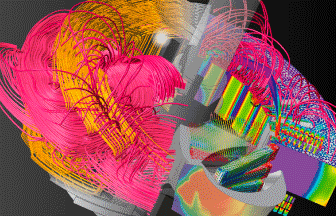
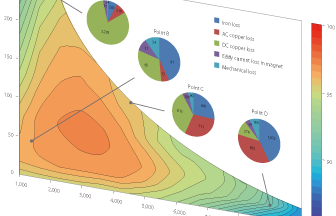
 | 148 - Loss Analysis of a Power Transformer (Flyback Converter) | Module:DP,LS,TR,TS | 2012-08-31 | A flyback converter is a well-known system for small capacity power supplies in the several-dozen W class. They are cheap and have a simple structure, so they are widely used as converters for pressurization in home appliances. In recent years there has been a trend toward making small-scale switching transformers even smaller and higher-frequency, so it is not rare to see converters using the flyback system drive 100 kHz or more. Because of the higher frequencies and smaller scales of transformers, an important challenge of how to control their heat generation has emerged in the design process. The losses that produce heat can be separated into copper loss in the coil and iron loss in the core. Copper loss is distributed inside of the coils because of the proximity effect, which is caused by influence from the skin effect and leakage flux. This means that local heat generation in the coils becomes a problem. Iron loss also has a complex distribution because it depends on the magnetic flux density distribution that accounts for the core's magnetic saturation, so the core's local heat generation becomes a problem as well. A magnetic field analysis simulation based on the finite element method (FEM) can precisely evaluate the complex loss distributions of the coil and core, so it is optimal for an advance study of a switching transformer's thermal design.
|

 | 123 - Thermal Analysis of a Choke Coil
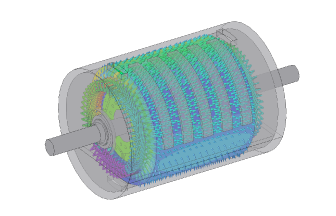
| Module:HT,TS | 2012-07-31 | A choke coil is an electric component that is intended to filter high-frequency current. The current generated in the choke coil has offsets caused by the skin effect, proximity effect, and leakage flux near the gap, so it is distributed both inside of and between the wires. Iron loss generated in the core is also distributed by offsets in the core's magnetic flux density. Iron loss in the choke coil's core and copper loss in its coil become a heat source in addition to reducing efficiency, so they need to be understood and reduced from a heating design standpoint. An analysis using the finite element method (FEM) is effective in getting more information about the design by quantitatively evaluating the heat generation phenomena with copper and iron losses as the heat sources. This Application Note shows the use of a thermal analysis to obtain the temperature distribution using the iron losses and copper losses in the choke coil as the heat source.
|

 | 110 - Loss Analysis of a Choke Coil
| Module:FQ,LS,TS | 2012-07-31 | A choke coil is an electric component that is intended to filter high-frequency current. Measures to evaluate the heat source as well as the core iron losses that occur within the choke coil and the copper losses of the coil that decrease efficiency need to be used for this analysis. The current generated in the choke coil has offsets caused by the skin effect, proximity effect, and leakage flux near the gap, so it is distributed both inside of and between the wires. Iron loss generated in the core is also distributed by offsets in the core's magnetic flux density. It is helpful to get tips for the design quantitatively and visually studying these detailed distributions, and an effective way of doing this is a magnetic field analysis that uses the finite element method (FEM). This Application Note shows how to obtain the iron loss and copper loss in a choke coil.
|

 | 105 - Leakage Inductance Analysis of a Transformer
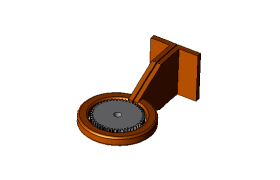
| Module:FQ,TS | 2012-07-31 | Inductance is an important physical quantity that determines a transformer's response characteristics against electric signals. Inductance is generally categorized into self-inductance and leakage inductance. Self-inductance is an indicator of to what extent the transformer can produce magnetic flux, and leakage inductance is an indicator of how much magnetic flux the transformer can send from the primary coil to the secondary coil without leaking. This is why self-inductance and leakage inductance are important items for transformer design requirements. The amount of inductance is dependent on the magnetic circuit, but the nonlinear characteristics of the magnetic properties make it so that the magnetic circuit changes when the operating point changes. The leakage inductance has all of the same properties, but it also has a flux path in non-magnetic regions, making it easily affected by the arrangement and geometry of the winding in addition to the core. This is why a magnetic field analysis using the finite element method (FEM) is necessary when evaluating these types of inductance. This Application Note explains how to obtain self-inductance and leakage inductance for two types of secondary coiling in a transformer: uniform coiling and close coiling.
|

 | 61 - Current Distribution Analysis of a Choke Coil
| Module:DP,TS | 2013-01-28 | A choke coil is an electric component that is intended to filter high-frequency current. The current in a choke coil's interior produces local heat generation because of the skin effect, proximity effect, and current offsets caused by leakage flux near the gap. From a heat resistant design standpoint, visual confirmation of detailed current distribution using a finite element analysis (FEA) is useful because it provides feedback for the design. This Application Note explains a case example that obtains the current distribution in a choke coil.
|
|