*Please prepare a license ID and password for the license administrator.
*It is different from the service for JMAG WEB MEMBER (free membership). Please be careful.
Overview
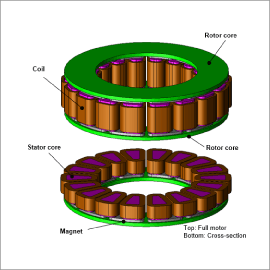
EV/HEV drive motors operating in high-torque/high-output regions produce significant losses that act as heat sources that increase part temperatures. Cooling systems are essential because these motors exceed the thermal resistance limit with air cooling alone. Axial flux motors have a pancake structure with smaller dimensions in the axial direction. These motors tend to use cooling jackets due to the limited amount of space for internal oil cooling channels.
A coupled analysis that combines a magnetic field analysis to obtain the Joule and iron losses with a thermal analysis can precisely evaluate the part temperatures. While it is difficult to identify the temperatures of each part in the actual machine, simulations can easily verify whether each part satisfies the thermal resistance limit.
This case study evaluates the temperature changes of each part of an axial flux motor with and without a cooling jacket during a WLTC drive cycle.
A coupled analysis that combines a magnetic field analysis to obtain the Joule and iron losses with a thermal analysis can precisely evaluate the part temperatures. While it is difficult to identify the temperatures of each part in the actual machine, simulations can easily verify whether each part satisfies the thermal resistance limit.
This case study evaluates the temperature changes of each part of an axial flux motor with and without a cooling jacket during a WLTC drive cycle.
Cooling Specifications
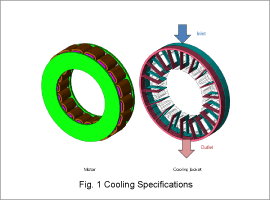
Fig. 1 provides a conceptual diagram of the cooling jacket.
The cooling jacket has a toroidal structure around the outer circumference of the motor. The coolant flow channels have a radial arrangement aligned with the coil position to ensure an efficient heat exchange. The cooling jacket uses water as the coolant with a flow rate of 7.8 L/min.
The cooling jacket has a toroidal structure around the outer circumference of the motor. The coolant flow channels have a radial arrangement aligned with the coil position to ensure an efficient heat exchange. The cooling jacket uses water as the coolant with a flow rate of 7.8 L/min.
Temperature Variations of Parts
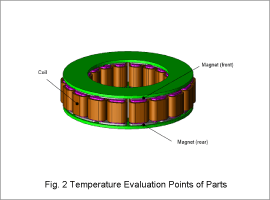
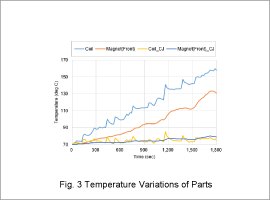
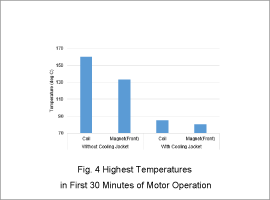
Fig. 2 indicates the temperature evaluation point of each part. Fig. 3 illustrates the temperature variations of each part. Fig. 4 outlines the highest temperatures during the first 30 minutes of motor operation.
As shown by Fig. 3 and Fig. 4, the motor model without a cooling jacket has a coil temperature of roughly 160 deg C and magnet temperature of about 130 deg C. The motor model with the cooling jacket keeps the coil and magnet temperatures at 90 deg C or less.