
*Please prepare a license ID and password for the license administrator.
*It is different from the service for JMAG WEB MEMBER (free membership). Please be careful.
Overview
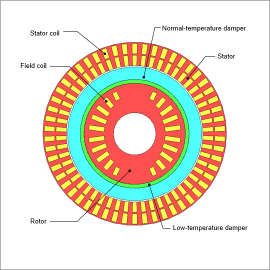
Superconducting rotating machines can generate powerful magnetic fields using a small and light structure while having almost no excitation losses. These types of machines have been highlighted as the core technology for the next-generation power devices expected to operate with extremely high efficiency. However, significantly low temperatures (several K) are essential when using low-temperature superconductors. Designs must incorporate cooling systems optimized for these temperatures. That is why precise loss evaluations are critical during the design stage.
This case study describes a quantitative loss evaluation for the field winding of a low-temperature superconducting generator that uses a superconducting analysis model.
This case study describes a quantitative loss evaluation for the field winding of a low-temperature superconducting generator that uses a superconducting analysis model.
Losses per Field Coil Slot
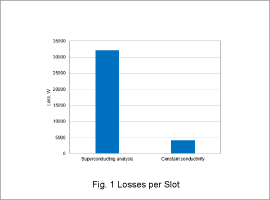
The losses for one slot of the field coil is shown in Fig. 1.
The analysis model that assumes constant conductivity overestimates the losses far more than the superconducting analysis model.
The analysis model that assumes constant conductivity overestimates the losses far more than the superconducting analysis model.
Current Flux Density Distribution of the Field Coil
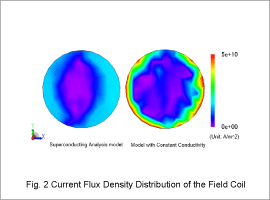
Current Flux Density Distribution of the Field Coil is shown in Fig. 2.The superconducting analysis model reproduces the current density saturation that occurs around the critical current density.
Conversely, the model that assumes constant electrical conductivity allows the current density to surpass the critical current density, which makes it impossible to accurately capture the physical phenomenon.
Conversely, the model that assumes constant electrical conductivity allows the current density to surpass the critical current density, which makes it impossible to accurately capture the physical phenomenon.