Overview
In order to achieve high responsiveness in motor control, it is necessary to accurately predict the behavior of a running motor. Since motor parameters used in observer models are conventionally composed of constant terms independent of the operating points on the controller side, there was a problem with the tracking capability of the output for command values. For this reason, in the end, a physical machine was needed for parameter tuning.
This issue can be resolved by using the JMAG-RT model, which is a high-fidelity motor model generated from the FEA model. JMAG-RT motor models can reproduce characteristics of a physical machine with high fidelity. In other words, a high-fidelity observer model can be created by extracting motor parameters required for them from high-fidelity motor models.
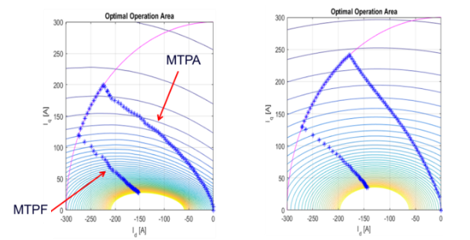
Fig. 1 Trajectory of the operating points drawn from a magnetic flux map extracted from a JMAG-RT model (left) and the trajectory using a map extracted from a DQ model (right)
The flux linkage map is different between the JMAG-RT model and the DQ model which does not take into account nonlinearity due to magnetic saturation. This difference can be seen in the form of a voltage limiting oval. As a result, this leads to differences in the trajectories of the current vectors during the control of the maximum torque/magnetic flux and maximum torque/current (blue point). If the trajectory on the right is used as command values for a physical machine, it will lower responsiveness.
You need to sign in as a Regular JMAG Software User (paid user) or JMAG WEB MEMBER (free membership).
By registering as a JMAG WEB MEMBER, you can browse technical materials and other member-only contents for free.
If you are not registered, click the “Create an Account” button.
Create an Account Sign in