Overview
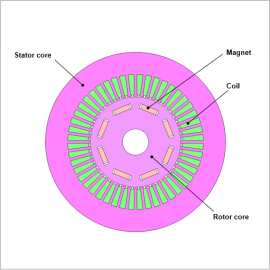
FEA optimizations are advantageous to realize designs meeting such strict requirements. Parametric optimizations can vary dimensions as design variables. Topology optimizations can evolve the initial geometry. Topology optimizations can also explore a large design space by hollowing out unnecessary parts, changing materials, and modifying connections to drastically transform the part layout.
This case study runs a topology optimization to minimize torque ripple and maximize average torque with the maximum stress on the rotor core and maximum radial displacement below a constant value.
Optimization Conditions
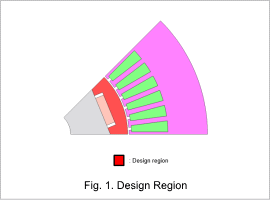
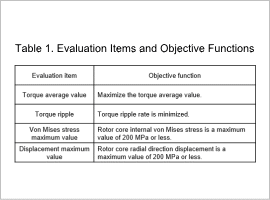
Fig. 1 illustrates the design region. Table 1 outlines the design requirements.
As shown by Fig. 1, the optimization sets the design region to the area around the magnet and gap that should significantly affect the Mises stress and torque. The rotor core geometry has symmetry every half pole. Therefore, the design region is one-half of the pole. The region geometry uses a mirror copy to create the rotor core parts. A multi-objective optimization simultaneously optimizes solutions according to multiple competing objective functions.
Optimization Results
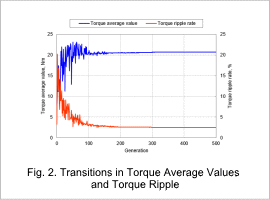
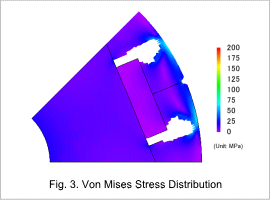
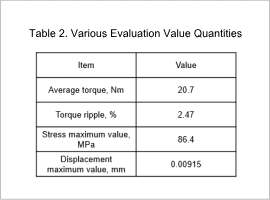
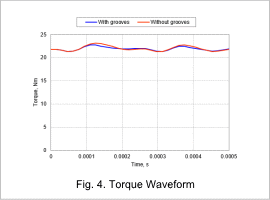
Fig. 2 presents the transition of the average torque and torque ripple rate of the cases with the maximum average torque for each generation. Fig. 3 illustrates the distribution of objective functions for feasible solutions. Fig. 4 shows the Mises stress distribution for the case with the highest average torque throughout all generations. Table 2 lists each physical quantity.
As shown by Fig. 2, the solutions converge with each generation as the average torque increases and the torque ripple rate decreases.
As illustrated by Fig. 4 and Table 2, the case with the maximum average torque satisfies the Mises stress and radial displacement constraints while also creating a flux barrier to increase the average torque.