
Ryosuke Takayama
Advanced Development Sect., Research & Development Dept.,
DIAMET CORPORATION
Abstract
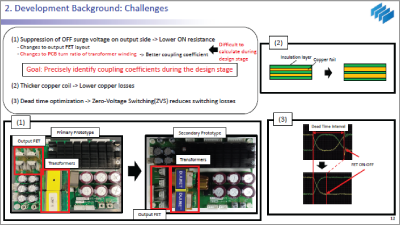
More widespread use of AI and smartphones are quickly increasing the amount of power used by data centers. Higher power consumption is driving the need for power sources that can provide better power conversion efficiency. A higher coupling coefficient in power transformers is one challenge that stands in the way of increasing this power conversion efficiency. A low coupling coefficient causes a wide range of problems from inefficiency due to leakage flux to more power surges and noise. This case study ran shape optimizations of core geometry to take full advantage of the greater malleability of powdered metallurgy in order to improve the coupling coefficient.
To read Proceedings, please sign-in.
Protected content here, for members only.You need to sign in as a Regular JMAG Software User (paid user) or JMAG WEB MEMBER (free membership).
By registering as a JMAG WEB MEMBER, you can browse technical materials and other member-only contents for free.
If you are not registered, click the “Create an Account” button.
Create an Account Sign in