
Masakazu Akahane
Digital Block Sensing & Storage Unit Research & Development Division,
HIOKI E.E. CORPORATION
Hiroyuki Sano
JSOL Corp.
Abstract
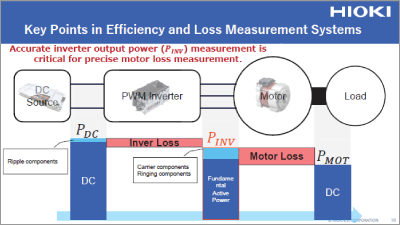
The deviation between analysis and measured results during motor loss evaluations remains a major obstacle to development efficiency, even with the advancements in MBD. Motor loss evaluations that use SiC/GaN inverters struggle to only capture the simple inductive load (L component) of motors, which makes accounting for the stray capacitance (C component) essential. Ringing loss in motors is a resonant phenomenon caused by the C component of the motor and L component of the cable between the inverter and motor. However, both conventional electric measurements and analysis models do not account for the ringing loss. Rather than simply closing the gap between measured and analysis results, this presentation describes the three points below to bring greater precision to both measurements and analyses as well as heighten the absolute accuracy of loss evaluations.
- Identifying the components that motor loss evaluations should take into account:
We will look at the importance of accounting for ringing and other losses in high-frequency domains and the impact it has on the total losses. - Grasping the requirements for measurement instruments to accurately obtain motor losses:
We will examine the performance necessary for measurement instruments to accurately obtain ringing losses that have been left ignored and look at power measurement solutions. In the future, these types of measurements will be essential for obtaining data fundamental to motor evaluations. - Accounting for wide-band support in analysis models:
Everyone who joins this presentation will learn specific approaches to make evaluations more reliable and enhance measurement and analysis methods. These insights help build highly reliable MBD systems, realize efficient development free of rework, and further enhance product performance.
This is a joint session held by HIOKI and JSOL. HIOKI will delve into actual measurement portions of the presentation, while JSOL will examine the analysis methods.
You need to sign in as a Regular JMAG Software User (paid user) or JMAG WEB MEMBER (free membership).
By registering as a JMAG WEB MEMBER, you can browse technical materials and other member-only contents for free.
If you are not registered, click the “Create an Account” button.
Create an Account Sign in