
Overview
Drive motors for electric vehicles need to not only meet high power density, high torque, high efficiency, and other performance requirements but also must minimize vibrations and noise, maintain mechanical strength at high speeds, suppress heat under high loads, and lower costs. Designers generally evaluate performance requirements primarily through the magnetic design. However, insufficient mechanical strength or excessive heat can force engineers to rework the magnetic design later on in development, which is a massive undertaking. The significant safety margin often left to avoid this rework inevitably drives up costs.
A comprehensive development process that refines the thermal, structural and control designs alongside the magnetic design can attain the necessary performance, strength and heat management. A standalone simulation-based design workflow takes every design into account to automatically obtain optimal design solutions that satisfy all requirements while reducing the risk of any rework.
This case study runs an optimization on the initial nabla-shaped IPM drive motor design to maximize torque and minimize magnet mass for greater fuel economy during the WLTC drive cycle. The simulation also limits magnet and coil temperatures as well as stress at high speeds. The results show that design solutions with the highest torque exceed temperature and torque tolerances. This demonstrates the necessity of multi-disciplinary evaluations in finding optimal design solutions without any rework.
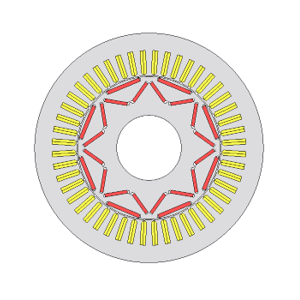
IPM Motor
Optimization Conditions
| Maximum torque | Maximize |
| Magnet mass | Minimize |
| Average cycle efficiency | 86% or higher |
| Magnet temperature | 100deg C or less |
| Coil temperature | 140deg C or less |
| Stress | 250MPa or less |
Fig. 1 IPM Motor and Optimization Conditions
The optimization analyzes nabla-shaped IPM motor with 8 poles and 48 slots. The efficiency map accounts for 600 V DC, a maximum current of 250 A, and maximum output control. The multi-disciplinary simulation not only evaluates the performance requirements but also magnet and coil temperatures as well as stress as outlined in the table on the right.
You need to sign in as a Regular JMAG Software User (paid user) or JMAG WEB MEMBER (free membership).
By registering as a JMAG WEB MEMBER, you can browse technical materials and other member-only contents for free.
If you are not registered, click the “Create an Account” button.
Create an Account Sign in