
Contents
1. Introduction
2. Typical Finite Element Vibration Analysis Method for Electromagnetic Machines
3. Proposed Vibration Analysis Method for Electromagnetic Machines Using Transfer Functions
4. Analysis Model
5. Creating Transfer Functions
6. Accuracy Validation
6.1 Comparison Conditions
6.2 Validation Results
7. Application Examples
8. Application Limitations and Challenges to Practical Implementation
9. Summary
10. References
1. Introduction
Modern EV power trains and other motor components must always pursue higher efficiency and output while lowering noise and vibrations. Electromagnetic force produced by the motor assembly is one major source of the noise and vibrations known to greatly impact these machines. However, current design practices tend to tackle the magnetic design separately from the noise/vibration design, which forces engineers to repeatedly rework each design. A design process that unilaterally accounts for the magnetic as well as noise and vibration characteristics solves this problem. In addition to the significant hurdles of a new design process, these types of system-level vibration analyses also drive up computational costs. As one way to reduce the computational costs associated with vibration analyses, some are turning to transfer functions as a means to simulate system-level vibration characteristics by utilizing the underlaying electromagnetic force to obtain the vibrations.
This paper proposes a new system-level noise and vibration design process that takes advantage of transfer functions to realize designs that account for the magnetic characteristics of the motor as well as the noise and vibration characteristics of the entire system.
2. Typical Finite Element Vibration Analysis Method for Electromagnetic Machines
The mechanisms that produce vibrations and noise in electromagnetic machines involve the electromagnetic vibrations that act as the excitation source, structural vibrations, and the phenomena amplifying those vibrations. CAE must run coupled magnetic field and structural analyses to simulate these mechanisms. The magnetic field analysis first obtains the electromagnetic force distribution to specify the electromagnetic force as input for a noise/vibration analysis. The coupled magnetic field and structural analysis only uses one-way coupling because the deformation should not affect the magnetic field. Fig. 1 provides a flow chart of a typical finite element vibration analysis. Finite element analyses tend to have a large number of elements and high computational costs due to the three-dimensional model and extensive regions necessary for a system-level structural analysis.
 Fig. 1 Typical Finite Element Vibration Analysis Process for Electromagnetic Machines
3. Proposed Vibration Analysis Method for Electromagnetic Machines Using Transfer Functions
The proposed analysis uses frequency response functions (FRF) to input the excitation force and output the vibrations in the frequency domain to freely simulate the response of different loads acting on particular operating points. The following equation expresses the transfer function:
\([X]=[G][f]\) (1)
\(X\) represents the vibration response. \(G\) expresses the transfer function. \(f\) is the excitation force. The equation only uses the electromagnetic force produced by the motor as the excitation force of the system. Fig. 2 provides a flow chart for a vibration analysis of an electromagnetic machine using transfer functions. The analysis provides the benefit of instantly obtaining vibration response results because the transfer function directly converts the electromagnetic force into the vibration response.
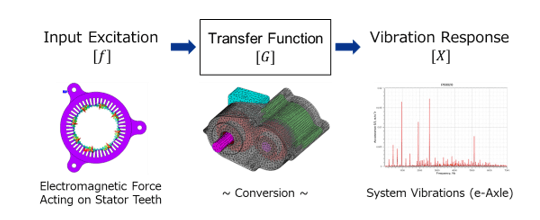
Fig. 2 Vibration Analysis Process for Electromagnetic Machines Using Transfer Functions
You need to sign in as a Regular JMAG Software User (paid user) or JMAG WEB MEMBER (free membership).
By registering as a JMAG WEB MEMBER, you can browse technical materials and other member-only contents for free.
If you are not registered, click the “Create an Account” button.
Create an Account Sign in