Overview
However, optimizations require a vast number of design variables in order to cover all of the potential adjustments, which would take significant time to explore the full range of options using FEA.
This case study proposes a design exploration approach that generates a surrogate model before the optimization to overcome the challenges presented by optimizations using only FEA. Offline optimizations that reference a surrogate model can estimate characteristics without continuously running FEA.
This document introduces a process for an offline optimization run using a surrogate model to explore design solutions that satisfy the requirements in less time while also reducing the computational costs.
Existing Design and New Requirements
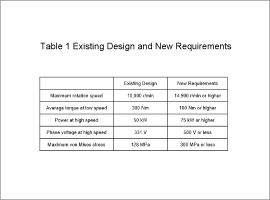
The existing design and new requirements are outlined in Table 1.
Optimization Conditions
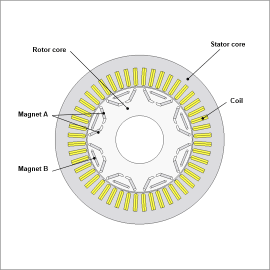
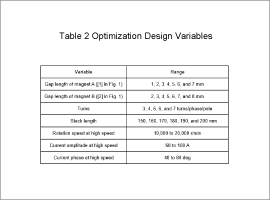
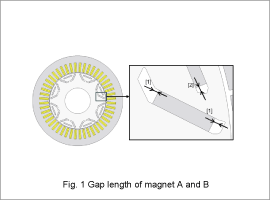
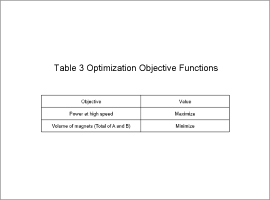
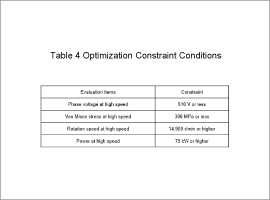
The design variables are outlined in Table 2 and Fig. 1, the objective functions in Table 3, the constraint conditions in Table 4.
Note that in this case study, to broaden the design exploration range, the average torque at low speed was not included as a constraint in the optimization calculation. The range satisfying the constraints was confirmed from the optimization results.
Furthermore, surrogate models has errors compared to FEA. If no feasible solution is obtained during offline optimization, relaxing the constraints may yield a feasible solution. In this case study, since a feasible solution could not be obtained due to voltage prediction errors during preliminary checks, the voltage constraint value was relaxed by 2 % to 510 V or less.
Optimization Results
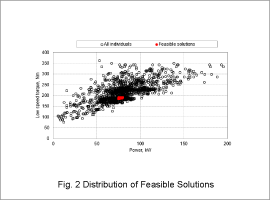
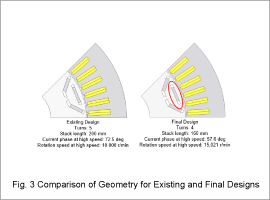
Fig. 2 illustrates the distribution of feasible solutions obtained by the optimization. Fig. 3 presents the geometry of the final design selected from the feasible solutions. The geometry in Fig. 3 has the lowest iron loss compared to the other solutions obtained by the optimization.
As shown by Fig. 2, the final design chosen from the optimization that obtained numerous feasible solutions can use the existing core geometry while still satisfying the new requirements.
As illustrated by the final geometry in Fig. 3, the design reduces the magnet area on the rotor surface, the number of turns, and stack length to satisfy the requirements for this case study.
Comparison of Offline Optimization Results and FEA
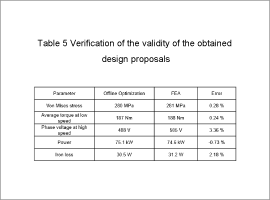
Table 5 compares the offline optimization results with the results verified by FEA using the design parameters obtained from the offline optimization calculation. All response values are predicted within plus or minus 4 %.
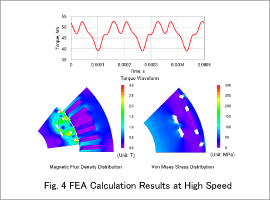
Fig 4 illustrates the torque waveform, magnetic flux density distribution, and Von Mises stress distribution obtained from the FEA calculation results. By combining offline optimization calculations with FEA calculations, optimization calculation time can be reduced while enabling detailed analysis at low cost.