
Overview
Superconductors have no resistance when excited by direct current but do lose energy when excited by alternating current due to a phenomenon known as AC losses. Accurately capturing and reducing the AC losses is essential for the upscaling and practical application of superconducting transformers, motors, power distribution cables, and other equipment. The AC losses also directly impact the thermal design and scale of cooling systems.
This case study analyzes the losses when applying alternating current to round superconducting wire. The simulation varies the current ratio by dividing the amplitude of the current by the critical current (I/Ic) from 0.1 to 0.9 to obtain the AC losses for each current ratio. The JMAG analysis results closely match results calculated using the Norris equation for the entire range of current ratios. The results validate JMAG as an accurate tool for capturing the nonlinear behavior inherent to superconductors that provides highly accurate data to gain design insights.
| Wire radius | 2.0 mm |
|---|---|
| Critical current density | 109 A/m2 |
| Frequency | 1 Hz |
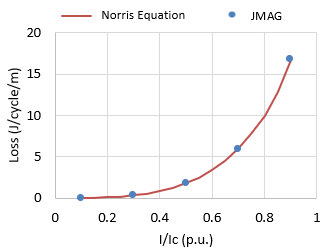
Fig. 1 Left: Analysis Specifications; Right: AC Loss Analysis Results vs Norris Equation
The graph plots the losses per cycle per unit length against the current ratios.
The JMAG analysis results closely match the Norris equation for a highly-accurate AC loss evaluation.
You need to sign in as a Regular JMAG Software User (paid user) or JMAG WEB MEMBER (free membership).
By registering as a JMAG WEB MEMBER, you can browse technical materials and other member-only contents for free.
If you are not registered, click the “Create an Account” button.
Create an Account Sign in