
Overview
Resonant LLC converters are gaining popularity as high-efficiency, low-noise power circuits used primarily in household appliances. Transformers act as critical components that govern the resonance characteristics of the converter and determine the target inductance and coupling coefficient. However, miniaturization and a shift to higher frequencies increase leakage flux, which can lower the coupling coefficient and increase losses. Magnetic field analyses are essential to grasp these phenomena sooner rather than later.
JMAG magnetic field analyses account for the parasitic capacitance dominant in high-frequency regions to precisely capture both self-resonant frequencies as well as wideband variations in impedance.
This case study analyzes a transformer in a resonant LLC converter to obtain the frequency characteristics of the inductance and resistance. The results illustrate the inductance and resistance increase significantly around 30 MHz due to displacement current.
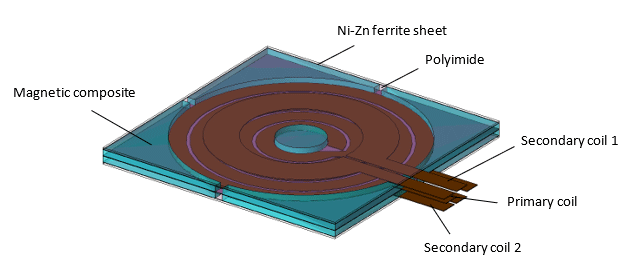
Fig. 1 Transformer
The case study evaluates the impedance characteristics of the transformer in Fig. 1.
You need to sign in as a Regular JMAG Software User (paid user) or JMAG WEB MEMBER (free membership).
By registering as a JMAG WEB MEMBER, you can browse technical materials and other member-only contents for free.
If you are not registered, click the “Create an Account” button.
Create an Account Sign in