
Rie Yoshida
Engineering Group, Magnet Manufacturing Dept.,
Functional Materials Production Division,
NICHIA CORPORATION
Abstract
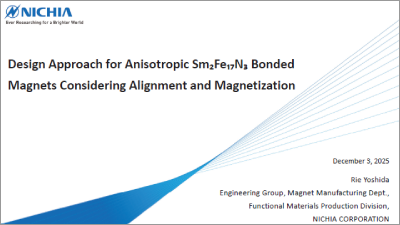
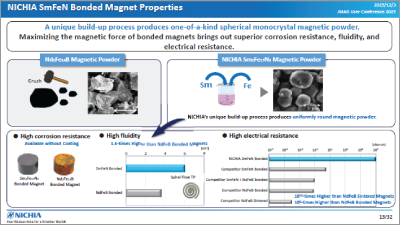
Plastic-bonded magnets offer greater design flexibility and orientation freedom, although their magnetic characteristics are lower than those of sintered magnets. When an external magnetic field is applied during the molding process, bonded magnets can be aligned in a specific direction (magnetic alignment), achieving motor performance comparable to that of sintered magnets.
However, outline designs using the JMAG material database present challenges because the simulation results often diverge from actual measurements due to incomplete magnetization, which is commonly observed in anisotropic designs. Therefore, we have developed a magnetization analysis method that accounts for the alignment process — the primary factor contributing to the divergence between simulated and measured results. This case study introduces an example of an IPM motor design intended for an automotive auxiliary motor application.
You need to sign in as a Regular JMAG Software User (paid user) or JMAG WEB MEMBER (free membership).
By registering as a JMAG WEB MEMBER, you can browse technical materials and other member-only contents for free.
If you are not registered, click the “Create an Account” button.
Create an Account Sign in