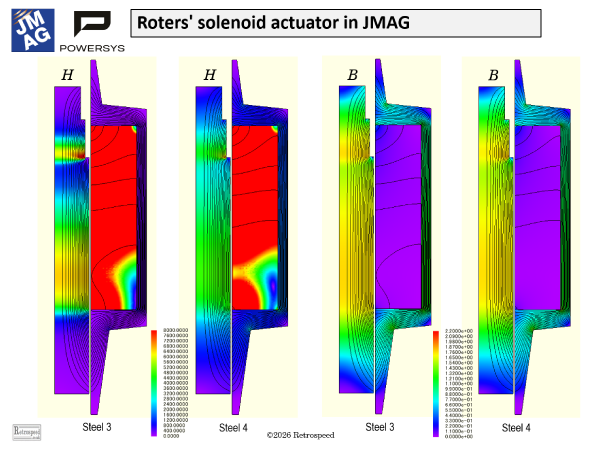
Fig. 1 Contour plots of H and B in Roters’ actuator with two different steels
Electromagnetic actuators (solenoids, relays, torque motors, etc.) comprise an important class of electromagnetic devices with a wide range of applications. They are used for short movements of mechanical parts, often with considerable force. They can also be used as sensors by virtue of the variable inductance that depends on the position of the moving element. Their design is well served not only by finite-element analysis, but also by thermal and dynamic analysis tools, and there may be a close link with control electronics in some cases. Actuator design is therefore truly a ‘multi-physics’ project.
One of the seminal texts on actuator engineering is the 1941 book by Herbert C. Roters [Wiley, 1941]. Roters was among the earliest authors to develop a rigorous theory of electromechanical energy conversion, and he does this in detail with full treatment of magnetic nonlinearity including hysteresis, minor BH loops, and residual magnetism. He treats both DC and AC actuators, and includes a full treatment of losses and heat transfer, with much detail on coil design. He also covers transient analysis of motion. The book includes a considerable amount of material property data including BH data for several solid steels of the type suitable for this application, and this data includes minor BH loops and ancillary data for reckoning with residual magnetism. The book includes numerous worked examples of different designs of electromagnets, solenoid actuators, etc.
The modern reader may be frustrated by the fact that Roters uses inch dimensions [in], with a strong preference for fractional inches especially in dimensioned drawings. He uses [lbf] (pounds force) for force, while H is in amp-turns/in, B in lines/in2 or kl/in2, flux in maxwells (lines), and energy in Joules. Permeance is in maxwells per ampere-turn, and µ0 = 3.19 (one of the advantages of the English system, compared with the cumbersome S.I. value!) He uses these units consistently and uncompromisingly, and I would say anyone who shies away from this book through fear of an obsolete system of units will be shutting the door on a treasure-trove.
The main theme of Roters’ analysis is the magnetic equivalent-circuit method, with a vast collection of permeance calculations based on idealised geometric shapes for imagined flux-paths. Roters is established as one of the main reference works on these formulas. He uses this method to develop force and inductance calculations for many different shapes of actuator, often heavily saturated and with geometric features that would create singularities and other impasses in classical analytical field analysis. Of course these methods have by now been supplanted by modern numerical analysis available in commercial software tools, with capabilities far beyond anything that could have been imagined in 1941 (or even in 1981). The era of numerical analysis in its modern software form dates back to the 1980s, and the classical magnetic equivalent circuit was certainly in widespread use until that time. Very probably its use continued for several years, even up to the present time in some cases, because the transition to numerical analysis software was not overnight and it was also expensive (bearing in mind not only the cost of the software licence but also the man-hours required to make the transition, the re-training and the reorganization of company documentation, and the completion of test programs to validate the methods).
Some things are missing from Roters’ book. It does not give any details of the test methods or apparatus used in making magnetic property measurements; nor does it include test methods or apparatus related to thermal measurements or the measurement of force or inductance, even though a limited amount of test data is included.
Videos 74 & 75 present the analysis of a particular solenoid actuator described and analyzed by Roters. Video 74 describes (and partially reconstructs) Roters’ analysis by the magnetic equivalent-circuit method, while Video 75 parallels the analysis using JMAG. The initial idea was to run JMAG on this actuator to address the question,
‘Just how accurate were those venerable old methods?’
The project developed into a fascinating comparison between two very different worlds of engineering design and analysis. Far from a plain comparison of numerical values, it extended to a range of observations about the engineer’s work-flow and the costs of different elements of the process in man-hours and facilities.
Fig. 1 is an example taken from the JMAG analysis, which obviously would not have been available to Roters in 1941.
Why the title, ‘Actuator agony’? In many ways the results of the comparison were unsatisfactory and incomplete. The penetrating analysis of JMAG occasioned a prima facie questioning of Roter’s results — not only his calculation but also his test data. Because of reluctance to challenge the authority of either Roters or JMAG, questions had to be asked about the significance of rarely-discussed aspects, particularly in relation to the measurement and modelling of DC BH data. There were reasons to question whether the steel used in Roters’ test was in fact the same as the one used in his calculation, but with no prospect of resolution. In fact the whole project cries out for a newly-manufactured prototype of Roters’ actuator, with well-characterized material property data and very careful measurement of force vs. position over the whole range (about 40 mm). It could make a great student project, maybe for a team of students (mechanical and electrical).
Many of the problems arising in the comparison seemed quite intractable — almost suggesting that an exact comparison between old and new methods is not possible, or at least, can be accomplished only approximately. Hence the title of this article!
Among the positive conclusions from the study, the advantages of both systems of methods became much clearer than they would be if one worked with only one system of calculations knowing nothing about the other. Both systems have their advantages.
Not only that, the project taught me a lot about JMAG. I needed two projects to get the results I wanted. The first took several days, and I needed some help (kindly provided by Zoltan Nadudvari of Powersys). In the second one, I was able to set up a complete model from scratch in 20 minutes. We used to say the finite-element method was slow. That’s not slow! Further, once I started to use it and interrogate the solutions in various ways with various in-built post-processing facilities, the results came thick and fast — and most of these were results that were not possible by any other method, and (sadly) not available to our distinguished pathfinder Herbert C. Roters in 1941.
Notes
Videos 74-75 cover the material of this Engineer’s Diary in more detail.
References
[1] Roters H.C., Electromagnetic Devices, John Wiley & Sons, N.Y., 1941
[2] Hunt W.T., Static Electromagnetic Devices, Hassell Street Press, 2021
[3] Hoole S.R.H., Computer-Aided Analysis and Design of Electromagnetic Devices, Elsevier, N.Y., 1989
[4] Pulyer Y.M., Electromagnetic Devices for Motion Control and Signal Processing, Springer-Verlag, 2012
[5] Engelmann R., Static and Rotating Electromagnetic Devices, Marcel Dekker, 1982
[6] Wiak S. and Napieralska Juszczak E., Computational Methods for the Innovative Design of Electrical Devices, item #327 in the Studies in Computational Intelligence Series
[7] Solenoid Voltage Regulating Relays, §23 in The Electrical Engineer’s Reference Book, Edited by E. Molloy, published by George Newnes Limited, London, Fourth Edition, 1949
[8] Charles Falco, The Much-Maligned Miller, I Background, Fishtail, Magazine of the Velocette Owners’ Club, No. 513, January 2026, pp 35–37 II; Electrifying The Vincent, ibid., No. 514, April 2026, pp 44–47