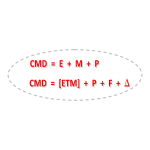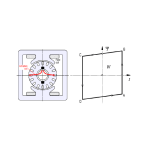
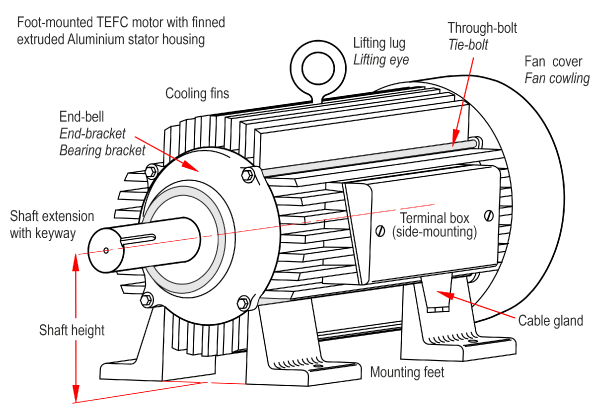
Fig. 1 Names of motor parts
Electric machine engineers have to communicate with colleagues in many different languages, and although English is popular as a lingua franca it is not standardized. In particular the terminology / nomenclature / naming-convention for motor parts is rich in synonyms, as exemplified in this very sentence: three terms (names) for the same thing.
Other examples quickly come to mind. What in one company is called a ‘bearing housing’ may be called an ‘end-shield’ in another, while ‘bearing bracket’ and ‘end-cap’ are sometimes used for that same component. Some motors are supplied without bearings or bearing housings, and since these are not really motors (not complete motors at any rate) they are sometimes called ‘rotor/stator part-sets’. We mustn’t call them ‘bearingless motors’ because those are clever inventions in which the rotor is suspended by magnetic forces produced by windings in the same stator as the main phase windings. You don’t get that with a part-set: you have to supply your own bearings and housings.
Sometimes the same term is used to mean different things by different people. A common example is the term ‘phase’. To me, one phase of a motor winding is an entity of the winding that carries the phase current, for example the U-phase in a motor with three phases U,V and W. If the motor is star-connected, the phase current will be the same as the line current, where the line is one of the three wires entering the terminal box from the AC power supply. But we also say that a three-phase overhead line has three individual phase conductors, so we have some confusion in the use of the terms phase and line. The motor engineer uses the term phase for a physical section of the winding (it could hardly be called the line inside the machine, because line to a machine engineer is outside the machine — something that is connected at the terminal box). But the power-system engineer distinguishes the three individual lines or conductors by referring to them as phases. The logic of that terminology is pretty sound, since the main thing that distinguishes any one of the three lines from the other two is the phase angle of its voltage or current. (Yes, phase here has a slightly different meaning again, but we’d better stop analysing because the intention is not to write a dictionary).
Let’s talk about torque (without stopping to ask why two words with the same pronunciation are spelt differently). In continental Europe the term moment is common, but in the English-speaking world I would say that torque is an engineering term while moment is physics. They have the same meaning, but in equations we commonly find T in one document and M in another. Vive la différence! When I first learned about moment in school, it was taught in terms of a couple: i.e., two tangential forces acting at opposite ends of a diameter. At that elementary stage in applied mathematics, there was no question of continuous rotation, no question of doing work! It was only later when I started to learn about internal combustion engines that torque was the thing that sold sporty engines. So here we have three different terms — torque, moment, couple — that are essentially identical: but their use in different contexts is quite important. If you tried to sell a "torque motor" as a "moment motor" or a "couple motor", you might not end up doing a roaring trade. (Then again, why does good business "roar"?) If you described a motorcycle engine has having ‘a lot of moment’, you could easily be misinterpreted because ‘moment’ in motorcycling means ‘nearly falling off’.
Let’s talk about spindles. In some industries that use large numbers of them, a spindle is a complete motor with special shaft-fittings peculiar to the process function. They run fast, quietly, and smoothly in perfect synchronism. But not every motor engineer works in that industry, and a more general meaning of spindle is the shaft: that is, just one component, not the complete motor. It might also be known as the axle, although axle is probably more common in motor-vehicle parlance, or in connection with horse-drawn carriages. A spindle conjures up the notion of something spinning very fast, with connotations of ancient spinning-wheels and spinning-jennies; while axle suggests something with at least one wheel rolling along the road. Shaft is undeniably the bit that delivers torque: usually we can see only one end of it, with a spline or a keyway. Indeed if we only ever see the business end of the shaft, it will come as a surprise how complicated the rest of it is, with changes of section, ‘upset scores’ to fix laminations, and more.
These stories are of course from my personal experience (where else could they come from?), and everyone will have a unique set of associations and mental images for any given term. We are fortunate in electrical engineering in that many terms refer to physical things that be seen and handled, or at least drawn, so that the process of agreeing the correct term is easy.1 Even for abstract entities like space-vector or flux-linkage we may have more than one name, but only one non-negotiable definition that is often expressed mathematically. There are even cases where terms are confused: for example, flux is often used for flux-linkage even though one is a distributed field quantity and the other is a terminal quantity (like voltage or current). They are totally different concepts and it maddens the purist to hear them confused. The mathematical definition saves us from the confusion and misunderstanding that can result from sloppy speech, especially when we’re doing calculations. Thank goodness for mathematics! (Even software is fussy about such things!)
It’s common for engineers to be dismissive of the apparent pedantry of precise language, perhaps because the tribal lingo spoken in the design office has a levelling effect and no-one wants to stand out. Nothing wrong with that. But if I go to the local agricultural show I will come away not knowing what language is spoken by the local farmers. All I can say with certainty is that there is little room for equivocation or uncertainty in whatever it is they are saying to each other. In other words, they understand each other perfectly, even though outsiders haven’t a clue what they are saying. It is the same in engineering. Starting with a clear idea of the meaning of rotor and stator, one gradually acquires the motor-speak that keeps us all together. As in any other walk of life, one’s vocabulary grows, and with it the precise appreciation of the spoken, the written, and the heard word (as well as its correct meaning).
Young engineers now have the extraordinary resource of specialist web-sites and videos at their fingertips, and even on-line dictionaries. There is an incredible wealth of detail on the precise meaning and usage of engineering and scientific terms, and it even spills over into translation between dozens of languages. In the old days we had dictionaries, of course, including specialist technical dictionaries; but they could not keep up with the pace of change. Some of the grand old dictionaries are still very valuable for their etymological detail and examples of usage — aspects which receive less attention in internet-based resources which are preoccupied with the here-and-now, catering for people who are in a hurry rather than those who want to study the history and origins of words. The classical dictionaries also tell us how a word may be used in another (and often unfamiliar) context, or how it was used in the past. For example, nowadays decimate is often taken to mean a reduction to 1/10, but originally it meant a reduction by 1/10 (to 9/10, not 1/10). Language is fluid.
To finish, I would make a humble request: always to use the precise term — what the French call le mot juste. Of course there is a virtue-signalling side to this habit, but more importantly it ensures that people understand exactly what is meant. So valuable for apprentices and students, especially. The cognoscenti will probably figure out what is intended, no matter how sloppy the expression; but slurred speech begets slurred speech, and clarity may be lost — not only in the detail but also in the big picture. Imagine Albrecht Dürer painting with a 1" fitch brush, or a JMAG flux-plot on a 320 × 200 black-and-white display.
Notes
1 When I was an apprentice I was often surprised at the sheer number of technical terms used on the shop-floor (for example, ‘spigot’ or ‘flange’ or ‘spider’ or ‘self-aligning bearing’), to say nothing of the special vocabulary we had to acquire in our college studies (for example, ‘flux-density’ or ‘inductance’ or ‘detent torque’). It was like learning a new language, and I remember we were all eager to learn it (while most of us were slow to learn foreign languages and not too keen on the minutiae of English grammar, either). Even now, if I go to the local ironmonger (hardware store) and ask for a "wood-screw about this long and this thick" with suitable hand-gestures, Alan behind the counter will look at me with utter disdain and ask if I mean a 3/4" No. 10, and do I want Phillips, Pozi-Drive, Torx, or plain slotted; countersunk, raised-head or dome-head? Brass, stainless steel, japanned, plain steel, or enamelled white? Nowadays on the internet, the more precise the search terms, the faster you’ll find what you’re looking for. Same idea.
Further reading
[1] Simon Heffer, Scarcely English, Hutchinson Heinemann, 236pp, 2024. ISBN 978-1-529-15279-1
[2] Webster’s New World Dictionary of the American Language, Simon and Schuster, 1982
[3] A Standard Dictionary of the English Language, G.J. Howell & Company, London, 1903 (Particularly rich in illustrations and usage, and for the fact that it tried to unify the American and English orthography in a ‘rational’ way). Although its scope is general, it is particularly useful for engineering and crafts.
[4] The Shorter Oxford English Dictionary, Oxford, Clarendon Press, 1973.
[5] Calvert Watkins, The American Heritage Dictionary of Indo-European Roots, Houghton Mifflin, 1985
[6] Roget’s Thesaurus, Longmans, third edition, 1962.
[7] Google Translate™.