
Superconductivity
Superconductivity breaks down into two major types of wires: low-temperature metallic superconducting wire that is already in practical use and high-temperature superconducting wire pioneered in research and development since its inception in 1986.
Low-temperature superconducting wire has a wide range of applications, such as Magnetic Resonance Imaging (MRI) used for medical purposes and nuclear magnetic resonance spectrometers and accelerators for physical and chemical analyses.
High-temperature superconducting wire has potential applications in compact nuclear fusion reactors, power transmission lines, electrical propulsion motors, and other superconducting machines as well as superconducting coils utilizing REBCO and other such materials.
Superconducting machines require multiphysics evaluations. This includes not only magnetic evaluations to analyze the high magnetic flux density but also thermal evaluations to obtain high current and temperature rises in addition to strength evaluations when applying powerful Lorentz forces. These types of analyses necessitate large-scale models and significant nonlinear properties.
The massively parallel solver and multiphysics simulation features in JMAG provide not only high-speed but high-accuracy multidisciplinary evaluations.

Superconducting Material Modeling
JMAG offers two ways to model superconducting materials: n-value and Bean models. The critical current density Jc, n-values, and reference electric field Ec in these models take into account the magnitude and angular dependency of the magnetic flux density as well as the temperature dependency. These models that contain superconductivity characteristics make purpose-driven analyses possible.

Current Density vs Electric Field Characteristics in n-value and Bean Models
This figure illustrates the superconductivity characteristics in n-value (n-values from 4 to 10) and Bean models. The data indicates the standardized characteristics for the critical current density (Jc) and reference electric field (Ec).
Users can either register properties themselves or use materials provided by manufacturers that are already listed in the material database.
Starting with JMAG-Designer V25.2, you can use superconducting materials provided by material manufacturers.
- Low-temperature superconductivity Nb3Sn (JASTEC), NbTi(JASTEC)
- High-temperature superconductivit REBCO (Fujikura, Furukawa Electric/SuperPower)
Introducing JMAG-Designer Ver.25.2
Use Case
CORC Cable Analysis Accounting for Anisotropy
Conductors On Round Core (CORC) are one type of conductor used in Tokamak fusion reactors that wraps REBCO wire tape helically around a core. The electrical properties of the tape surface have angular dependency from the perpendicular to horizontal direction. Therefore, this case study introduces an evaluation that takes into account anisotropy.

An angle of 0 deg has significantly lower critical current density than an angle of 90 deg due to the increase in |B|. That is why the critical current density tends to drop much more at the tape end with an angle of 0 than in the center where the magnetic flux density is high.
JMAG features
Three-dimensional analysis, high-speed solver, n-value models, material properties accounting for magnetic anisotropy, and AC loss analysis
Leaflet

This case study compares the critical current density distributions of CORC cable formed by helically winding REBCO tape around a core obtained throug...
Quench Analysis of a High-temperature Superconducting Coil
High-temperature superconducting coils have a wide range of applications to realize small and lighter devices with higher efficiency from nuclear fusion, MRI, and power cables to maglev trains. However, quenching in a pat of a coil cause damage if the material transitions from superconducting to normal state. Evaluations are essential to prevent this from happening. This case study comprehensively evaluates the behavior of this quench phenomenon in a no-insulation REBCO pancake coil.

The figure illustrates the results at the center of the superconducting layer and ends of the copper layer in the width direction of the tape wire. The temperature of the tape wire remains stable at 77 K past 150 seconds. However, localized quenching starts after 170 seconds. These results indicate some of the current branches in the radial direction through the copper layer.
JMAG features
Three-dimensional transient analysis, high-speed solver, eddy current analysis, n-value models, temperature/magnetic flux density-dependent material properties, and coupled thermal and magnetic field analysis
Leaflet
This case study runs an overcurrent analysis of a no-insulation pancake coil that uses rare-earth barium copper oxide (REBCO) tape as a high-temperatu...
Related materials
JMAG Users Conference Proceedings

Yuki Kihira, Kawasaki Heavy Industries, Ltd....
Masao Hiragushi, Seikow Chemical Engineering and Machinery, Ltd....
Jun Yoshida, Sumitomo Heavy Industries, Ltd....
White Papers

This paper introduces a simulation to comprehensively analyze the physical phenomenon during a quench event. The case study analyzes a no-insulation p...
This paper examines the need to account for anisotropy in electromagnetic field simulations through the analysis of the CORC cable presented in Fig. 1...
Leaflet
This case study analyzes the losses when applying alternating current to round superconducting wire....
Application Catalog

This case study describes a quantitative loss evaluation for the field winding of a low-temperature superconducting generator that uses a superconduct...
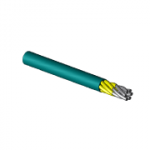
This case study evaluates the AC losses of a straight-stack and twisted-stack NbTi cable to verify how the different cable structures affect the size ...
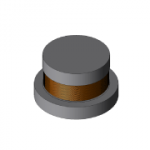
In this example, an NbTi superconducting magnet for an MRI machine that has a no-insulation structure that has a stabilizing layer with contact betwee...
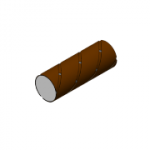
This case study evaluates the changes in losses produced in CORC cables with different pitches by a transverse magnetic field. ...

This case study evaluates a pancake superconducting coil to obtain the temperature and current density variations....