[Designer Data] is available in JMAG-Designer Ver. 25.1 or later.
Features and principal use
- Evaluate whether a motor topology still satisfies new requirements.
- Account for coil/magnet temperatures and stress produced by centrifugal force using surrogate models generated from magnetic field, thermal, and structural analysis results when motor requirements change.
- Change conditions and run optimizations using the JMAG-SBO tool to quickly respond to any changes in the motor requirements.
Model Diagram
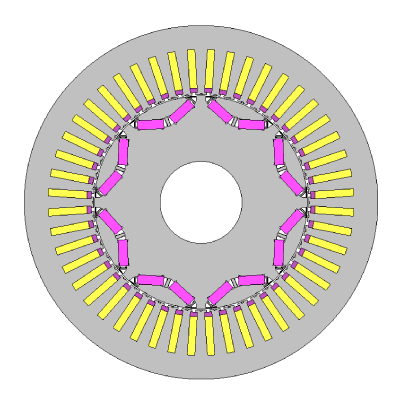
Run multi-disciplinary magnetic field, thermal, and structural analyses,
using dimensions as design variables while keeping all other parameters the same.
- Efficiency Map
- DC Voltage: 800V
- Max. Current: 565A
- Demagnetization analysis
- Current: 936A
- Stress Analysis
- Rotational Speed: 21,600rpm
- Thermal Analysis
- Max. Torque: 1,000rpm
- 11,500rpm 40Nm
Reference Materials Used to Create Model
[1] Marika Kobayashi, “A Study on High Performance of Rare-Earth-Saving and Rare-Earth-Free Motors Using Reluctance Torque”, Ph.D Thesis、Osaka Prefecture University, 2022. https://cir.nii.ac.jp/crid/1910583860648766848
[2]Bin Zhang, Xiuhe Wang, Ran Zhang and Xiaolei Mou, "Cogging torque reduction by combining teeth notching and rotor magnets skewing in PM BLDC with concentrated windings," 2008 International Conference on Electrical Machines and Systems, Wuhan, China, 2008, pp. 3189-3192.
[3] Yuki Shimizu,"Research on Design Optimization of IPMSMs for Automotive Applications“, Ph.D Thesis、Osaka Prefecture"、Ph.D Thesis、Osaka Prefecture University, 2022.https://cir.nii.ac.jp/crid/1910020910695345536
[4] S. Chowdhury, E. Gurpinar, G.-J. Su, T. Raminosoa, T. A. Burress, and B. Ozpineci, “Enabling technologies for compact integrated electric drives for automotive traction applications,” in Proc. IEEE Transp. Electrific. Conf. Expo (ITEC), 2019, pp. 1–8.
Design Variables
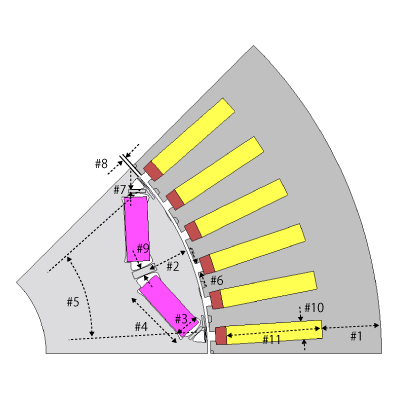
| #1 | mBackYokeThickness | (14-25)mm |
| #2 | mFluxBarrierDepth | (7-15)mm |
| #3 | mMagnetThickness | (4.5-6.5)mm |
| #4 | mMagnetWidth | (10-22)mm |
| #5 | mPoleArcAngle | (29-40)deg |
| #6 | mdSlotOpening | (1.5-3.5)mm |
| #7 | strAuxBridgeThickness | (0.7-2)mm |
| #8 | strBridgeThickness | (0.7-2)mm |
| #9 | strInterMagnetRibThickness | (0.7-4)mm |
| #10 | mSlotWidth | (3-5.5)mm |
| #11 | mSlotDepth | (16-28)mm |
Surrogate Model
Training Datasets
The training datasets to create the surrogate model consist of 32,090 analysis cases.
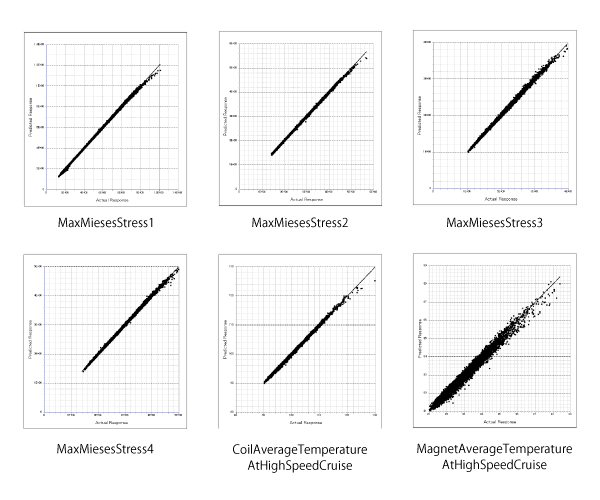
Surrogate Model Accuracy: Coefficient of Determination (R2)
| Stator (Outside Diameter) | StatorOuterDiameter | 0.9999 |
|---|---|---|
| WLTC Cycle Efficiency | WLTCCycleEfficiency | 0.9974 |
| Max. Power | MaxPower | 0.9995 |
| Max. Torque | MaxTorque | 0.9994 |
| Max. Torque Operation Time (temperature) | CoilOperatableTimeAtLowSpeedMaxCurrent | 0.9984 |
| Area of the Magnet to be Demagnetized | DemagRatioInPercent | 0.9843 |
| Max. Mieses stress | MaxMiesesStress1 | 0.9996 |
| MaxMiesesStress2 | 0.9992 | |
| MaxMiesesStress3 | 0.9984 | |
| MaxMiesesStress4 | 0.9991 | |
| Max. Coil Temperature | CoilAverageTemperatureAtHighSpeedCruise | 0.9977 |
| Max. Magnet Temperature | MagnetAverageTemperatureAtHighSpeedCruise | 0.9748 |
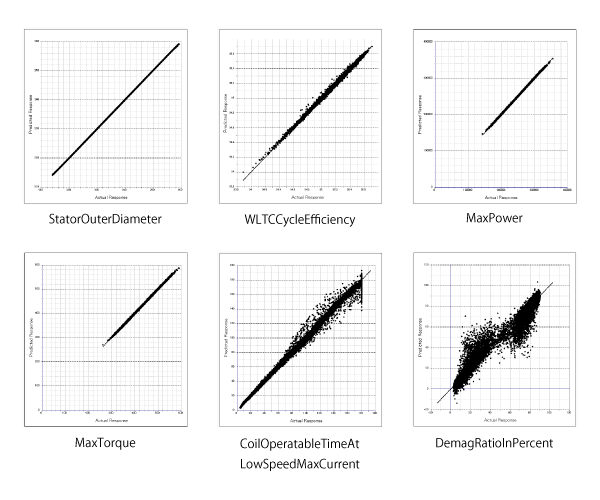
Surrogate Model Accuracy: Actual Results vs Predicted Results
Example of Target and Constraints settings
Target
| Stator (Outside Diameter) | StatorOuterDiameter | Minimise |
|---|---|---|
| WLTC Cycle Efficiency | WLTCCycleEfficiency | Maxmise |
Constraints
| Req. 1 | Req. 2 | Req. 3 | |||
| Max. Power | MaxPower | >= | 290 kW | 310 kW | 300 kW |
|---|---|---|---|---|---|
| Max. Torque | MaxTorque | >= | 480 Nm | 510 Nm | 500 Nm |
| Max. Torque Operation Time | CoilOperatableTimeAtLowSpeedMaxCurrent | >= | 10 sec | 40 sec | 30 sec |
| Magnet Area Subject to Demagnetization |
DemagRatioInPercent | <= | 8% | 1% | 5% |
| Max. Stress | MaxMiesesStress | <= | 370 MPa | 370 MPa | 370 MPa |
| Max. Coil Temperature | CoilAverageTemperatureAtHighSpeedCruise | <= | 144 deg C | 144 degC | 144 degC |
| Max. Magnet Temperature | MagnetAverageTemperatureAtHighSpeedCruise | <= | 100 deg C | 100 degC | 100 degC |
Results
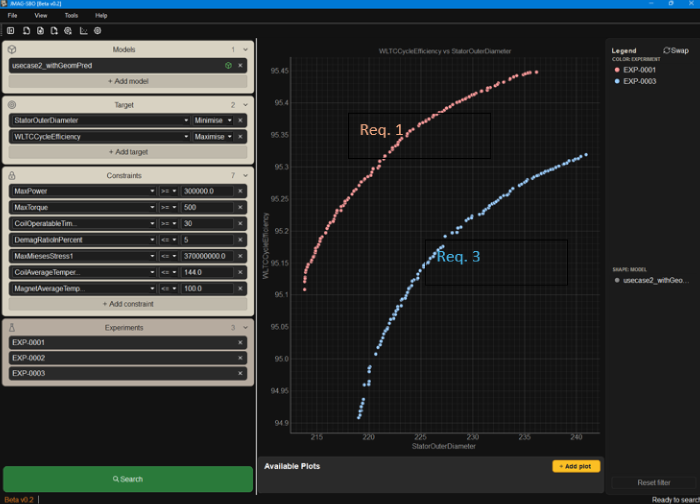
JMAG-SBO found feasible solutions meeting Requirements 1 and 3. The design solutions satisfying the high torque and output of Requirements 3 tend to have a larger outer stator diameter (horizontal axis) than those satisfying Requirements 1. However, the optimization did not find design solutions capable of satisfying the strict demagnetization ratio of Requirements 2.